Kaufungen Manor House: A Saxon Estate Rebuilt Around 1530
Site at a Glance
- Popularity
- Medium
- Country
- Germany
- Primary era
- Early Modern
- Eras represented
- Early Modern, Modern
- Civilizations
- Electorate of Saxony, German, Holy Roman Empire
- Site type
- Domestic
- Remains
- Manor House
On this page10 sections
History
The von Kaufungen estate
Kaufungen Manor House is a historic manor in central Kaufungen, Germany, first recorded as an estate in 1226 and serving as the ancestral seat of the von Kaufungen family. The family’s earliest known member, Henricus de Khoufungen, appears in a record from 1231.
By the fifteenth century the estate belonged to Kunz von Kauffungen. During the Saxon Fratricidal War, a dynastic conflict in Saxony, troops of Duke William III burned it in the summer of 1450. In debt after taking part in the conflict, Kunz pledged the estate to Hans von Maltitz in 1454.
After the Saxon elector, a prince entitled to participate in choosing the Holy Roman Emperor, refused compensation for a ransom, damage to Kunz’s Thuringian estates, and the seizure of his manor at Schweikershain, Kunz planned to abduct the elector’s princes as leverage. The attempt failed on the night of 7–8 July 1455. Kunz and his helpers were executed at Freiberg on 14 July, his property was confiscated, and the Kaufungen estate was razed.
Rebuilding and succession
The last remains of the old castle were cleared between 1523 and 1535. Around 1530, the lords of Maltitz established a new estate on the site and encouraged settlement at Kaufungen.
The estate later passed to the lords of Pflugk and, from 1584, to the von Thumbshirn family. In 1647, Wolf Dittrich von Thumbshirn acquired neighboring Bräunsdorf, which became an outlying farm estate associated with Kaufungen. Around 1683, both properties passed to the von der Planitz family.
Wolkenburg lordship and land reform
The von Einsiedel family, owners of nearby Schloss Wolkenburg since 1635, acquired Kaufungen and Bräunsdorf in 1766. Kaufungen was then referred to as a castle. It and Wolkenburg shared judicial administration within the lordship of Wolkenburg, part of the Electoral Saxon district of Borna. This arrangement continued until the mid-nineteenth century. The von Einsiedels lived at Wolkenburg, while Kaufungen’s manor house served as an outlying estate and as a home for its tenant. Bräunsdorf instead belonged to the Schönburg domain of Penig, under Wettin overlordship.
The von Einsiedels retained Bräunsdorf until 1897 and held Kaufungen and Wolkenburg until the 1945 land reform in the Soviet occupation zone. The estate was dissolved and its land distributed among new farmers. In 1947, farm buildings and several ancillary buildings on the slope behind the east wing were demolished.
Decline and restoration
Neglect left the buildings in disrepair, and tenants moved out in the mid-1970s. Repairs became possible after German reunification. After the vacant manor house was purchased, a restoration company began using it in 2003.
Remains
The surviving manor house
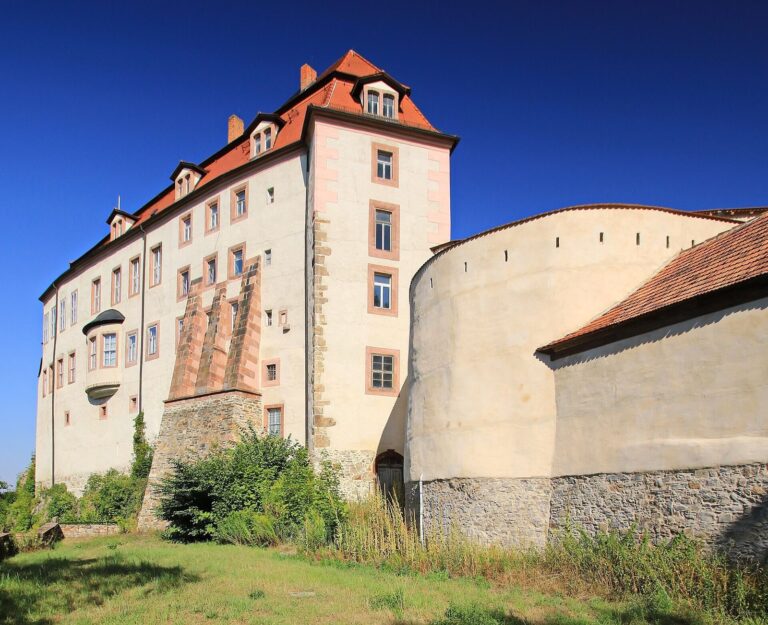
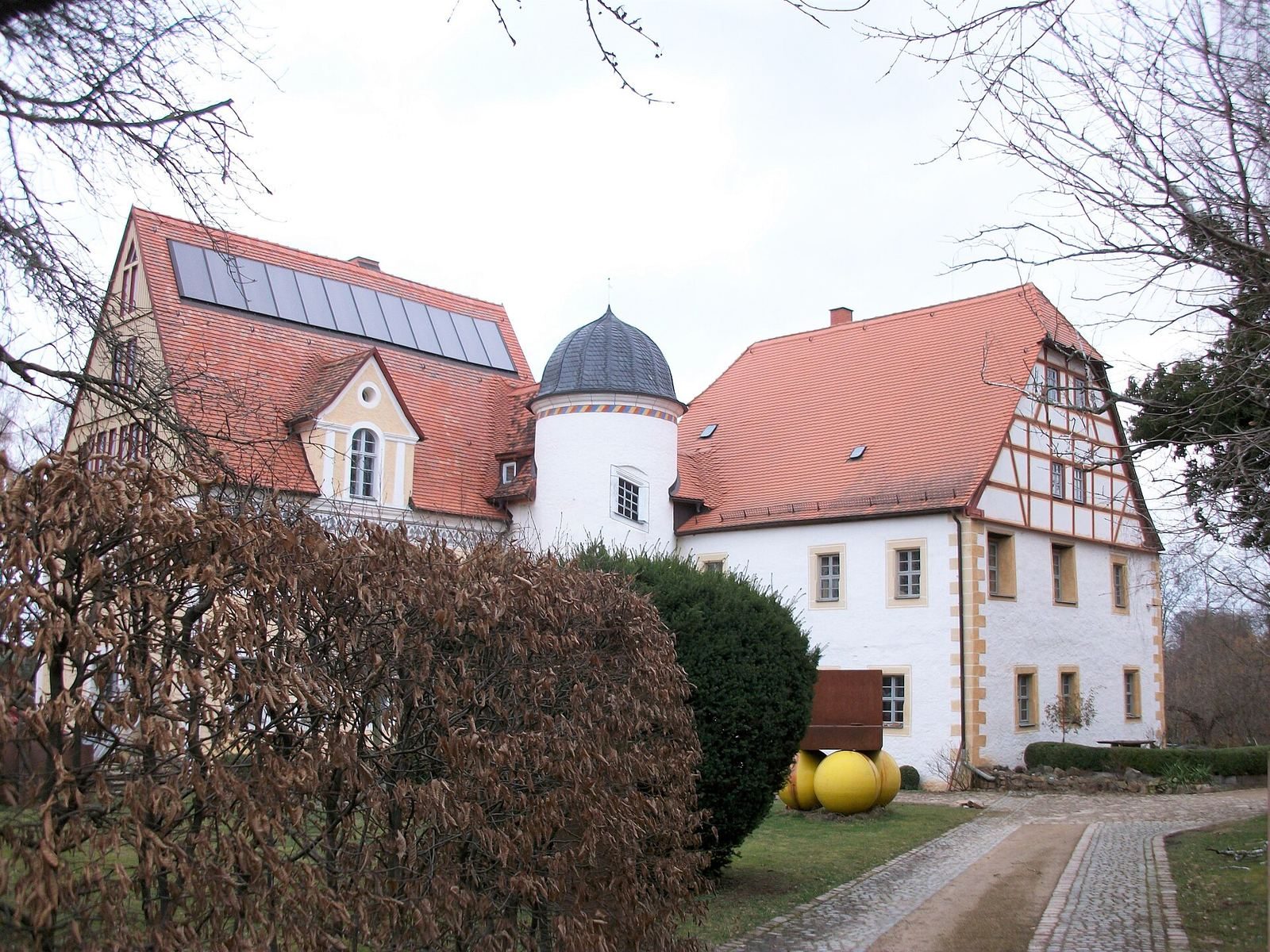
The surviving manor house has an east wing and a north wing, with a round Wendelstein, a tower-like spiral stair structure, set into the corner where they meet. The building stands in central Kaufungen, directly behind St. Gallus Church.
East wing
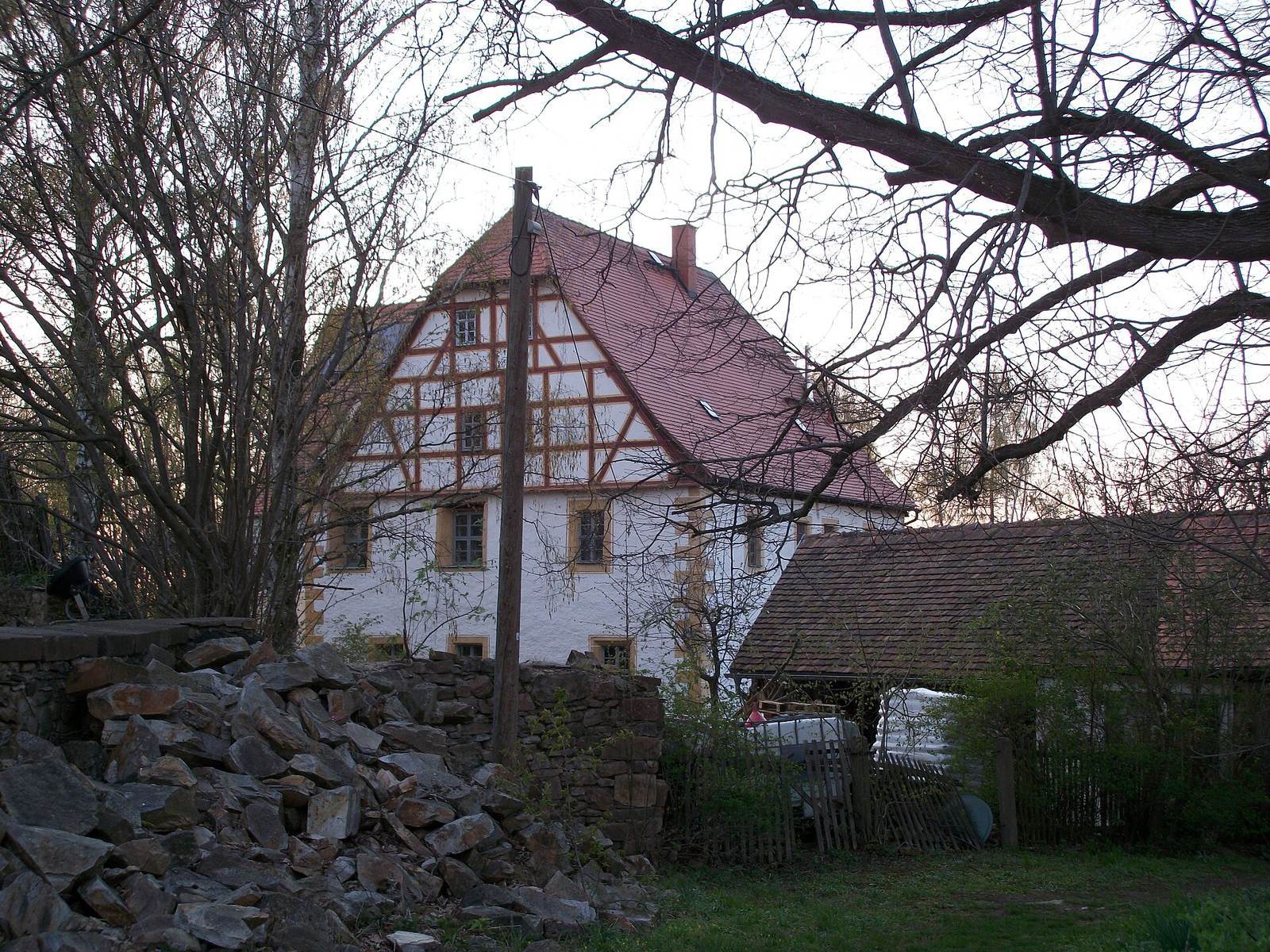
Built in 1595, the east wing has a plain Renaissance design inspired by classical art and architecture. Its half-timbered gable and roof framing were added in 1784. A room on the upper floor, with timber-plank walls, a wooden-beam ceiling, and wood paneling, came to light during restoration work. The 2006–07 exterior restoration left the wing with a finish dating to the late sixteenth century.
North wing
The north wing dates to 1610. Beneath its eaves is a tracery frieze, a decorative band of interlacing patterns, added around 1800 in a neo-Gothic style that revived Gothic forms. The exterior restoration gave this wing an eighteenth-century finish, incorporating the frieze.
Spiral stair tower
The stair tower’s cap was lost in a lightning strike in 1842. A replacement top was added in 2007, modeled on historical examples.