Innersee Castle: A Renaissance Residence in Austria
Site at a Glance
- Rating
- 5
- Popularity
- Very Low
- Country
- Austria
- Primary era
- Early Modern
- Eras represented
- Early Modern, Modern
- Civilizations
- Habsburg, Holy Roman Empire
- Site type
- Domestic
- Remains
- Castle
On this page9 sections
History
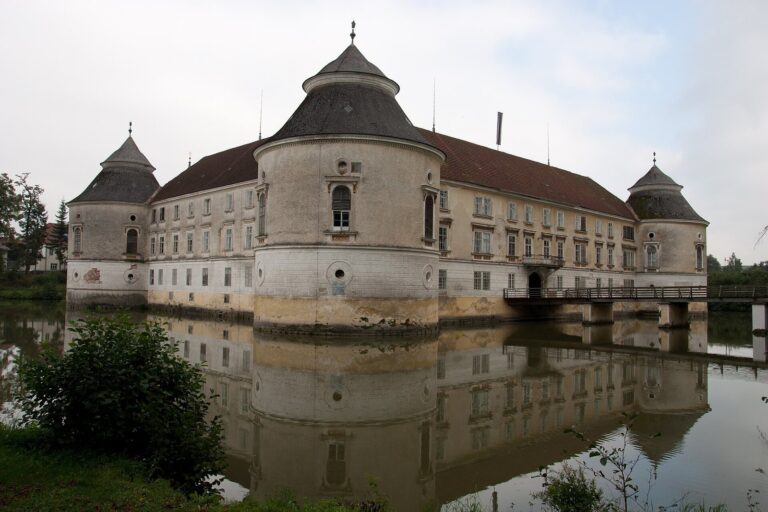
Innersee Castle is a Renaissance castle in Innernsee, Austria. Its present form dates to the early 17th century and reflects the Renaissance, a European cultural and artistic period spanning the 14th through 17th centuries. The site began as a water castle.
Early settlement and conversion to a residence
Hans Innerseer, a retainer of Castle Starhemberg first recorded in 1286, founded the settlement of Innersee. The castle itself is first mentioned in 1301. The Innerseer family held the original water castle until Hans Paul, its last owner from the family, sold it and the associated estate because of financial difficulties. The Frankinger family owned the property briefly before Bartholomäus, Baron von Dietrichstein, acquired it in 1579 and turned the castle into a residence.
Rebuilding and changes of ownership
During the Upper Austrian Peasants’ War, a regional peasant uprising, rebels seized and burned the castle in 1626. Christoph von Kher bought the burned site from Dietrichstein and had it rebuilt. The Fieger family acquired the restored castle in 1635. In 1679 it passed to the Willinger family through marriage, and they joined Innersee with the estate of Hinterndobl. The property later passed by inheritance to Johann Ludwig von Gabelkoven.
In 1777 Innersee and Hinterndobl were sold to Ernst Ignaz Gemberly von Weidenthal. Empress Maria Theresa, the 18th-century Habsburg ruler, had ennobled him for his work to improve agriculture. His son Ernst, an engineer and captain in the Habsburg army, married Rosalia von Meyer zu Lauterbach. After Ernst’s death in 1795, Rosalia held both estates until 1842.
Ownership from the nineteenth century to the present
Ernst Ignaz’s grandson Ernst Franz Josef remained unmarried. His sister Rosalie Elisabeth married Josef Maximilian Heyß, and their son Franz Maximilian inherited Innersee and Hinterndobl from his grandmother, Rosalia. Franz Maximilian served on the Reichsrat, the Habsburg monarchy’s representative council, and became Rottenbach’s first freely elected mayor. After his death in 1867, his widow Karoline held the property until her death in 1895. Their childless children, who lived at the castle, took in their niece Josefine Heyß, then living in Laibach.
Josefine married landowner Adolf von Payrhuber in 1916, and they took over the estate the following year. Their daughter Josefine married Ignaz Sickinger in 1946, and the couple inherited the estate in 1953. Ignaz served as Rottenbach’s mayor from 1962 to 1982. Adolf Sickinger and his wife Hedwig became owners in 1983; the property now belongs to Bernhard and Brigitte Sickinger and their children Kerstin and Anja. Extensive renovation, carried out through private initiative, began in 1990. The castle remains a private residence.
Remains
Layout and main buildings
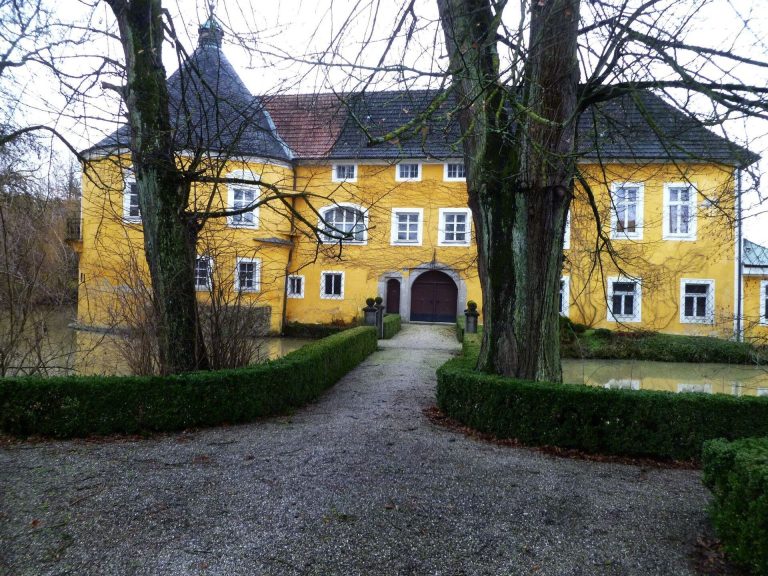
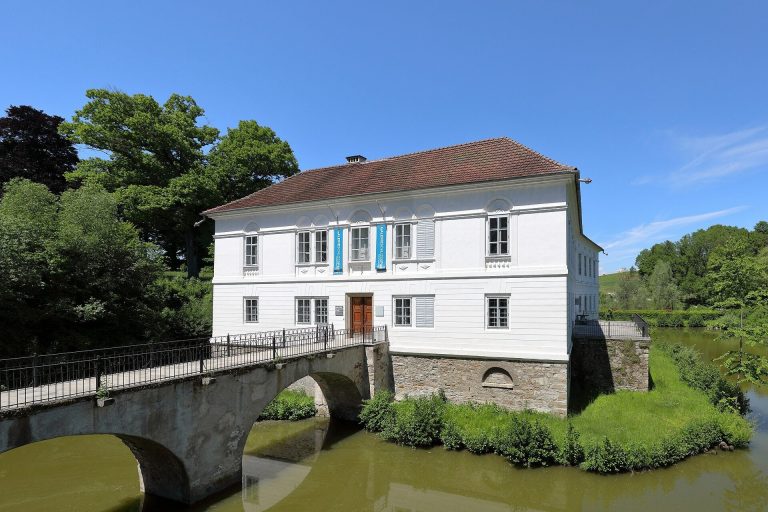
Set in Innersee’s flat landscape, the castle’s early 17th-century Renaissance form includes an east wing integrated into the main building. The courtyard is bounded by the castle on two sides and a pond on the third. An old mill stands to the north and formerly belonged to the castle. The estate also includes an old manor farm and an agricultural holding of 75 joch, a historical land-area unit whose size varied by region.
Water features
The pond on the west side survives from the former moat. A dry ditch to the east also indicates the earlier presence of a pond, while shells found underground on that side point to a formerly much larger area of water. The moat along the front and rear of the castle was probably filled with material from wings destroyed by fires.
Entrance and galleries
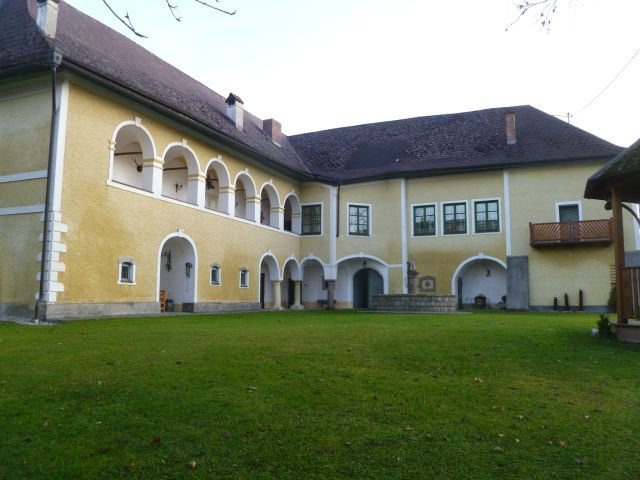
A 1674 engraving by the Austrian artist Georg Matthäus Vischer depicts the castle with a central tower. The mid-17th-century castle also had a gate tower, of which the portal and exceptionally thick walls in the entrance area survive. A short covered porch runs along the ground floor of the entrance wing. Above it, the right-hand section has an open arcade gallery, a gallery formed by a row of arches; the corresponding gallery in the main wing is enclosed by windows.
Portal and courtyard features
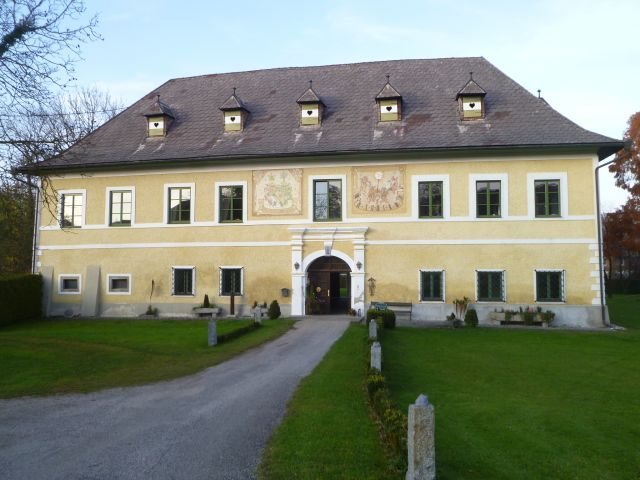
The Renaissance portal bears the coat of arms of former owner Ernst Ignaz Gemberly von Weidenthal on its left. A sundial to the right displays the dates 1626 and 1990. In the middle of the courtyard stands a Florian fountain erected by an owner in recent times.