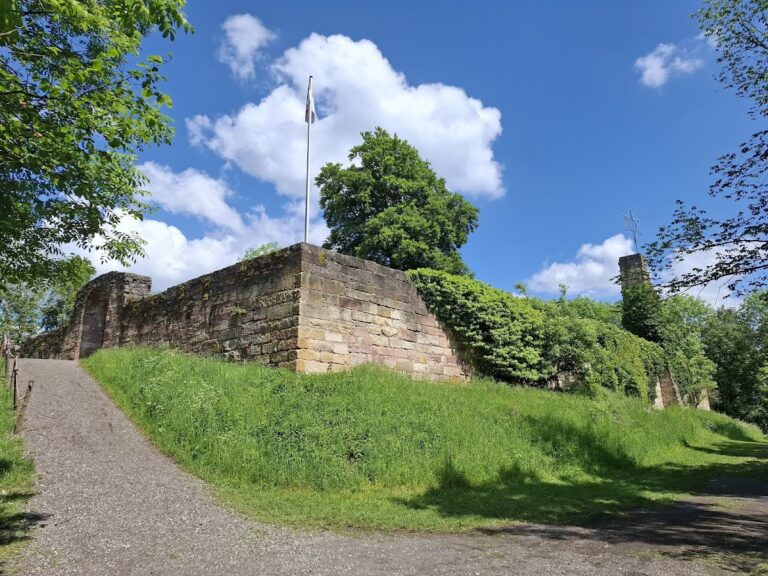
Schloss Hohenfels: A Classical Country Residence in Coburg


Site at a Glance
- Rating
- 5
- Popularity
- Very Low
- Country
- Germany
- Primary era
- Modern
- Eras represented
- Modern
- Civilizations
- German
- Site type
- Domestic
- Remains
- Castle
On this page8 sections
History
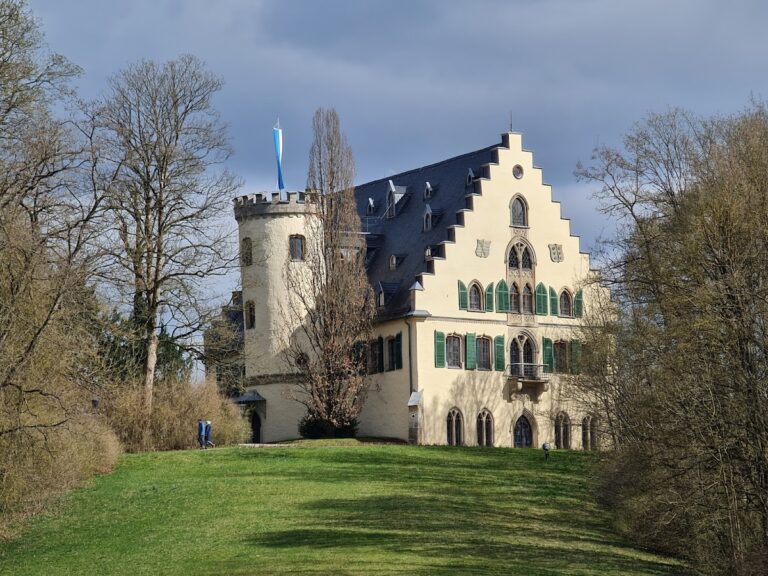
Schloss Hohenfels is a castle-like country residence in Germany, situated above Callenberger Straße in Coburg. Commissioned in 1837 by Herzog Ernst Alexander von Württemberg, it was completed in 1840 in the Classical style, whose orderly proportions drew on ancient Greek and Roman architecture. The residence and its park were first called Ernsthöhe after their patron.
Construction and the Ernsthöhe residence
The building was planned by Balthasar Harres, a pupil of the influential Prussian architect Karl Friedrich Schinkel. After Harres left in 1838, Vincenz Fischer-Birnbaum completed the residence in 1840, at the same time that the ducal Saxon court theatre was being built. Ernst Alexander intended the property as a country home for himself and his future wife on a green elevation within a former game park.
Ernst Alexander later became associated with the opera singer Natalie Eschborn, who performed under the name Frassini. At his urging, Hessian Landgrave Ferdinand ennobled her as Baroness von Grünhof, a title taken from a family estate near present-day Mitau in Latvia. The couple married in Hamburg on 18 August 1860. Ernst II, Duke of Coburg, had met Frassini during a performance in London and persuaded her to accept a guest contract at the Coburg Court Theatre.
After Ernst Alexander died in 1868, Baroness von Grünhof lived at Ernsthöhe as his widow until 1890. She then moved to Berlin and left the property to her daughter Alexandra. Alexandra sold the estate in 1893 to Julius Heinzel, a factory and estate owner from Łódź.
The Heinzel and Bergmann estates
After Julius Heinzel was ennobled as Baron Heinzel von Hohenfels, he renamed Ernsthöhe Schloss Hohenfels. He also founded a stud farm near the residence. Its horses won races at Berlin’s Hoppegarten trotting track in 1906 and 1907.
In 1918, Heinzel sold the whole estate to Sigmund Bergmann, an electrical entrepreneur from Berlin. Bergmann commissioned the Berlin architect Otto Rehnig to adapt the house to his requirements, adding another phase to the building’s history as a private residence.
Municipal ownership and the Nazi period
Schloss Hohenfels, its park, and its associated buildings passed into municipal ownership on 1 November 1932. From September 1933, the city used the ancillary buildings as a women’s labour-service camp. From May 1934 until 1944, the castle housed the first Reich School of the National Socialist Women’s Association, the women’s organization of Nazi Germany. A Reich Labour Service camp for female adolescents was added in 1939. The Reich Labour Service was a compulsory state organization that combined labor with ideological service.
The estate stood empty from 1945 to 1954. In 1954, the Medau School moved into Schloss Hohenfels from the Naval Sports School in Flensburg-Mürwik. Founded in Berlin in 1929 as a private gymnastics school, the Medau School had closed there as a consequence of the Second World War.
Educational use since 1954
Since 1979, the Medau School has been Germany’s only school integrating gymnastics and physiotherapy training. A vocational school for speech therapy joined it in 1999. The state-recognized private University of Applied Sciences Schloss Hohenfels was founded in 2004 for specialized therapies in the health-care sector. It offered two bachelor’s degree programs, meaning undergraduate university qualifications, until relocating to Bamberg in 2010. The Medau School and its training programs continue under the same name, while the IB-Hochschule Berlin has provided a training-accompanying health-sciences degree at the site since autumn 2010, with in-person teaching once a month on weekends.
Remains
Schloss Hohenfels stands on Ernsthöhe, above Callenberger Straße in Coburg. The estate’s physical arrangement comprises the main castle, its associated park, ancillary buildings, and the area of the stud farm established near the residence. The central building was designed as a Classical country residence, with the restrained façades and balanced proportions associated with nineteenth-century German Classicism.
The residence and grounds
The former residence forms the principal structure of the estate, set within the park that originally shared the name Ernsthöhe. Its present form incorporates the alterations commissioned by Sigmund Bergmann after 1918. The surrounding estate also retains the historical relationship between the castle, park, ancillary buildings, and the nearby stud-farm grounds, although the buildings now serve educational purposes rather than private residence.
Current educational facilities
The castle accommodates the Medau School and facilities connected with gymnastics, physiotherapy, speech therapy, and health sciences. The former University of Applied Sciences Schloss Hohenfels occupied the building before its relocation to Bamberg in 2010, while the Medau School continues to use the historic residence for its training programs.
Nearby sites