Schloss Hofhegnenberg: A Medieval Castle Transformed into an Aristocratic Residence


Site at a Glance
- Rating
- 4.6
- Popularity
- Very Low
- Country
- Germany
- Primary era
- Early Modern
- Eras represented
- Medieval, Early Modern, Modern
- Civilizations
- Duchy of Bavaria, Holy Roman Empire, Kingdom of Bavaria
- Site type
- Domestic
- Remains
- Castle
On this page12 sections
History
Schloss Hofhegnenberg is an aristocratic residence in Germany, located at Hofhegnenberg in the municipality of Steindorf. It developed from a high-medieval castle on the Roßberg and was substantially renewed during the sixteenth century, with later Baroque and neo-Gothic alterations. The estate reflects the rise of the Hegnenberg family from medieval service nobility to the lower nobility and its long association with the Bavarian ruling house.
From Althegnenberg to the Hilltop Castle
The Lords of Hegnenberg probably came from Upper Swabia. Engelschalk and Hermann von Hegnenberg appear in written records in the late twelfth century as Welf ministerials, medieval service nobles who could later enter the lower nobility. Their original seat was the small motte castle of Althegnenberg, about four kilometres from Hofhegnenberg.
Around 1300, the family left its ancestral seat and built a larger castle on the prominent ridge at Hofhegnenberg. The move reflected the family’s growing position and its wish for a more representative hilltop residence. The new castle may also have been begun at ducal command. After the bishop of Augsburg ordered the destruction of Kaltenberg Castle near Geltendorf in 1296 to restrain Wittelsbach expansion, the Hegnenbergs joined the retinue of Duke Rudolf. Hofhegnenberg may therefore also have served as a border fortification facing the Prince-Bishopric of Augsburg, an ecclesiastical territory governed by the bishop of Augsburg.
The first written reference to the hilltop castle dates to 24 October 1354. In that year, the knight Winhart von Rohrbach bequeathed tithes from nine Juchert of arable land, a historical agricultural measure, “behind the castle at Haegniberg” to the Prince-Bishopric of Augsburg. The field name Roßberg links this reference to the predecessor of the present residence.
Lordship and Ducal Service
In 1399 Arnold the Elder of Hegnenberg sold the ducal fief, including the castle, to Hans the Pflaumdorfer, bailiff of Friedberg, for 1,800 new Hungarian gulden. The purchase deed also set out the full extent of the Hofmark, a territorial lordship with local jurisdiction and landed rights. Its boundaries remained unchanged until the nineteenth century.
Hans the Pflaumdorfer transferred the lordship in 1405 to Jörg von Ersingen and the younger Paul Aersinger. Paul sold it back to Duke Wilhelm III in 1411. In 1462, Dukes Johann and Sigismund appointed Heinrich Adelzhauser as bailiff of Hegnenberg. Since the dukes owed him 1,000 gulden, they allowed him to use the lordship until the debt was repaid. Raphael Sättelin appears as bailiff in the 1515 land register of Schloss Hägnenberg, while around 1540 the medieval castle was apparently in very poor condition.
The Hegnenberg-Dux Residence
In 1542 Duke Wilhelm IV enfeoffed his illegitimate son Georg von Hegnenberg with the Hofmark Hegnenberg. Born around 1511, Georg became the progenitor of the Hegnenberg-Dux family and was known as the “Knight of the Golden Spur.” He had large parts of the residence renewed, and the alteration and new construction were complete by 1557. The former high-medieval southwest tower remained above the rebuilt complex until it was cut down around 1790, when the western castle entrance was also altered.
The main line of the Hegnenberg-Dux family ended in 1786 with Count Georg Ignaz Peter. A branch of the family was raised to the rank of Imperial Count in 1790. Through the daughter of the last count, the lordship passed in 1902 to the family of her husband, Otto Wilhelm Freiherr von Gebsattel. The von Gebsattel family occupied the principal castle building until the property was sold in 2008.
The former pilgrimage chapel preserves a religious tradition connected with the estate. Its frescoes recount episodes from the pilgrimage’s history, including an attempted destruction of the miraculous Marian image by a Swedish soldier during the Thirty Years’ War, the European conflict of 1618 to 1648 that affected much of the German lands. The castle complex is surrounded by a large English-style park and has also served as a television setting, including for Forsthaus Falkenau from 1988 to 2006.
Remains
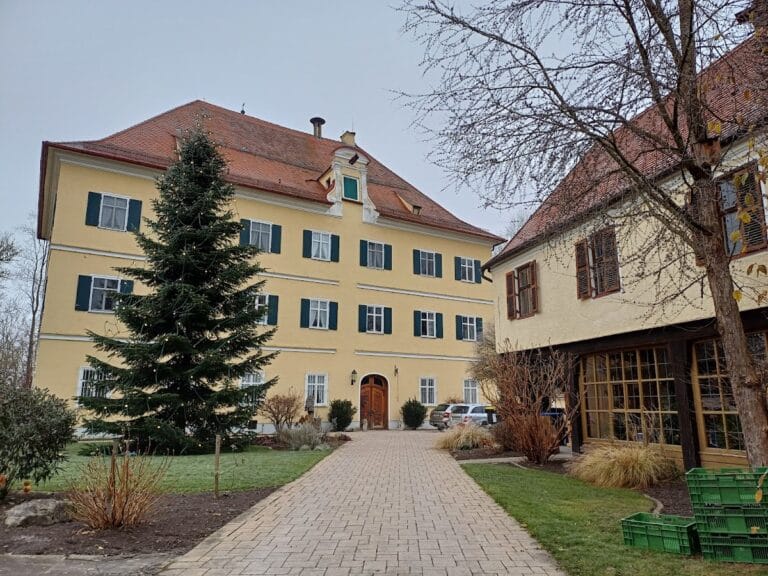
Schloss Hofhegnenberg occupies the Roßberg above Steindorf within grounds enclosed by mature trees. The principal castle is an extensive four-wing complex arranged around a rectangular inner courtyard. Its two- and three-storey wings have pitched roofs, while a large rectangular service courtyard lies to the northeast. Most buildings in that service courtyard date from the nineteenth century.
Principal Castle
Two square corner towers project above the main complex at the northwest and southeast corners. The northeast tower carries an octagonal upper section capped by an onion dome, while the southeast tower has neo-Gothic crenellation. The exterior walls are articulated by simple rectangular windows fitted with shutters. Round-arched arcades on the eastern and western courtyard façades have been walled up.
Western Gatehouse
The western gatehouse was remodelled in neo-Gothic form around 1790. Its long passage leads into the inner courtyard, and a coat-of-arms stone dated 1557 is set above the entrance.
Eastern Gatehouse
The representative eastern gatehouse dates from the eighteenth century and uses restrained Baroque forms.
Earlier Defences and Estate Grounds
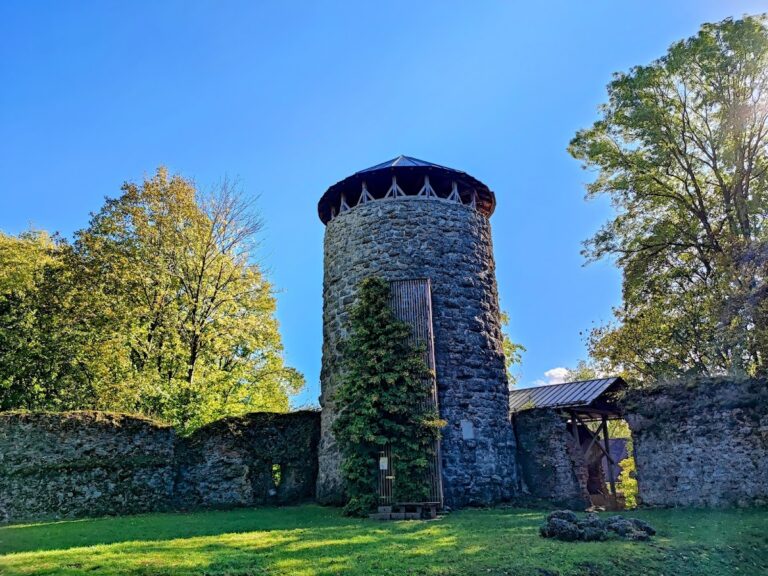
The high-medieval castle survives most clearly in the bossed ashlar blocks of the presumed keep stump at the southwest corner. These masonry blocks have roughly projecting outer faces. The tower remnant is described as an important surviving testimony to high-medieval aristocratic culture in the district.
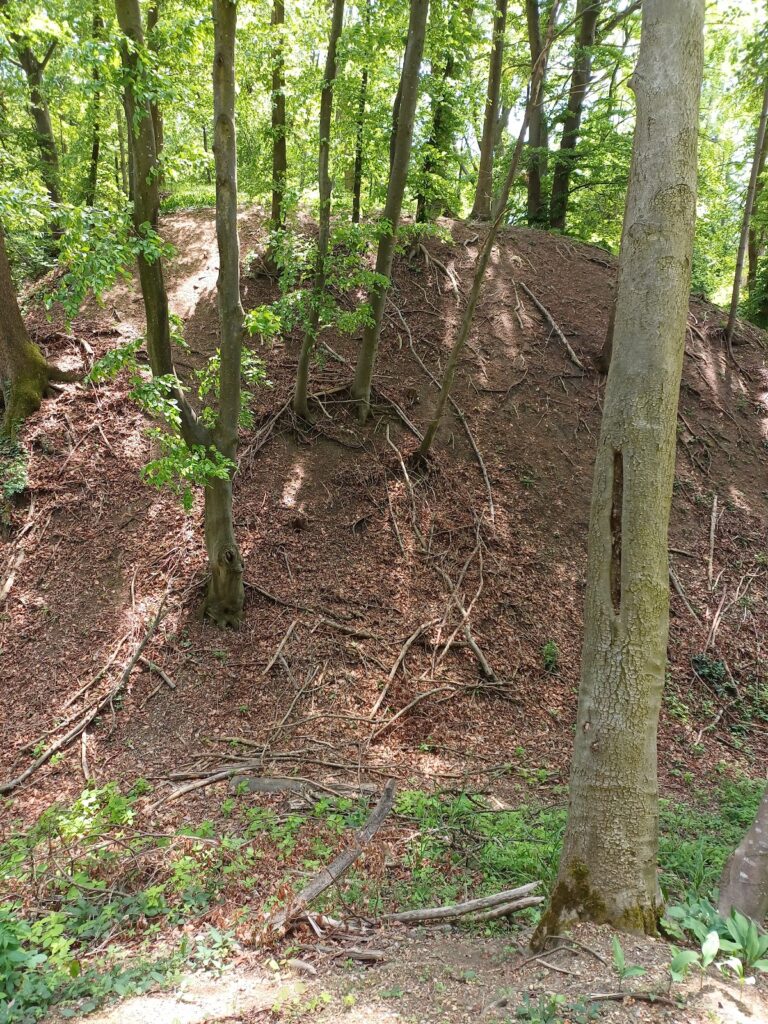
A 1701 engraving by Michael Wening, a Bavarian engraver and topographical illustrator, shows an extensive Baroque bastion fortification surrounding the castle precinct. Several earthworks and a masonry vault remain visible in the grounds.
Pilgrimage Chapel
Chapel of St. Mary
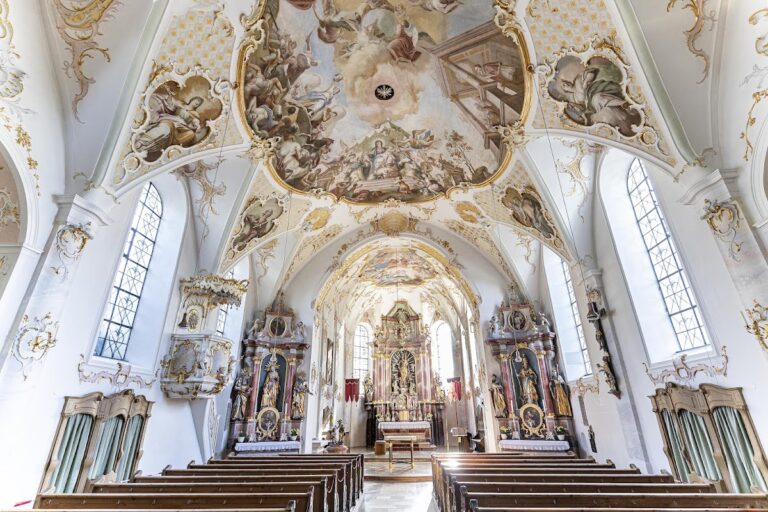
The former pilgrimage chapel of St. Mary occupies the ground floor at the southeast corner of the castle quadrangle. Created during the sixteenth-century rebuilding, its square room measures approximately ten metres on each side. Four groin vaults, formed by the intersection of barrel vaults, are supported by a central column.
Vault frescoes created around 1740 illustrate the history of the pilgrimage. One scene shows a Swedish soldier attempting to throw the miraculous Marian image into a fire during the Thirty Years’ War. The background includes a view of the castle’s west side, which also appears in Wening’s 1701 engraving.
The devotional image at the centre of the high altar dates from the second half of the fifteenth century. It depicts a seated Madonna surrounded by a Baroque halo of rays, with eight putti seated on cumulus clouds in the arcade arch. The altar structure dates from 1739, and its side figures, Saint George and Saint Nicholas, were made by Bartholomäus Kriechbaum.
Wilgefortis Side Chapel
A southern extension, the Wilgefortis side chapel, was added in 1751. The adjoining space is closed on three sides. Since the nineteenth century, it has housed the large red-marble epitaph of Georg von Hegnenberg-Dux, transferred from the former Franciscan church in Munich. Georg, who died in 1589, is shown in armour within a Renaissance aedicule, a small architectural frame resembling a shrine or temple front.