Haiming Castle: A Manor and Former Water Castle
Site at a Glance
- Rating
- 3.5
- Popularity
- Very Low
- Country
- Germany
- Primary era
- Modern
- Eras represented
- Early Modern, Modern
- Civilizations
- Electorate of Bavaria, Holy Roman Empire, Kingdom of Bavaria
- Site type
- Domestic
- Remains
- Manor House
On this page11 sections
History
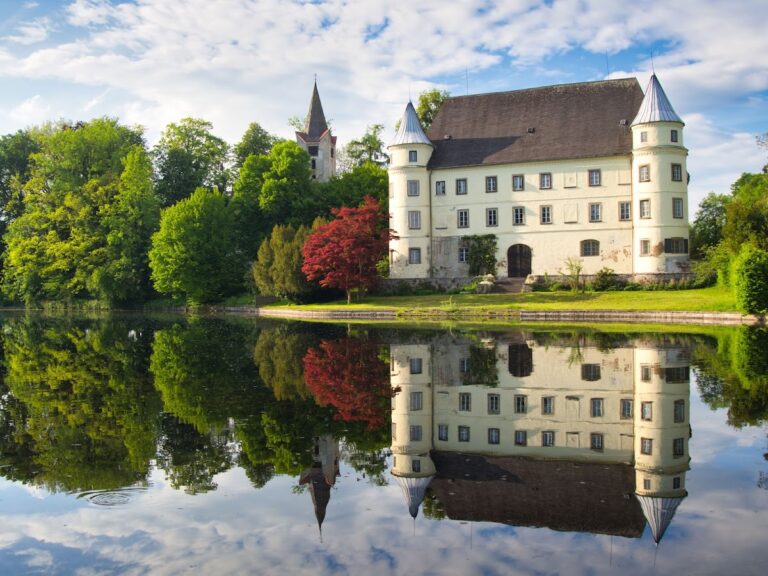
Haiming Castle is a manor and castle complex in Haiming, Germany, whose present residence was built in the Neoclassical style from 1838 to 1840. The estate is recorded from the eighth century, while a water castle is thought to have been built around 1400. Haiming’s early connection to the Diocese of Passau, followed by centuries of changing noble ownership, shaped its history.
Early estate and medieval lords
Haiming appears in eighth-century records when a landowner, Hrodpald, donated extensive estates there. It was the only locality in the Mattigau region belonging to the Diocese of Passau rather than the Archdiocese of Salzburg. Bishop Waldrich of Passau established the parish.
Medieval records trace a local noble family through land transfers and other property dealings. Eberhard of Haiming gave an estate at Fillmansbach to Mattsee Abbey. Merbot and Bertolf of Haiming witnessed a transaction in 1139, and Haimo of Haiming witnessed a transfer to Baumburg Abbey in 1159. Wilhalmus de Haimmingen was also associated with a transfer to Raitenhaslach Abbey. A deed from St. Peter’s Abbey describes Gebhard of Haiming as a knight serving Heinrich of Stammham. This suggests that Gebhard had lost his status as a free noble and entered the service of another lord. Later records name Renward of Haiming in 1180 and Heinric of Heimingen in 1201 and 1204.
When Konrad of Stammham, a canon of Passau Cathedral, died in 1204, his inheritance, including Haiming, passed to the Bishopric of Passau. By 1258, the manor owed substantial dues to the cathedral chapter. Haiming later became a fief of Duke Frederick II of Austria, who granted it to Count Rapoto III of Ortenburg. Both men died without heirs, and the estate returned to Passau.
In 1262, Bishop Otto of Lonsdorf sold Haiming to the knightly von Chalb family. A 1345 papal letter granting an indulgence for the church identifies Eberhard of Chalb as lord of Haiming. Eberhard died in 1354 and was buried at Raitenhaslach. Niklas of Chalb, named in 1376 and the last member of the family recorded in the area, is thought to have built the village’s water castle around 1400.
From the Ausmholz family to the Pürchingers
The knightly von Ausmholz family succeeded the von Chalbs. In 1401, Bishop Georg confirmed Johannes Ausmholz’s right of presentation, meaning the right to nominate a candidate for the parish post. Johannes said the right had come to him through his forebears Thomas and Leopold. In 1404, after falling out of favor with the Bavarian duke and being imprisoned, Johannes sold Haimling and moved to Burghausen. Members of his family later worked there as toll collectors. That same year, Hans Tobelhamer, a revenue official in Burghausen, acquired the manor.
Hans’s son Andreas succeeded him in 1414 and served as administrator at Neuötting from 1441 to 1445. Andreas’s son Friedrich died without male heirs. In 1463, Duke Ludwig the Rich settled a dispute among Friedrich’s daughters in favor of Katharina Tobelhamer. Her marriage to Jörg Pfaffenpeck, builder of Haiming’s parish church of St. Stephen, made him lord of the manor. After Jörg died in 1486, Katharina married Sebastian Pelkhover, a captain of the Burghausen militia. Christoph Pfaffenpeck, her son from her first marriage, inherited half the manor. The resulting inheritance dispute was settled in 1522. Christoph died childless in 1523, Sebastian in 1531, and Sebastian’s son in 1535.
Rights to the manor passed through the marriage of Katharina’s sister Barbara Tobelhamer to the knight Hanns Pürchiger. In 1546, Achatz of Pürching styled himself lord of Eckershaim and Haiming, while his brother Benedikt acquired shares in the manor. In 1562, the Bishop of Passau granted the brothers the church fief, an estate held by grant from an ecclesiastical authority, which included the castle. Their successor, Jörg, acquired the castle and manor seat at Winkelhaim from the heirs of Wolf Jahenstorf of Winkelhaimb in 1606.
Elsenheimer and Freyberg ownership
Jörg died in 1610, and his heirs sold Haiming to Christoph Ulrich of Elsenhaim on 6 July 1612. Christoph acquired Schloss Winkelham the following year. His administrative duties at Mainburg and later as president of the court chamber in Munich kept him largely away from Haiming, but he left the estate intact to his three sons when he died on 18 September 1630. An inheritance division in 1632 awarded the manor to Hanns Thomas Elsenheimer.
In 1667, Hanns Thomas transferred the estate to his daughter Eva Maria Franziska, who was married to Adam Kaspar, Baron von Freyberg. Adam Kaspar worked as a revenue official in Burghausen and later as a territorial deputy at Landshut. Their son Judas Thaddäus was named heir. During his long absence with Elector Max Emanuel in Belgium and France, his brother Carl Adam administered the family’s properties. Judas Thaddäus’s wife, Maria Klara, inherited from him and named Maria Josepha of Bavaria as her heir. When Maria Klara died on 29 November 1750, her will took effect and Maria Josepha became lady of the manor.
Berchem ownership and the nineteenth-century rebuilding
On 24 April 1759, Maria Josepha sold her Haiming property to Maximilian, Baron von Berchem, president of the court chamber. Haiming and Piesing were subsequently united as the Patrimonial Court of Haiming-Piesing. A Patrimonial Court was a landholder’s judicial jurisdiction, and its class indicated the extent of its authority. The court was reduced from first to second class in 1827–1828, and manorial rights were generally abolished in 1848.
The old water castle was demolished between 1837 and 1840. From 1838 to 1840, Count Sigmund von Berchem had a new castle built above its former pond. After the Berchem counts died out in 1869, Haiming and Piesing passed to the 14-year-old Sigismund Felix, Baron von Ow, son of Josefine, Count Sigmund’s eldest daughter, and Felix, Baron von Ow. Sigismund Felix became a priest and transferred his inherited properties to his brother Anton. In 1906, he became Bishop of Passau as Sigismund Felix von Ow-Felldorf. The Ow family continues to reside in Haiming and Piesing. The complex is protected as both an architectural monument and the site of a late medieval and early modern castle.
Remains
The former water castle
A 1721 view by Michael Wening depicts the water castle as two buildings linked by a covered defensive walkway, with bridges providing access. The main building had three storeys, including a basement level, strong retaining walls and a hipped roof. The second building had two storeys and a hipped roof. The view also shows ponds and waterworks around the castle.
The nineteenth-century complex
Main residence
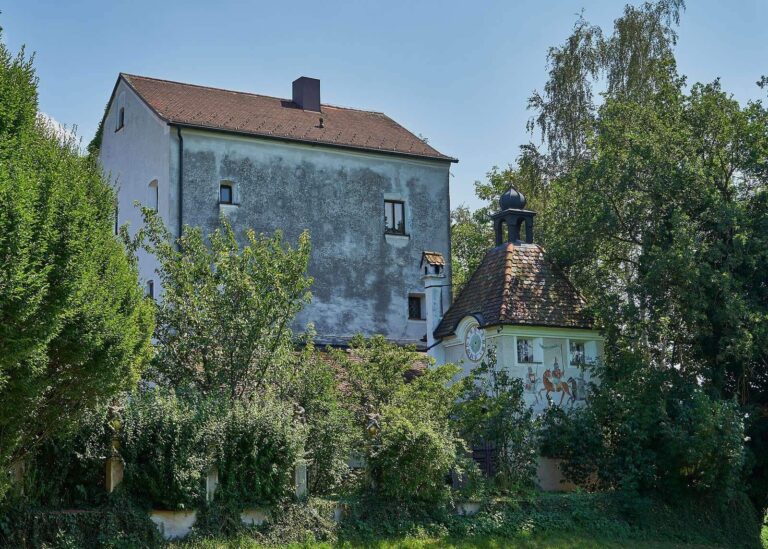
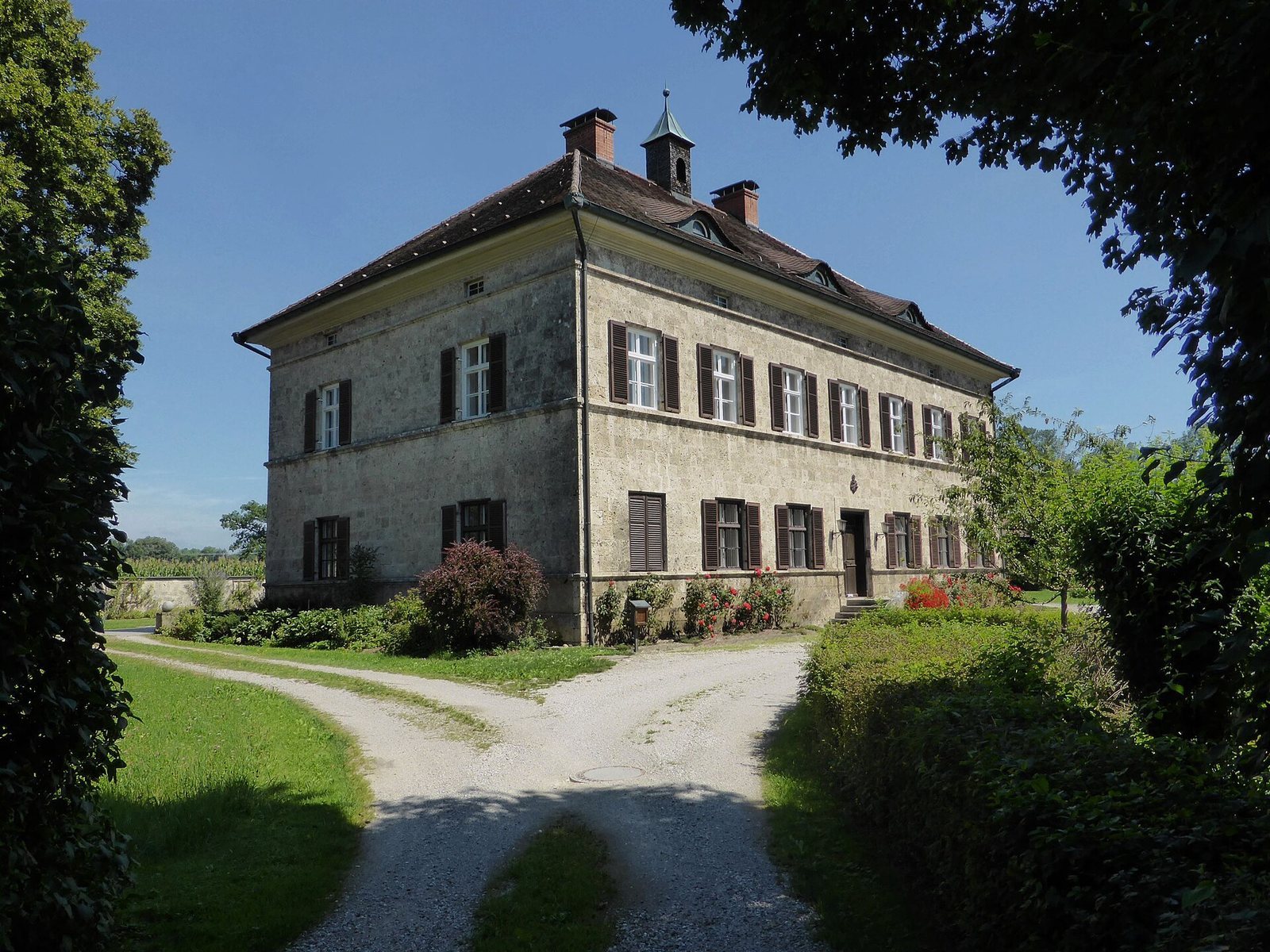
The present castle stands above the former castle pond. It is a rectangular Neoclassical building with unplastered tuff blocks, a volcanic stone, carefully cut and fitted, and a flat hipped roof.
Former records office
Two small buildings with hipped roofs stand west of the main residence. One is the former records office, which contains an altar from the old castle chapel. The altar dates to the middle of the seventeenth century.
Valentin Barn
The other western outbuilding, known as the Valentin Barn, dates to the first half of the eighteenth century. It is a boarded timber-block structure built partly of masonry.