Schloss Fröhliche Wiederkunft: A Saxon Hunting Lodge in Germany


Site at a Glance
- Rating
- 3.7
- Popularity
- Low
- Country
- Germany
- Primary era
- Early Modern
- External website
- Open
- Eras represented
- Early Modern, Modern
- Civilizations
- Electorate of Saxony, Holy Roman Empire
- Site type
- Domestic
- Remains
- Castle
On this page9 sections
History
Schloss Fröhliche Wiederkunft is a sixteenth-century hunting lodge in Germany, built for Elector Johann Friedrich I of Saxony at Wolfersdorf between 1548 and 1550. Its name, meaning “Joyful Return,” refers to Johann Friedrich’s release from captivity and reunion with his family at the castle in 1552.
Destruction and Construction
An aristocratic hunting lodge stood at nearby Trockenborn by the beginning of the sixteenth century. It was destroyed in 1547 during the Schmalkaldic War, the conflict between the Protestant Schmalkaldic League and Emperor Charles V’s forces in 1546–1547. Johann Friedrich, a leading Protestant prince and elector of Saxony, was captured during the war. After the destruction of the earlier lodge, he commissioned Nikolaus Gromann to build a replacement at neighboring Wolfersdorf.
The new castle was completed between 1548 and 1550. On 24 September 1552, after his release from captivity, Johann Friedrich met his family there and gave the building the name Fröhliche Wiederkunft.
Hunting Lodge and Ducal Residence
Johann Friedrich’s successors continued to use the castle for hunting during the sixteenth and seventeenth centuries. From about 1650, hunting parties increasingly moved to Hummelshain. Wolfersdorf then served the princely hunting administration, and the castle began to deteriorate.
Between 1858 and 1865, former reigning Duke Joseph of Saxe-Altenburg ordered a restoration, remodeling, and enlargement in the Neo-Gothic style. This nineteenth-century revival drew on medieval Gothic forms and historically inspired detailing. Four large painted panels showing episodes from Johann Friedrich’s life were also brought into the castle during this campaign.
In June and July 1866, the castle briefly housed George V, the last King of Hanover, after his army capitulated and before he went into exile in Austria. George V was Duke Joseph’s son-in-law.
Ernst II and State Ownership
After Duke Ernst II of Saxe-Altenburg renounced his throne on 13 November 1918, he moved from Altenburg Castle to the Wolfersdorf hunting lodge in 1922. With the assistance of Kurd Kisshauer, he had a modern observatory installed there.
The castle was expropriated during the land reform of 1945–46. The Soviet occupation authorities allowed Ernst II to live there for the rest of his life, and he remained until 1955. He died as a citizen of the German Democratic Republic, the East German state that existed from 1949 to 1990. The castle then became state property, while his wife, Maria Freifrau von Rieseneck, had to leave.
Decline and Restoration
Under state ownership, the castle was used as a Jugendwerkhof, an East German institution for the disciplinary and ideological re-education of young people. From 1990 it was used as a “Jugendlernhof.” The building fabric deteriorated considerably during this period.
Extensive desilting of the pond took place in 1997, and ammunition was recovered from its bottom. The castle was sold in 2007 to a native of Jena, after which restoration began on sections at risk of collapse. Supported by the Free State of Thuringia and the German Foundation for Monument Protection, the project sought to preserve the castle as a cultural and historical asset and make it accessible to the public. Considerable progress had been made by 2013.
After Ernst II’s death, furnishings associated with the castle were moved to Leuchtenburg Castle. The four painted panels from the nineteenth-century interior were later transferred to the Berlin Zeughaus, now the German Historical Museum.
Remains
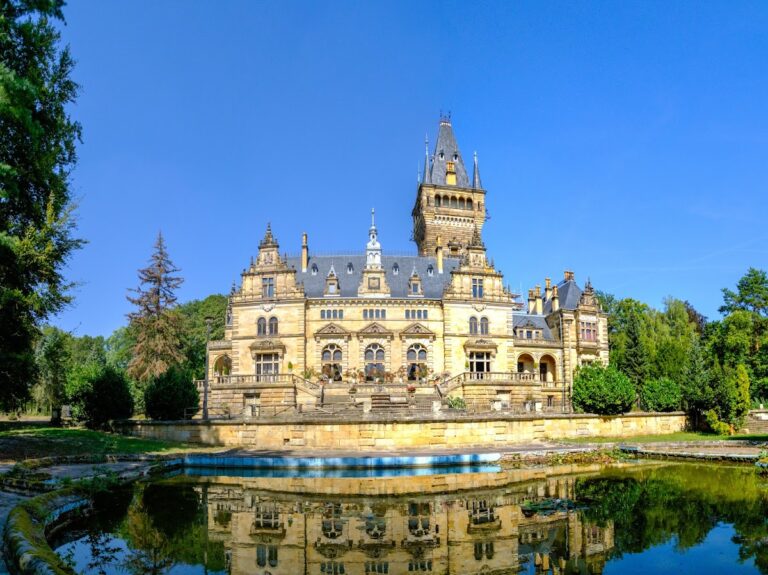
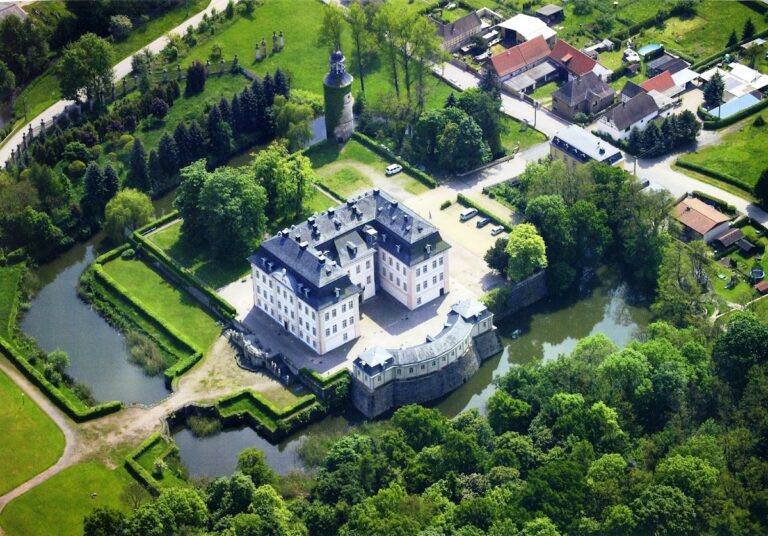
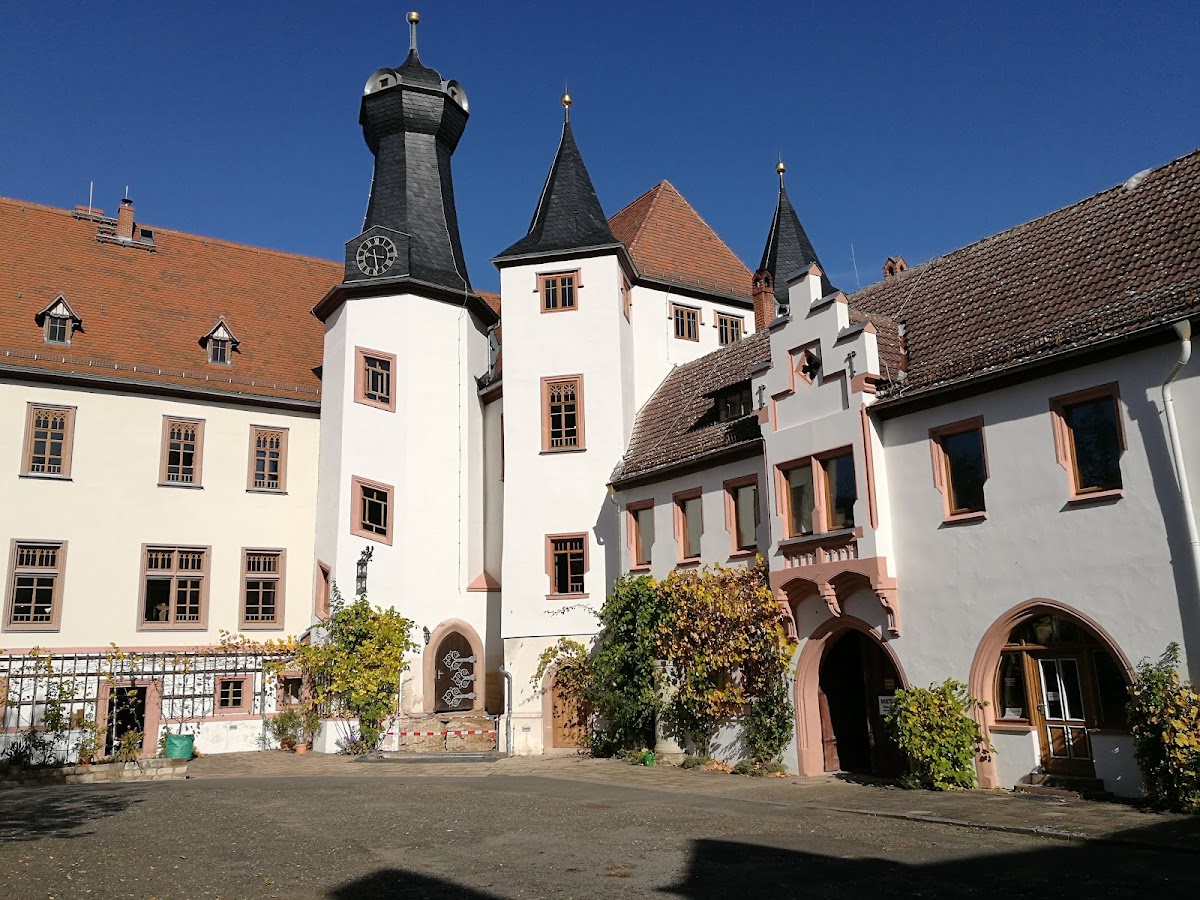
Schloss Fröhliche Wiederkunft stands on an island in a small pond at the center of Wolfersdorf. Its sixteenth-century core is an L-shaped, two-storey timber-frame building set on a stone base storey. The castle retains much of this original core, while later work altered and enlarged parts of the complex in the Neo-Gothic style.
Sixteenth-Century Core
The main building contains eight heated rooms and eleven chambers. A wooden stair tower once provided access to the upper floors. The timber frame rests on the stone lower storey, and the surviving core preserves the principal structure of the hunting lodge built between 1548 and 1550.
Service Buildings and Later Features
Service and farm buildings surrounded the core castle. Most of these structures were renewed and altered during the nineteenth century. The 1858–1865 remodeling also introduced Neo-Gothic additions, while the modern observatory installed for Ernst II during his occupation from 1922 formed a later functional addition to the castle.
Painted Panels and Conservation
Four large painted panels depicting scenes from Elector Johann Friedrich I’s life were installed in the castle during the nineteenth-century restoration. They were later removed and transferred to the Berlin Zeughaus, now the German Historical Museum. Modern restoration has concentrated on building sections that were partially in danger of collapse, helping to secure the surviving historical fabric.