Lobdeburg: A Medieval Castle Ruin near Jena


Site at a Glance
- Rating
- 4.6
- Popularity
- Low
- Country
- Germany
- Primary era
- Medieval
- External website
- Open
- Eras represented
- Medieval
- Civilizations
- Holy Roman Empire
- Site type
- Military
- Remains
- Castle
On this page11 sections
History
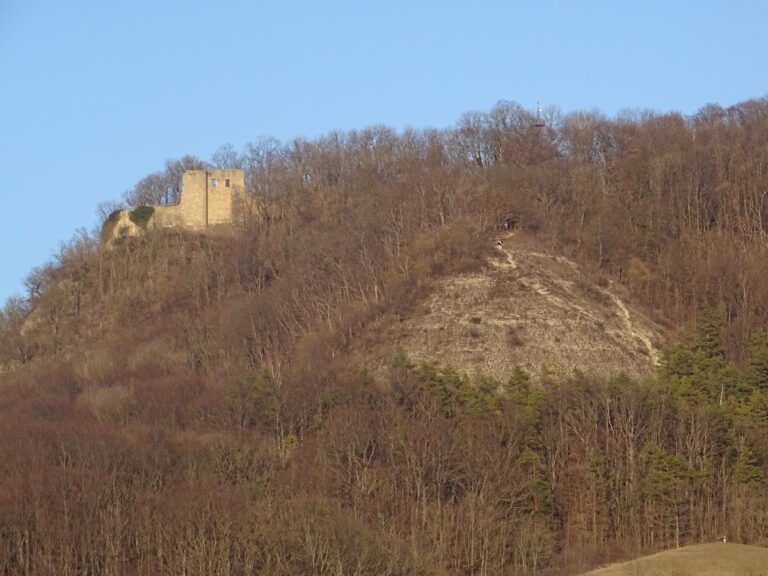
Lobdeburg is a medieval castle ruin in Germany between Lobeda and Drackendorf, districts of Jena, whose Romanesque construction was completed in 1185. The name describes three associated fortifications, known as the upper, middle, and lower castles, although the middle castle is generally regarded as the main Lobdeburg. The site was first mentioned in 1166 and probably arose under the Lords of Auhausen, imperial ministeriales, a medieval service nobility that performed military and administrative duties for the emperor.
Origins and the Lobdeburg dynasty
The castle took its name from Lobeda, and the family branch living there soon adopted the name von Lobdeburg. Around 1220, the family divided into five lines: Leuchtenburg, Arnshaugk, Elsterberg, Saalburg, and Burgau. By 1227, the principal line had become known as von Leuchtenburg and had moved its residence from Lobdeburg to Leuchtenburg at Kahla. An official then administered Lobdeburg on the family’s behalf.
During the expansion of their territories, the Lobdeburgs were probably involved in the planned development of Jena. Their rule is directly associated with a market there during the last quarter of the twelfth century, and they acted as its lords and protectors. The dynasty granted town rights to Jena between 1225 and 1240, followed by Stadtroda in 1251, Lobeda by 1284, Schleiz by 1285, Neustadt by 1287, Pößneck by 1289, and Kahla by 1299.
Five bracteates, thin medieval coins usually struck from a single sheet of silver, were minted around 1175 to 1200 with the inscription “Hartmannus de Lobdeburc.” Because Jena was the largest settlement in the Lobdeburg territories, these coins may have been intended for its market.
Decline and later history
The Lobdeburg dynasty flourished during the twelfth and thirteenth centuries, but it became poorer and lost political influence during the fourteenth century. Its territories gradually passed to the Wettins, a major ruling dynasty whose possessions included Thuringia and the margraviate of Meissen. Lobdeburg came under Wettin control during the fourteenth century, ending much of the Lobdeburgs’ territorial independence.
During the Saxon civil war of 1446 to 1451, Duke Wilhelm of Saxony captured the castle in 1450. The Puster family held it until 1591, after which the complex began to decay. Stone from the ruins was reused, among other purposes, in the Saale bridge at Burgau, built between 1491 and 1544.
The Lobdeburg-Gemeinde 1912 e.V. association has worked with Jena’s monument authority since 1912 to maintain and restore the castle and its surroundings. Since German reunification, emergency conservation has been carried out on the Romanesque secular monument, while Jena city archaeologist Matthias Rupp has prepared comprehensive architectural and archaeological documentation of the middle Lobdeburg. Lobdeburg is regarded as a cultural monument, and restoration took place in 2018 and 2019.
Remains
Lobdeburg is a slope castle on a spur of the Wöllmisse plateau, between Lobeda and Bürgel, at approximately 300 metres above sea level. Its position overlooks or controls the middle Saale valley, the Roda valley, and the Leutra valley. The surviving complex is preserved as a ruin and includes a residential tower, a palas, a chapel, a protective wall, and a cistern tower.
Associated fortifications
Upper Lobdeburg
The upper Lobdeburg was a separate fortification associated with the main castle. Its surviving remains include part of a ring wall. It was long interpreted as an outer bailey protecting the main castle from the plateau, while other interpretations regard it as an independent fortress. The precise relationship between the upper and middle castles has therefore been reassessed.
Lower Lobdeburg
A lower Lobdeburg was recorded in 1236 as castrum inferiorum. It was long identified with a castle in Lobeda, but later interpretation has questioned that identification and proposed that “lower castle” may instead have been another name for the middle Lobdeburg. One architectural interpretation places it near the lower end of the Lobeda market, where the name later passed to a former estate.
Middle Lobdeburg
Residential tower
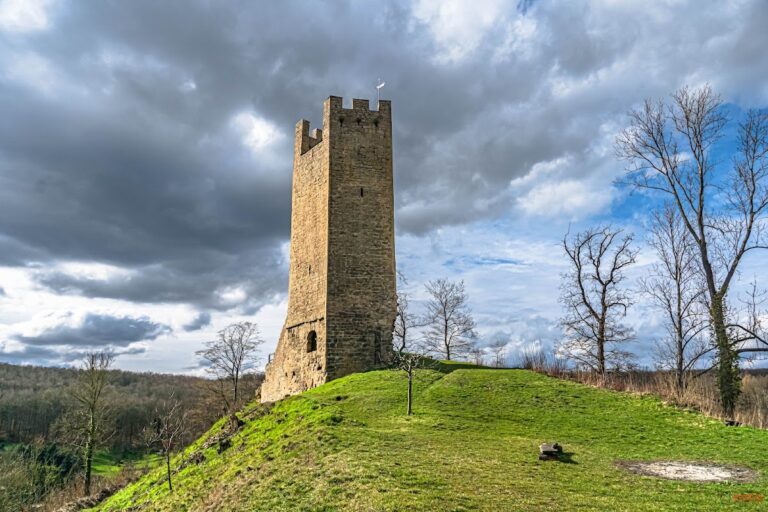
The residential tower retains double-arched windows and other features of Romanesque architecture, the medieval style associated with massive masonry, round-headed openings, and robust structural forms. Restoration in 2018 and 2019 created a viewing platform within the tower. The structure remains part of the preserved castle ruin.
Palas and chapel
The middle castle includes a palas, the principal residential or representative hall of a medieval castle, together with a chapel. The palas has been stabilized with a steel supporting framework, allowing the surviving structure to remain part of the ruin complex.
Protective wall and cistern tower
A protective wall and a cistern tower also survive within the complex. A cistern tower is associated with a cistern, a structure used to collect or store water. These elements form part of the defensive and practical infrastructure of the middle Lobdeburg.
The castle itself was not damaged when a fire at the end of 2018 burned several trees around Lobdeburg. Conservation work has continued alongside architectural and archaeological documentation of the middle castle.
Nearby sites