Schloss Erdmannsdorf: A Historicist Castle in Germany


Site at a Glance
- Rating
- 3
- Popularity
- Very Low
- Country
- Germany
- Primary era
- Modern
- Eras represented
- Medieval, Modern
- Civilizations
- German, Holy Roman Empire, Margraviate of Meissen
- Site type
- Domestic
- Remains
- Castle
On this page7 sections
History
Schloss Erdmannsdorf is a castle in Germany, in Augustusburg, that developed from a medieval fortified site probably established around 1160. It was first mentioned in 1191 as the manor seat of Werner de Ertmarsdorf, who is also regarded as the builder of Nidberg Castle near Zöblitz. The site occupied a defensible rocky spur above the Zschopau River and later became a landed estate supported by extensive agricultural holdings.
From Fortification to Manor
The original spur castle was gradually transformed into a manorial estate and then into a castle complex. A manorial estate was a landed property centred on a lord’s residence and supported by farmland and dependent economic buildings. The property passed successively among the von Erdmannsdorf, von Schütz, and von Könneritz families.
After the von Erdmannsdorf family, the estate was acquired by the von Schütz family, which originated in Franconia. Its ennobling document dates from 1486, and the family was ennobled as von Schütz in 1539 when Hieronymus von Schütz, then mayor of Chemnitz, received noble status. His grandson Ernst von Schütz later acquired Erdmannsdorf. Julius Ernst von Schütz and his son Friedrich Wilhelm von Schütz were among the family’s prominent representatives.
The Könneritz Estate
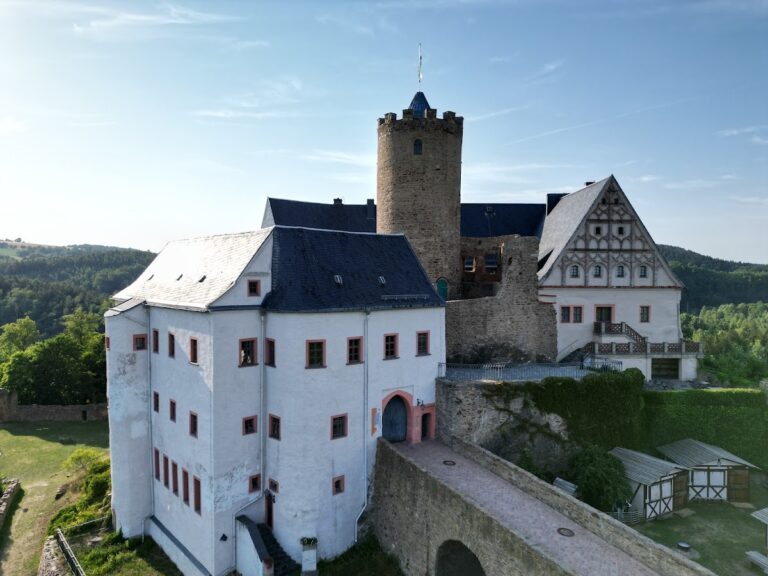
The von Schütz family sold Erdmannsdorf in 1793, after which the von Könneritz family became the landowning family. During the 1840s, Hans Heinrich von Könneritz, a Saxon diplomat and ambassador to Paris, remodelled the estate as a castle. This reconstruction gave the building its present historicist character. Historicism was a nineteenth-century architectural approach that revived forms from earlier historical styles, here including Tudor Gothic, which drew on architectural forms associated with Tudor-period England.
The estate continued to function as a substantial landed property. A former agricultural building was replaced by new farm buildings in 1822 and demolished in 1829. A later Hans von Könneritz acted as patron of the local church and had the Trinity Church rebuilt. In 1924, Ferdinand Richard von Könneritz (1867–1943), the next younger brother of Hans von Könneritz, inherited the manor house and estate. The estate was leased in 1925 and then covered 334 hectares.
Alteration and Modern Use
Decorative elements of the Tudor-Gothic reconstruction were destroyed around 1965 during renewal of the exterior plaster and associated renovation. The castle’s ancillary building was restored in 2000. The complex now contains apartments, meeting or association rooms, and an exhibition room. The former medieval spur castle is also protected as an archaeological monument associated with the later castle complex.
Remains
Site and Medieval Fabric
Schloss Erdmannsdorf stands south of Erdmannsdorf in the Ore Mountains, on a southeast-facing rocky spur above the Zschopau River. The medieval fortification occupied a projecting site about 30 to 40 metres in diameter. Most of its medieval fabric was levelled during the later conversion into a manorial estate and castle, but the foundations remain visible. The oldest surviving part is known as the stone house, while further medieval fabric can be seen in the castle cellar.
Historicist Castle and Estate Buildings
The present castle is built in the historicist style and incorporates Tudor-Gothic forms and decorative elements. The agricultural and service buildings erected in 1822 remain connected with the estate’s later development, while the earlier farm building was demolished seven years later. The restored ancillary building contains four apartments, with meeting or association rooms and an exhibition room on the ground floor.
Nearby sites