Borlinghausen Castle: A Moated Estate in Willebadessen
Site at a Glance
- Popularity
- Medium
- Country
- Germany
- Primary era
- Early Modern
- Eras represented
- Medieval, Early Modern
- Civilizations
- Holy Roman Empire
- Site type
- Domestic
- Remains
- Castle
On this page8 sections
History
Borlinghausen Castle stands in a park just outside the village of Borlinghausen in Willebadessen, Germany. Its oldest part predates 1411, and a major enlargement in the Weser Renaissance style was completed in 1587. The estate passed through several families before its purchase by the von Weichs family in 1926.
Medieval origins and the Spiegel family
The settlement of Borlinghausen first appears in a record dated 8 December 1065, a donation charter of King Henry IV, who later became Holy Roman Emperor. The charter gives its name as Burchartinchusen, meaning “Burchart’s house.” In 1411, the Counts of Waldeck granted the knight Gerd von Spiegel zu Peckelsheim the village and castle, along with church-related rights held under feudal tenure.
The estate later passed by inheritance to Johann von Spiegel zu Peckelsheim, hereditary marshal of the Prince-Bishopric of Paderborn, a territory governed by a prince-bishop. A hereditary marshal held an inherited court office. After Johann died in 1559, his inheritance was divided among his four sons in 1577, and Werner received Borlinghausen. Werner had succeeded his father as marshal in 1567. He substantially enlarged the castle in the regional Weser Renaissance style.
Later Spiegel owners
Werner died in 1594, leaving the estate to his underage son Johann. By 1755, Borlinghausen belonged to Johann Heinrich von Spiegel, a former officer in the service of the Duchy of Brunswick. He remodeled the castle in 1779. His only son, Karl Franz Theodor, inherited it in 1789.
After 1807, the estate was held by a Baron von Spiegel-Borlinghausen, a chamberlain to Jérôme Bonaparte, Napoleon Bonaparte’s younger brother and king of Westphalia. The baron’s son served as a captain in Bonaparte’s army in 1813. Karl Josef von Spiegel inherited Borlinghausen in 1822 and left it to his only child, Marie Louise, in 1832. She married Baron Franz Karl von Elmendorff in 1835.
Ownership from the nineteenth century onward
In 1839, Marie Louise sold the estate to Bierbaum, a Protestant banker from Braunschweig. Seven years earlier, he had lent her 44,000 thalers, a currency used in German lands, so she could pay off her mother and uncle. Bierbaum later gave Borlinghausen to his eldest son, Julius.
Julius Bierbaum sold the estate in 1860 to Oswald von Wendt, a former Catholic lieutenant colonel in the Austro-Hungarian army. Von Wendt had the village church of St Mary, Help of Christians, built between 1869 and 1872. After his death in 1877, his sister Leonia inherited the estate. In 1880, she passed it to her daughter Marie, who was married to Count Franz zu Stolberg-Stolberg of Westheim.
After Count Franz died in 1912, his son Josef sold Borlinghausen to Berta, Baroness von Fürstenberg. Klemens Reichsfreiherr von Weichs zur Wenne bought the castle and estate in 1926, after selling Bladenhorst Castle, which was threatened by mining damage. The von Weichs family has retained the estate, and family members continue to live in the castle.
Remains
Castle and associated tower
Main castle
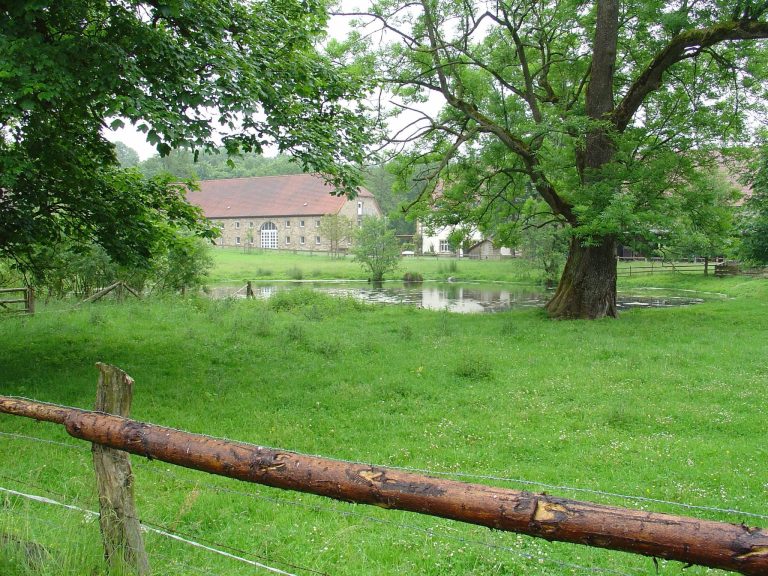
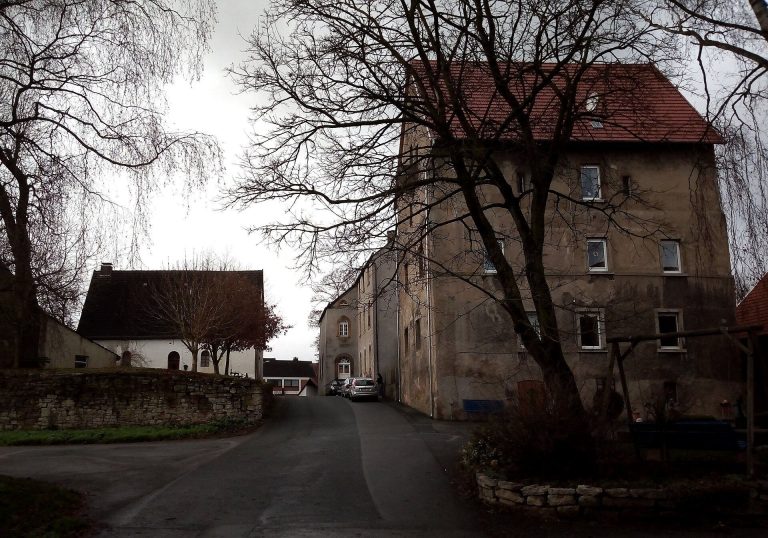
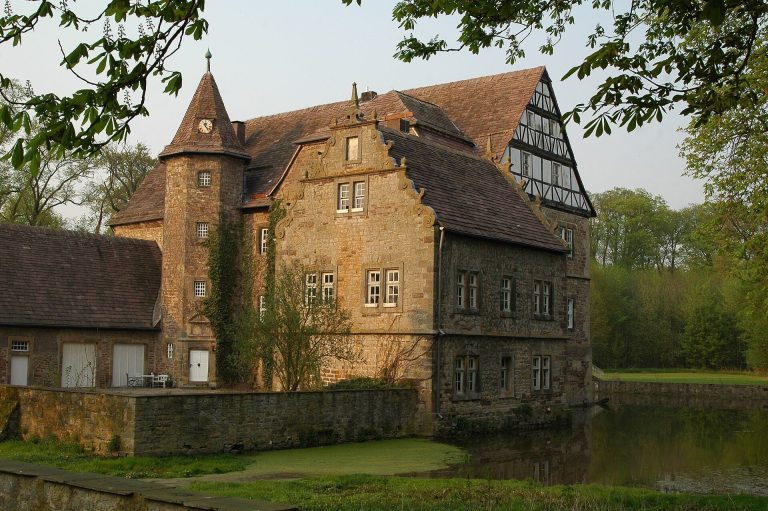
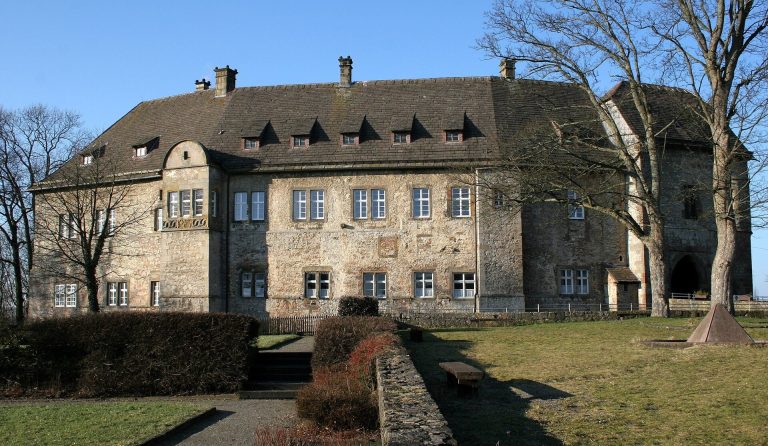
The moated castle stands in a park, slightly apart from the village. Its angular building has two storeys above a high basement base, with an octagonal stair tower at the angle providing access. The shorter wing retains parts of the Gothic predecessor, including Gothic window surrounds and traces of a drip cornice. Weser Renaissance decoration appears on the roof gables, which were renewed in 1898–99. Above the richly ornamented entrance at the stair tower, an inscription reads “WERNER SPIEGEL.1587.CATARINA KANNE.”
Bierbaums Nagel
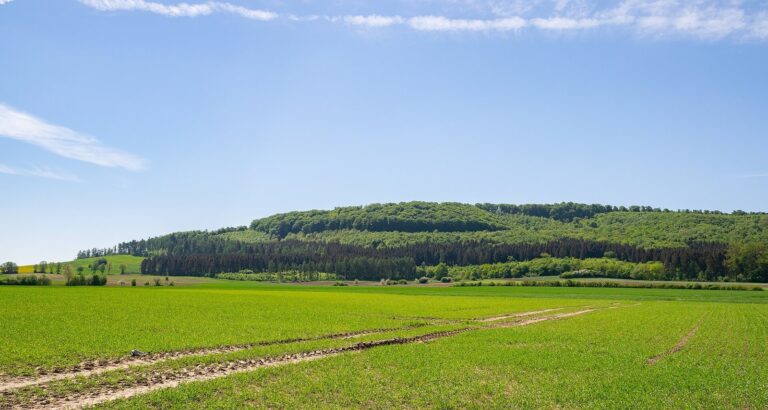
The estate’s watch-and-observation tower, known as Bierbaums Nagel, stands on the crest of the Egge Mountains at 431 metres above sea level. Julius Bierbaum commissioned it for his wife in 1847. In clear weather, she could see Herkules, the monumental statue and landmark associated with Kassel.