Schloss Assen: A Moated Renaissance Castle in Germany


Site at a Glance
- Rating
- 4.5
- Popularity
- Low
- Country
- Germany
- Primary era
- Early Modern
- External website
- Open
- Eras represented
- Medieval, Early Modern, Modern
- Civilizations
- German, Holy Roman Empire
- Site type
- Domestic
- Remains
- Castle
On this page13 sections
History
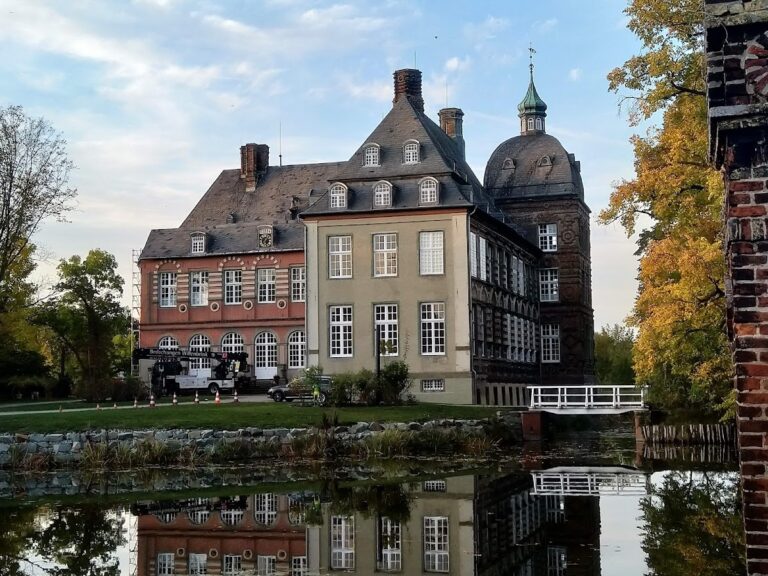
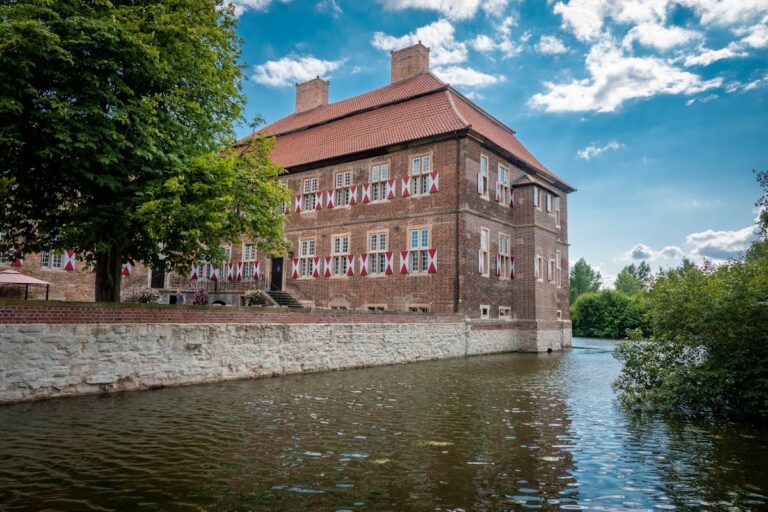
Schloss Assen is a moated castle in Germany, at Lippborg in the municipality of Lippetal, North Rhine-Westphalia. The complex developed from a fortified site known as “Borch to Assen,” which existed by the eleventh century, and includes a Lippe Renaissance building begun in 1564 and a Neo-Gothic chapel added in 1858.
Medieval origins and feudal ownership
In 1023, Emperor Henry II, the medieval German ruler who reigned from 1002 to 1024, donated the fortified site and its lands to Abdinghof Abbey in Paderborn, a Benedictine monastery. In 1384, Röttger von Ketteler received the castle as a fief, meaning property granted by a superior lord in return for service or allegiance. The estate was divided among separate holdings in 1455.
Haus Neu-Assen and reunification
In 1564, Laurenz von Brachum built Haus Neu-Assen south of the older castle for Goswin von Ketteler. Goswin lived in the new building, while his brother occupied the older castle. The two structures were later connected. The divided holdings were reunited at the end of the sixteenth century when Konrad von Ketteler married Odilia von Ketteler. Their childless marriage transferred the inheritance to Odilia’s sister Eva, who was married to Goswin von Ketteler of Hovestadt, and later to Goswin’s sister, the wife of Gottfried von Heyden.
The von Galen period
Unresolved inheritance disputes eventually led Johann Heinrich von Galen, supported by his brother Christoph Bernhard von Galen, to purchase the estate. Johann Heinrich moved into Schloss Assen in 1653. Christoph Bernhard, Prince-Bishop of Münster, was a bishop who also exercised secular territorial authority, and wanted his brother and a trusted associate established near the southern border of his territory.
After the Assen branch of the family died out, the castle passed to Clemens August, Count von Galen (1748–1820), who came from Dinklage. From 1850, Schloss Assen served as the family’s second residence alongside Burg Dinklage. Matthias, Count von Galen (1800–1878), and his wife extensively renewed the property and added its Neo-Gothic chapel in 1858. The von Galen family retained Schloss Assen until 1997.
Changes after 1984
Following the 1983 crisis of the Frankfurt private bank Schröder, Münchmeyer, Hengst & Co., Ferdinand, Count von Galen, transferred the house to his father in late 1984 and sold the estate’s forests and meadows to the meat wholesaler Alexander Moksel and his wife, Antonie. Der Spiegel gave the sale price at the time as 32 million marks. The transaction enabled Ferdinand von Galen to settle his private debts.
In 1997, Christoph Bernhard, Count von Galen (1907–2002), donated his residence to the Servants of Jesus and Mary, a Catholic religious community founded in 1988. He had lived there alone after his wife’s death in 1992. His adult children did not wish to take over the property, and he cited the cost of maintaining and renewing the large building as a reason for the donation.
Religious community and educational use
Christoph Bernhard von Galen came into contact with the community through his daughter Johanna, honorary president of the Catholic Scouting Association of Europe, which received spiritual support from the Servants of Jesus and Mary. From 1997 to 2016, the community operated the Cardinal von Galen College, a boys’ boarding school, at Schloss Assen. The institution was named after Christoph Bernhard’s uncle, Clemens August Graf von Galen.
In December 2005, the North Rhine-Westphalian Ministry of Education refused authorization to expand the college into a Gymnasium, a German secondary school leading toward university entrance examinations. Boarding-school students consequently attended a Gymnasium in Beckum outside the community and the castle. Father Raphael von Canstein directed the boarding school until 2012. Its closure was announced in January 2016 after enrolment fell from 17 pupils to 10, and it closed during the summer holidays that year.
The building was intended to receive structural repairs and remain in use by the Servants of Jesus and Mary. Repair work in the crypt and cellar began in January 2017, when a construction hut was also established on the grounds. In 2018, the community moved its novitiate, the institution or period in which candidates receive formation before taking religious vows, from Blindenmarkt to Schloss Assen.
Remains
Buildings and layout
Moated castle complex
Schloss Assen is a moated castle in the Lippe Renaissance style, a regional form of Northern Renaissance architecture associated with Lippe and neighboring Westphalian areas. Its layout reflects the joining of two principal buildings: the older fortified castle and Haus Neu-Assen, constructed south of it in 1564. The later connection brought the medieval fortified site and the Renaissance residence into one castle complex.
Neo-Gothic chapel
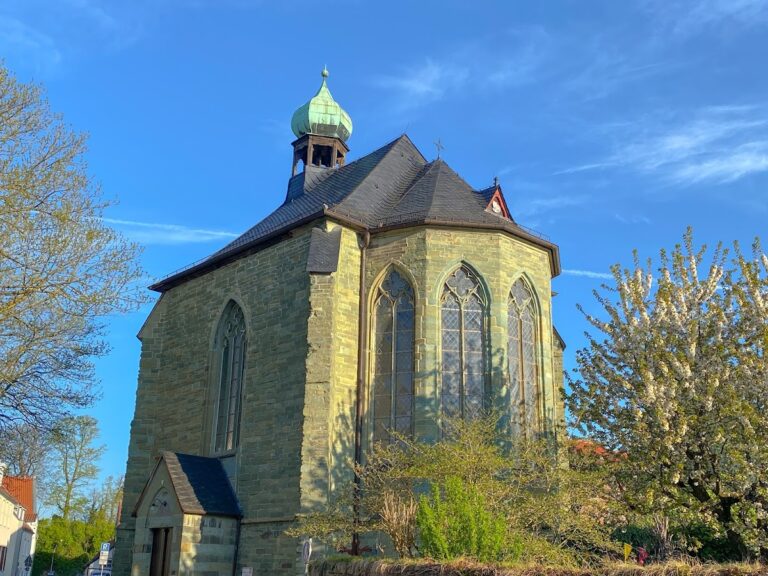
A Neo-Gothic chapel forms part of the castle complex. Built in 1858 during the comprehensive renewal undertaken by Matthias, Count von Galen, and his wife, it reflects the nineteenth-century revival of medieval Gothic architectural forms.
Courtyard monument and lower levels
Cardinal Clemens August monument
A bronze sculpture stands in the inner courtyard and depicts Cardinal Clemens August von Galen seated with the manuscripts of his 1941 sermons. Clemens August von Galen, known as the “Lion of Münster,” was a German Catholic bishop and cardinal whose sermons publicly opposed National Socialist policies. The monument was inaugurated on 8 September 2007, marking the tenth anniversary of the boarding-school institution.
Crypt and cellar
The castle complex contains a crypt and cellar. Repair work in these lower parts of the building began in January 2017 as Schloss Assen continued under the care of the Servants of Jesus and Mary.