Palacio de Anaya: A Neoclassical College and University Building in Salamanca


Site at a Glance
- Rating
- 4.7
- Popularity
- Medium
- Country
- Spain
- Primary era
- Early Modern
- Eras represented
- Early Modern
- Civilizations
- Spanish
- Site type
- Civic
- Remains
- Palace
On this page10 sections
History
Palacio de Anaya is a neoclassical university building in Salamanca, Spain, whose construction began in 1760 after the 1755 Lisbon earthquake severely damaged its predecessor. Neoclassicism revived the ordered forms of ancient Greek and Roman architecture through features such as columns, pediments, symmetry, and restrained ornament. The present building replaced the Colegio Mayor de San Bartolomé, an institution founded in 1401 by Diego de Anaya Maldonado, an archbishop who established it to provide selective education for students outside the university’s larger student body.
Foundation and rebuilding
The earlier college occupied the site before the present palace was built. Following the earthquake damage, José de Hermosilla and Juan de Sagarvinaga directed the construction of the new building from 1760. Palacio de Anaya became one of Salamanca’s few neoclassical buildings, distinguishing it from much of the city’s earlier architectural fabric.
Changing institutional role
After the university colleges were suppressed, the building acquired several uses. It became the seat of the Civil Government, a change that contributed to its later description as a palace even though its original purpose was as a college. It now houses the Faculty of Philology of the University of Salamanca.
The adjoining Church of San Sebastián began as the college chapel and now serves as a parish of the cathedral. On 6 October 2011, the Anaya college complex, the Hospedería, and the Church of San Sebastián were declared Assets of Cultural Interest in the category of monument.
Remains
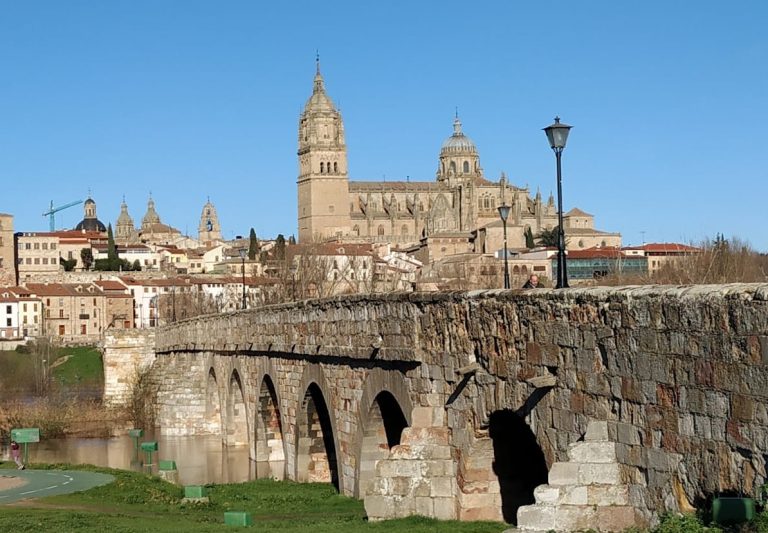
The surviving complex combines a neoclassical main building with associated religious and accommodation structures. Palacio de Anaya stands directly opposite Salamanca New Cathedral, while the Baroque Church of San Sebastián adjoins it. The main palace is organized around a courtyard and retains its monumental entrance, formal interior staircase, library, and doorway connecting the courtyard with the library.
Main palace
Facade
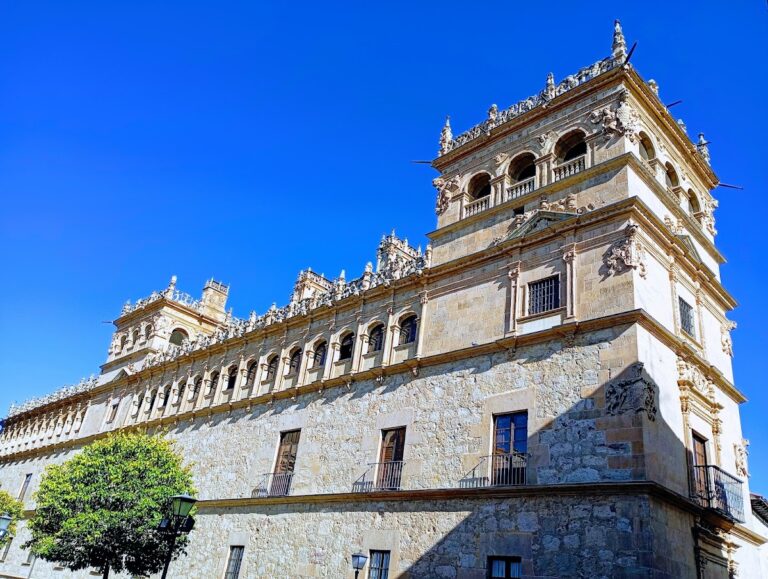
The principal facade is arranged around a large portico, a roofed entrance supported by columns. Four columns carry the entrance composition, which includes a decorated staircase and a pediment, the shaped feature crowning a classical facade. A large heraldic shield occupies the upper part of the building. Ten windows with iron grilles light the lower floor, while ten balconies occupy the upper floor.
Interior
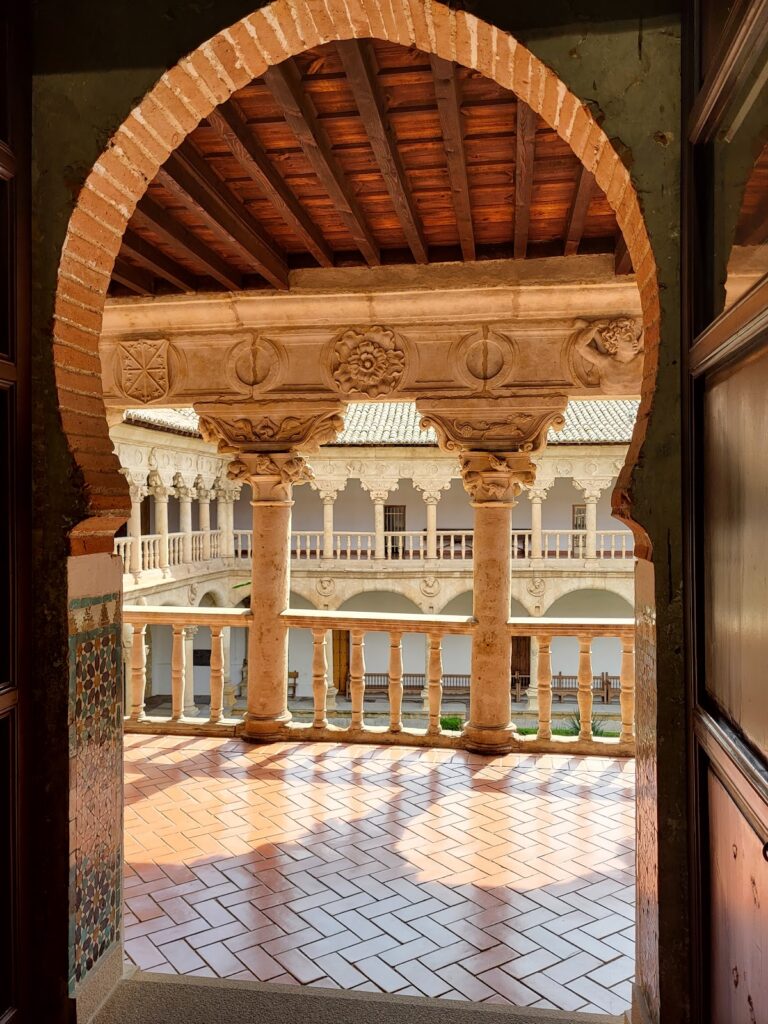
Inside, an imperial staircase provides a ceremonial approach through a broad central flight and associated landings. The palace also contains a neoclassical courtyard with round columns and an open gallery. Its spaces now accommodate the faculty’s secretarial and information services, departments concerned with Spanish language and literature, Spanish and Latin American literature, and Classical and Indo-European philology, as well as printing, photocopying, and lecture facilities.
A library forms part of the palace, with a doorway from the courtyard leading to it. The interior also contains a bust of Miguel de Unamuno, the Spanish writer, philosopher, and rector of the University of Salamanca. Victorio Macho, a Spanish sculptor, made the bust in 1930.
Associated buildings
Hospedería
The adjoining Hospedería, an accommodation building serving students connected with the college, was constructed in 1715 by Joaquín Churriguera. It housed students who paid for their studies by serving the noble and wealthy students living in the college. The building is now used for classrooms and offices, while its former stables contain the Faculty cafeteria.
Church of San Sebastián
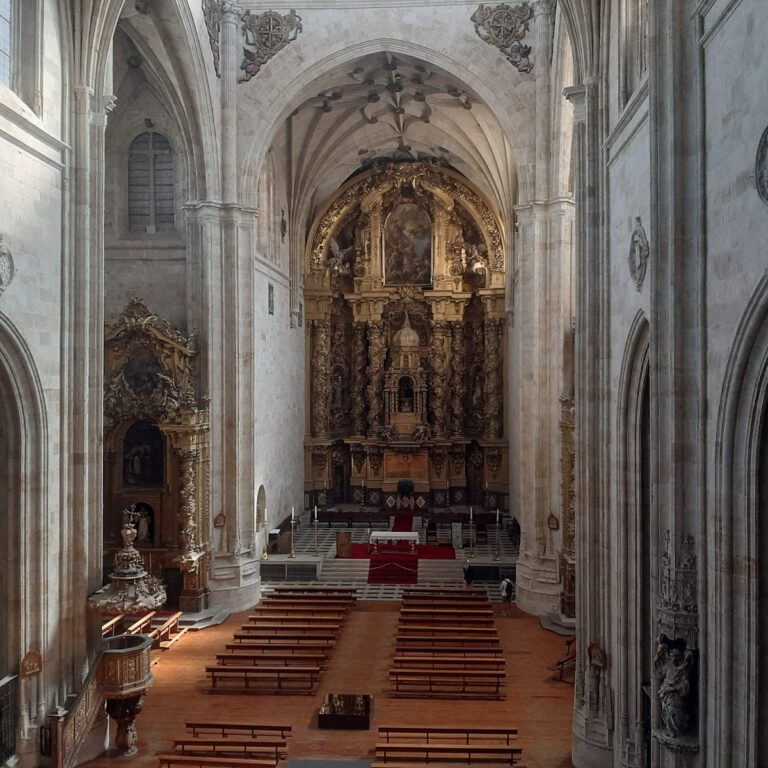
The Baroque Church of San Sebastián stands beside Palacio de Anaya. It was formerly the chapel of the Colegio Mayor de San Bartolomé and continues in a religious role as a parish of the cathedral.
Nearby sites