Scaleby Castle: A Medieval Fortified Castle in Cumbria


Site at a Glance
- Rating
- 4.3
- Popularity
- Very Low
- Country
- United Kingdom
- Primary era
- Medieval
- Eras represented
- Medieval, Early Modern
- Civilizations
- English
- Site type
- Domestic
- Remains
- Castle
On this page11 sections
History
Scaleby Castle is a medieval fortified castle in Scaleby, England, in the United Kingdom. Robert de Tilliol built it after 1307 on land granted by Edward I, with Edward II authorizing the construction of a fortified castle. The site stands about 6 miles (9.7 kilometres) from Carlisle and reflects the regional position of the Tilliol family, whose prominence extended back to the reign of Henry I.
The Tilliol foundation
The first castle consisted of two groups of buildings joined by a small courtyard. Curtain walls, defensive walls linking fortified structures, protected the complex, while a large circular moat filled with water and a second inner moat added further protection. This arrangement established Scaleby as both a residence and a fortified stronghold.
The male line of the Tilliol family ended in 1435. Through marriage, the castle then passed to the Colville family, who undertook a major rebuilding campaign in the late fifteenth century. Their work remodeled the pele tower, great hall, and gateway, and added a polygonal barbican, a fortified entrance structure projecting beyond the gateway.
The Musgraves and the Civil War
The Musgrave family later acquired Scaleby Castle. Sir Edward Musgrave rebuilt the south range in 1596, changing part of the medieval complex during the late Tudor period.
During the English Civil War, the conflict between supporters of Charles I and Parliament, Sir Edward Musgrave’s grandson, also named Sir Edward Musgrave, declared for the king and became a strong Royalist supporter. In February 1645, Parliamentary forces conducting the siege and capture of nearby Carlisle also besieged Scaleby Castle. They captured the castle and caused considerable damage, although Edward Musgrave later recovered it.
At the beginning of the Second English Civil War in 1648, Musgrave again took up arms for Charles I. Parliamentary forces quickly captured Scaleby Castle and set it on fire. Heavily in debt after the war, Sir Edward Musgrave sold the property to Richard Gilpin.
Restoration and later use
Richard Gilpin restored the castle around 1800, and it remained with the Gilpin family until the property fell into disrepair. Rowland Fawcett later restored it again, and James Fawcett was resident there in 1847. Further restoration converted the complex into a country house incorporating medieval remains and remodeled elements. Scaleby Castle is now a Grade I listed building, England’s highest category of statutory protection for buildings of exceptional architectural or historic interest, as well as a scheduled monument. It is the seat of Oliver Eden, 8th Baron Henley.
Remains
Scaleby Castle is a stone complex whose medieval plan was organized around two building groups and a small intervening courtyard. Curtain walls enclosed the groups, while a large circular water-filled moat, approximately 7.4 metres (24 feet) wide, surrounded the castle. An inner moat also formed part of the defensive arrangement and has been largely destroyed. The present building combines these defensive elements with later domestic work and restored sections.
Medieval defensive and residential buildings
Pele tower
The pele tower is a fortified border-region tower house with three floors and thick walls. It measures approximately 40 by 30 feet (12 by 9.1 metres) and formed a substantial fortified part of the castle. The Colville rebuilding in the late fifteenth century remodeled the tower, which now stands as one of the medieval elements incorporated into the country-house complex.
Great hall and gateway
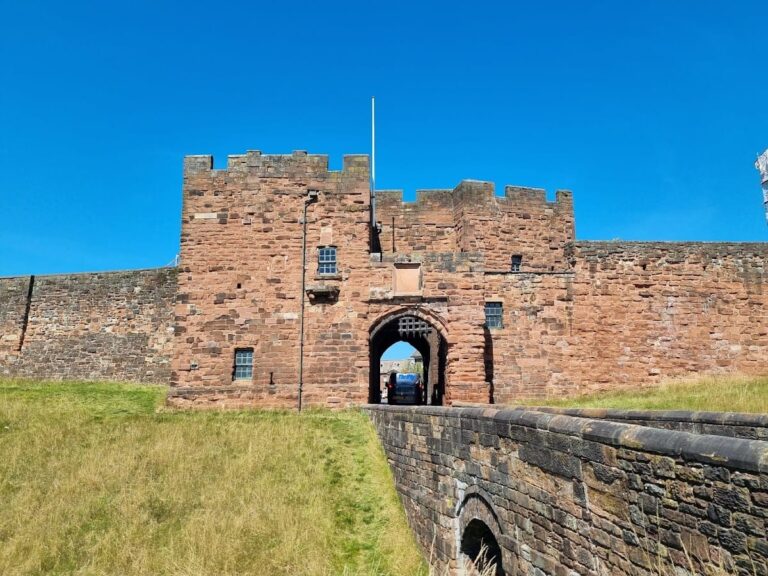
The great hall and gateway were also remodeled during the late fifteenth-century rebuilding. The gateway was accompanied by a polygonal barbican, which projected beyond the entrance as an additional fortified structure. Together with the curtain walls, these buildings expressed the defensive organization of the medieval castle while later alterations adapted the complex for domestic use.
Later ranges and country-house fabric
South range
The south range was rebuilt by Sir Edward Musgrave in 1596. It forms part of the later architectural phase that modified the medieval castle before the Civil War and its subsequent restorations.
Restored complex
The castle’s present form brings together the remains of the medieval fortification, the late-fifteenth-century remodeled buildings, the sixteenth-century south range, and later restored country-house fabric. Its stone walls, defensive enclosures, and altered residential spaces preserve the successive changes made to the property after its foundation.
Nearby sites