Santuario di Fonte Colombo: Franciscan Sanctuary-Convent in Italy


Site at a Glance
- Rating
- 4.8
- Popularity
- Medium
- Country
- Italy
- Primary era
- Medieval
- External website
- Open
- Eras represented
- Medieval, Early Modern, Modern
- Civilizations
- Papal States
- Site type
- Religious
- Remains
- Monastery
On this page16 sections
History
Santuario di Fonte Colombo is a Franciscan sanctuary-convent in Italy, near Rieti, where Francis of Assisi composed the definitive Franciscan Rule between late 1222 and early 1223. Set in the medieval landscape of the Rieti Valley, it is one of four sanctuary-monasteries associated with the Way of Francis, together with Greccio, the Sanctuary of La Foresta, and Poggio Bustone.
Benedictine origins and Franciscan development
The site began as a Benedictine outpost connected with Farfa Abbey. Its name, Fonte Colombo, means “Fountain of the Doves.” Franciscan tradition attributes the name to Francis of Assisi, who is said to have seen white doves drinking from a clear spring in the surrounding woods.
The Franciscan settlement grew near Sant’Elia Reatino, a castrum, or fortified settlement that served as a local social and economic centre. The first convent buildings were modest structures of stone and wood. Francis adapted deteriorating dwellings for use by the friars, and after his death the principal building was enlarged with twelve cells.
The composition of the Franciscan Rule
Between late 1222 and early 1223, Francis spent forty days at Fonte Colombo in prayer and fasting. There he dictated the definitive Franciscan Rule to Brother Leo, in the presence of Brother Bonizio of Bologna, a specialist in canon law. The shorter text became known as the Bullated Rule, the formally approved rule governing the Franciscan Order.
Pope Honorius III, the head of the Roman Catholic Church, gave the Rule definitive approval on 29 November 1223. Franciscan tradition also relates that, after the text had been entrusted to Brother Leo, friars led by Brother Elias took it away to prevent its presentation to the pope. Francis prayed for divine intervention, and a heavenly voice confirmed the Rule, bringing the protest to an end.
Francis at Fonte Colombo
At the end of 1225, about a year before his death, Francis returned to Fonte Colombo in an attempt to treat a serious eye illness. The condition had probably been contracted in Egypt during the Fifth Crusade, the campaign in which western Christian armies sought to recover territory in the eastern Mediterranean. Tradition describes the treatment as involving fire. Francis addressed the fire as “Brother Fire” and asked it to moderate its force, after which the fire is said to have caused him no pain and astonished the physician.
Another Franciscan tradition holds that Francis first received the stigmata at Fonte Colombo. The stigmata are wounds or bodily marks understood in Christian devotion as corresponding to those suffered by Christ at the Crucifixion.
Later Franciscan history
The church was consecrated on 19 July 1450 by Cardinal Nicholas of Cusa, bishop of Trier, and dedicated to Saints Francis and Bernardino of Siena. On 6 January 1519, custody of the convent passed to Bernardino of Asti and Stefano da Molina, who established the Reformed Friars Minor there. This reform branch of the Friars Minor sought a stricter observance of Franciscan ideals.
The sanctuary continued to develop through successive building campaigns. Its church and convent were altered over several centuries, while the surrounding woodland, spring, caves, and chapels preserved the physical setting associated with Franciscan memory. In August 2024, the sanctuary was declared a site of historical and artistic interest following a proposal by the archaeological, fine-arts, and landscape protection authority for metropolitan Rome and the province of Rieti. The declaration was accepted by the Regional Commission for Cultural Heritage of Lazio within the Ministry of Culture.
Remains
The sanctuary lies on a wooded ridge of Monte Rainiero at approximately 549 metres above sea level, near Rieti and Contigliano. An old holm-oak forest surrounds the buildings, and a stream runs below the present monastery. The complex is arranged around a small square. The main church, former dwellings, cloister, and other convent buildings occupy the upper area, while a descending path leads to the Hermitage of Saint Francis, the church of the Blessed Virgin or Magdalene, the Oratory of Saint Michael, and the Sacro Speco, the natural cave associated with the composition of the Rule.
Upper convent complex
Main church
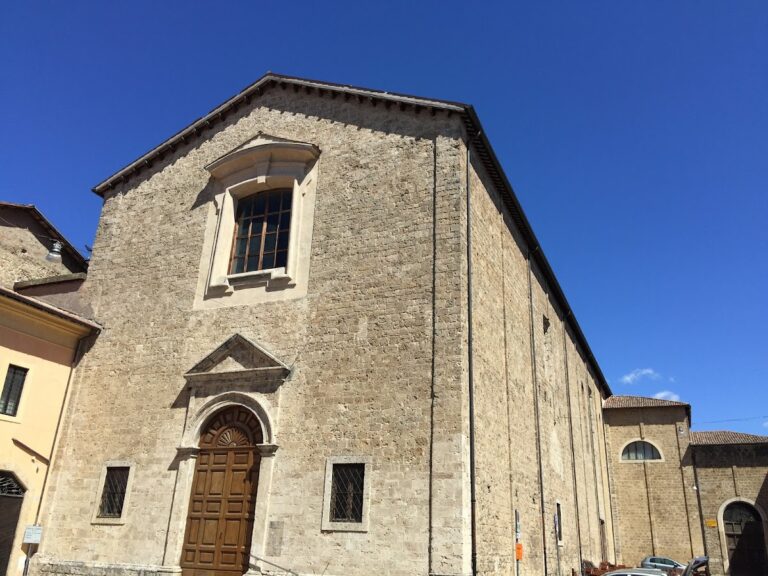
The main church is architecturally simple despite repeated alterations. It has a single nave beneath a timber trussed roof and a seventeenth-century wooden choir. The choir was lengthened in 1644, windows were later opened in the presbytery, and an additional room was added to the sacristy in 1712. The windows and rose window were modified during the twentieth century, while the portico was rebuilt in work completed in 1940.
Two seventeenth-century wooden sculptures stand along the right wall. One represents the Crucifixion, with Francis kneeling at Christ’s feet. The other is a high relief depicting the miraculous confirmation of the Rule by the Lord. The portal lunette contains a painting of the Madonna and Child with Saint Francis and Saint Louis of Toulouse.
The stained-glass windows were designed by Duilio Cambellotti and donated to the Franciscans in 1925 by the opera singer Mattia Battistini. Their subjects include Francis receiving the sanctuary site, giving his cloak to a woman from Posta, receiving a vision concerning the composition of the Rule, undergoing his eye operation, and encountering birds. The window above the portal depicts the Nativity events at Greccio.
Convent buildings and cloister
A cloister stands to the right of the church and is enclosed by convent buildings. The fifteenth-century structure called the Conventino contained the dormitory, refectory, and kitchen. A cloth-making workshop was attached to the convent during the same century for producing the friars’ habits.
The older farmhouse attached to the convent preserves the outline of an early domestic arrangement. Service areas occupied the lower floor, while the upper floor held two cells, the refectory, and the kitchen. The section known as the Fortilizio dates from the sixteenth century and contains eight rooms. The present guesthouse and the dormitory above it were built in the 1680s.
Way of the Cross
A gate in front of the convent begins a path marked by words from Exodus: “Remove your sandals from your feet, for the ground where you stand is holy.” Along the route are fourteen majolica stations of the Via Crucis, or Stations of the Cross, a devotional sequence commemorating episodes of Christ’s Passion. The stations were made by a Neapolitan school and date to 1745.
Lower sacred places
Hermitage of Saint Francis
The Hermitage of Saint Francis is associated with the eye operation that Francis underwent at Fonte Colombo. Rediscovered in 1947, it has remained substantially unchanged apart from two modifications dating to the fifteenth and eighteenth centuries.
Church of the Blessed Virgin or Magdalene
The church of the Blessed Virgin, also called the Magdalene, is attributed architecturally to the first half of the thirteenth century. Its early features include a pointed apse arch resting on square corbels and frescoes in the apse basin. The original gabled facade was altered in the late thirteenth century. A bell hangs above the resulting horizontal upper section, and tradition says that Francis used it to call the friars to prayer.
The small apse contains a poorly preserved fresco of Christ enthroned, with the Virgin and Child on the right and an almost illegible figure on the left. Two fourteenth- or fifteenth-century frescoes on the right wall depict a female saint, possibly Saint Cunegunda, and Saint Mary Magdalene. The opposite wall contains a seventeenth-century fresco of Saint Clare. Restoration in 1921 revealed a red Tau in a small window. The Tau is a T-shaped cross especially associated with Franciscan devotion, and popular legend attributes the drawing to Francis himself.
Oratory of Saint Michael and the Sacro Speco
The Oratory of Saint Michael forms an intermediate space between a cave and a chapel and incorporates the Sacro Speco. The cave is a long, narrow fissure in the rock resembling a tomb, with a simple wooden cross commemorating Francis’s presence. Francis is believed to have composed the Rule there during the period called the Lent of Saint Michael, which explains the oratory’s name.
Popular tradition attributes the fissure’s formation to the earthquake said to have accompanied Christ’s death. An inscription above the chapel door records Pope Sixtus IV’s visit in 1476. The altar contains an eighteenth-century copper depiction of Francis receiving the Rule from the Lord, attributed to the friar Emanuele da Como.
Cave of Brother Leo
The Cave of Brother Leo lies beyond the Oratory of Saint Michael. Tradition says that when the Lord appeared to Francis to give him the Rule, Brother Leo raised his head and left the imprint of his skull on the rock. This story gives the cave its name and connects it with the sanctuary’s central Franciscan tradition.
Holm oak and woodland chapels
A fenced tree stump marks the holm oak traditionally associated with the apparition of the Lord to Francis. Heavy snowfall caused the tree to collapse in the winter of 1622. In 1645, Giovanni da Pisa used its wood to carve the apparition scene now kept in the main convent church.
A path through the woodland leads to the Fonte delle Colombe, the clear spring that gives the sanctuary its name. It passes three chapels: one dedicated to Christ’s Ascension, one to Saint Anthony of Padua, and the Chapel of the Little Rule near the spring. The Ascension and Saint Anthony chapels were built in the eighteenth century and contain terracotta panels showing episodes from Francis’s life in the Rieti area. The Chapel of the Little Rule dates from the seventeenth century and contains six terracotta panels.
Nearby sites