Serbian Kovin Monastery: An Eastern Orthodox Monastery in Ráckeve, Hungary


Site at a Glance
- Rating
- 4.8
- Popularity
- Low
- Country
- Hungary
- Primary era
- Medieval
- External website
- Open
- Eras represented
- Medieval, Early Modern
- Civilizations
- Hungarian, Serbian
- Site type
- Religious
- Remains
- Monastery
On this page10 sections
History
Serbian Kovin Monastery in Ráckeve, Hungary, is an Eastern Orthodox monastery dedicated to the Dormition of the Mother of God, the feast commemorating the death and glorification of the Virgin Mary. It belongs to the Eparchy of Buda, the diocesan jurisdiction of the Serbian Orthodox Church serving Serbian communities in and around Hungary. The monastery is described as Hungary’s oldest male monastery and is one of the two monasteries in the eparchy.
Traditional Twelfth-Century Origins
A preserved tradition places the monastery’s origins in the first half of the twelfth century and names Queen Helena as its founder. Helena was the daughter of the Serbian grand prince Uroš I and the wife of Bela II the Blind, the Hungarian ruler. She governed Hungary during the minority of their son Geza II, whose reign lasted from 1141 to 1161. This tradition connects the monastery with the close dynastic and religious ties between the Serbian and Hungarian ruling houses of the period.
The Kovin Refugees and the 1440 Grant
The monastery’s later history was shaped by the Ottoman conquest of Serbian territory. After the Turks besieged and first captured Smederevo Fortress in 1439, they crossed the Danube twice and devastated Kovin and nearby settlements. Refugees fled into Hungary and reached Csepel Island.
On 10 October 1440, King Vladislav granted the refugees an Early Gothic church, a medieval style marked here by pointed and vertically organized construction, together with chapels and a bell tower. The grant probably also included a corresponding part of the royal landholdings. The settlement that developed there became known as Upper or Serbian Kovin. Its church was dedicated to the Dormition of the Mother of God, while the chapels were dedicated to Saint John the Baptist and Saints Cosmas and Damian.
Monastic Life and Abolition
The parish church may have become a monastery around the middle of the sixteenth century. A Turkish census from 1546 listed three monks and one priest in Serbian Kovin, indicating that a monastic community may already have been living beside the church. The monastery’s existence on Csepel Island is securely established by 1680.
In 1777, during Maria Theresa’s reduction of monasteries, Serbian Kovin was abolished. Its small brotherhood, probably led by Archimandrite Josif Stanojević, moved to Grabovac Monastery, and the church continued as a parish church.
Restoration of Monastic Status
After more than two centuries, Serbian Kovin regained monastic status on 26 September 2003, when Abbot Andrej Pandurović of Hilandar Monastery settled there. He became an archimandrite in 2019 and died on 19 September 2023. He was buried in Novi Sad. The current abbot is Archimandrite Metodije Marković.
Remains
Early Gothic Church
The main church is a substantial rectangular, single-nave Early Gothic building constructed at the end of the thirteenth century. It measures about 10 by 25 metres and provided approximately 175 square metres of usable floor area. Hewn-stone walls around 90 centimetres thick contain two portals and nine two-part windows, while 16 supporting buttresses reinforce the structure.
When the church and chapels were granted to the Serbian refugees in 1440, the Gothic building was adapted for Orthodox worship with only minor changes. The eastern bay, which ends on three sides, was partitioned to form an altar area of suitable size. The church’s interior later received extensive painted decoration, while its present iconostasis, the screen of icons separating the nave from the altar, dates from 1770.
Iconostasis and Sacred Images
The original iconostasis was probably a low screen carrying a small group of icons brought from Kovin in Banat. Four throne icons were painted in 1746 by unidentified Russian or Ukrainian masters. The remaining icons, including those placed unusually below the throne icons, were made by artists from Moshopolis.
The iconostasis is arranged in horizontal zones. Its lowest level is an unpainted parapet. Above it are the Royal Doors, the central doors of an Orthodox iconostasis, decorated with 14 medallions of prophets. Side doors carry icons above their openings, and the throne icons have elongated medallions at their bases. The fourth zone contains a cross with the Crucifixion, two accompanying icons, and apostles set within carved frames.
A miraculous icon of the Mother of God was located above the northern choir area by the middle of the nineteenth century. Jovan Kiriak, a resident of Kozani in Thessaly, commissioned the icon in 1760.
Detached Bell Towers
An originally separate stone bell tower stood on the east side of the church. Its ground and first-floor levels survive. The tower measures approximately 7.40 by 7.20 metres, with walls about 2.50 metres thick and foundations reaching roughly two metres below ground. Including its narrow pyramidal cap, its original height was estimated at about 50 metres.
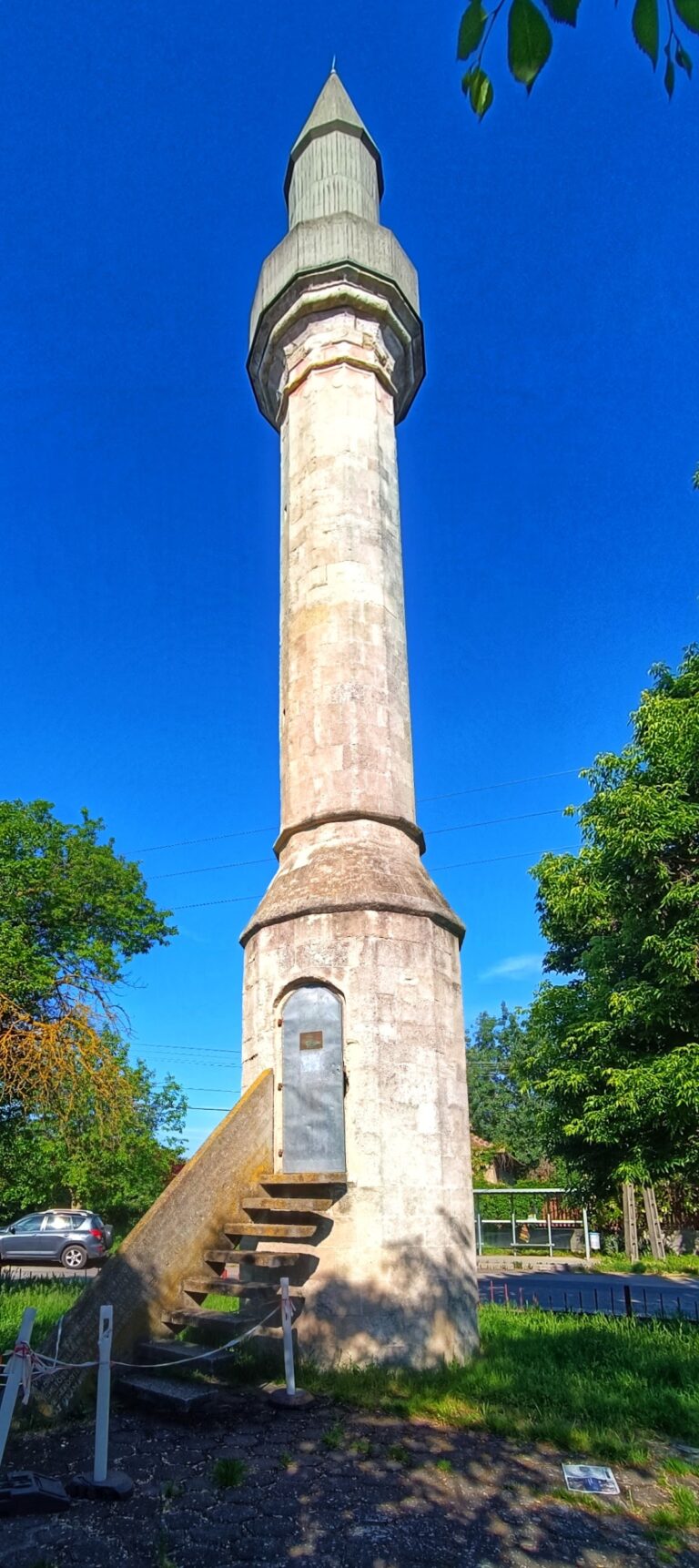
A later Baroque tower, built in 1756 on the foundations of an earlier tower that had probably collapsed, has a ground floor and three upper floors. Its timber decorative cap is covered with copper sheeting. The masonry section rises 26.10 metres, while the cap, apple-shaped finial, and cross add 14.30 metres, giving the tower a total height of 40.40 metres. Its complete separation from the church places it within a rare group of detached towers in Serbian Baroque architecture.
Frescoes and Painted Chapels
A bronze plaque set into the southern wall of the narthex, the entrance hall of the church, records three campaigns of wall painting. The earliest, dated 1320, survives only as a recorded phase, while a fragment from 1514 showing the Virgin and Child remains visible where later plaster has fallen away. The third campaign dates from 1765. An inscription above the southern door leading to the chapel of Saint John the Baptist also records three painting campaigns, and the side chapels were painted in 1771.
Artists led by Teodor Simeonov of Moshopolis painted the Church of the Dormition and its two chapels. Contracts between the master and the commissioners survive. The painters fitted traditional Byzantine and Serbian religious imagery to the church’s Gothic divisions and surfaces.
Frescoes cover the main church and chapels from the floors to the tops of the Gothic vaults, including the spaces between the interlaced supports. Their subjects include saints, Serbian rulers and saints, Evangelists, Apostles, martyrs, angels, and archangels. Life-size images of Serbian rulers extend along the lower wall sections, from Nemanja through Emperor Uroš and Prince Lazar.
A 1765 fresco on the southern wall, within the door jamb of the passage between the chapel of Saint John the Baptist and the main church, shows Joachim and Anna praying to the Virgin. Its arrangement resembles a Deisis, an intercessory composition normally centered on Christ with the Virgin Mary and Saint John the Baptist. Here, however, the Virgin and her parents are the principal figures, making the subject an unusual example within Serbian painting.
Nearby sites