Santa Toscana, Verona: A Roman Catholic Church with Hospitaller Origins
Site at a Glance
- Popularity
- Low
- Country
- Italy
- Primary era
- Medieval
- Eras represented
- Medieval, Early Modern, Modern
- Civilizations
- Holy Roman Empire, Italian, Venetian
- Site type
- Religious
- Remains
- Church
On this page10 sections
History
Santa Toscana is a Roman Catholic church in Verona, Italy, established around the middle of the 11th century in the Romanesque period. It stood beside a hospital near the medieval Holy Sepulchre Gate, named for the traditional Christian burial place of Jesus. The church served the cemetery of nearby San Nazaro, a monastery whose monks followed the Rule of Saint Benedict, and the Knights Hospitaller of St John of Jerusalem managed the hospital.
Foundation and Hospitaller administration
In 1178, the abbot of San Nazaro leased the church to the Hospitallers, a Catholic religious order associated with caring for pilgrims and the sick. The order’s later form, the Sovereign Military Order of Malta, administered the church until religious institutions were suppressed under Napoleon. Santa Toscana, venerated as a local saint of Verona, spent many years at the hospital. On 29 September 1344, her remains were transferred to the church and placed in a red-marble reliquary.
Expansion and a new dedication
Between the late 14th and early 15th centuries, the church was enlarged with a north aisle and a chapel for Santa Toscana. Its consecration in 1489 marked a change in dedication from the Holy Sepulchre to the saint. On 17 June 1713, Giovanni Francesco Barbarigo, bishop of Verona, consecrated the church again after a violent incident involving soldiers inside it.
Suppression and later restoration
A decree under Napoleon suppressed the church on 25 April 1806. On 6 December, it became a dependent rectory, meaning it was administered under the church of Saints Nazaro and Celso, and reopened to the public. During the Second World War, an aerial bomb exploded in the central nave and damaged the building. Restoration work followed in the immediate postwar years. In 1964, the Order of Malta renovated Santa Toscana’s chapel and moved the reliquary to the center of the space.
Remains
The church has a long main nave, a smaller aisle on its left, several chapels, and a raised presbytery at the far end. Its Romanesque exterior and varied interior roof forms preserve the outlines of this arrangement.
Facade and bell tower
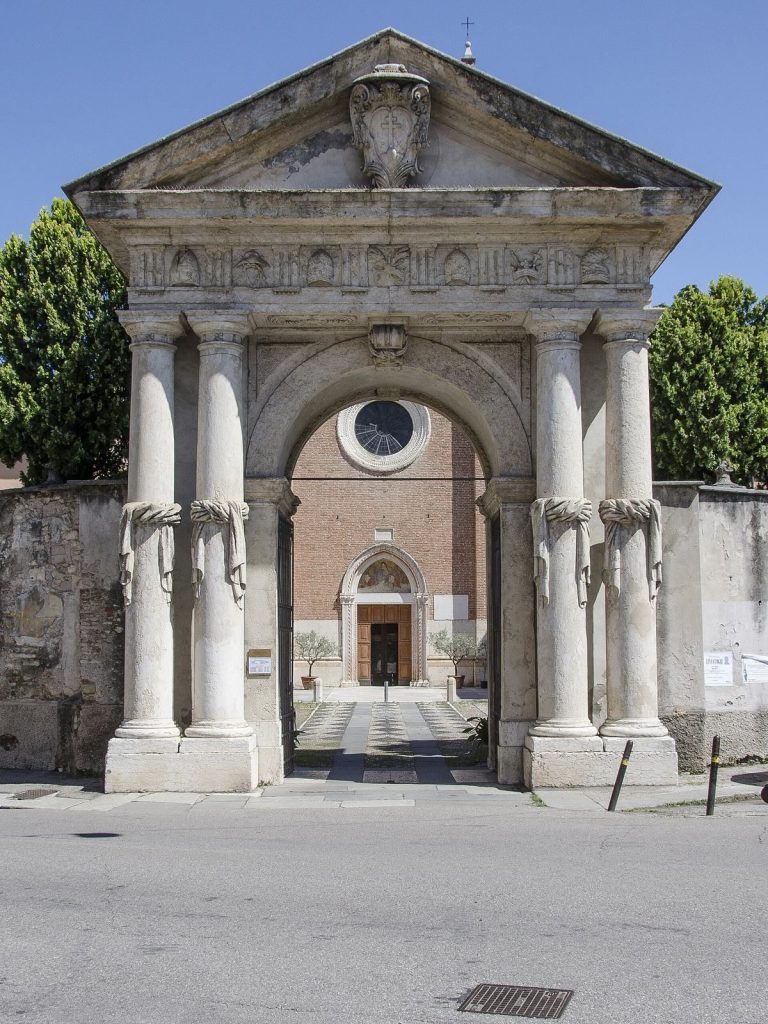
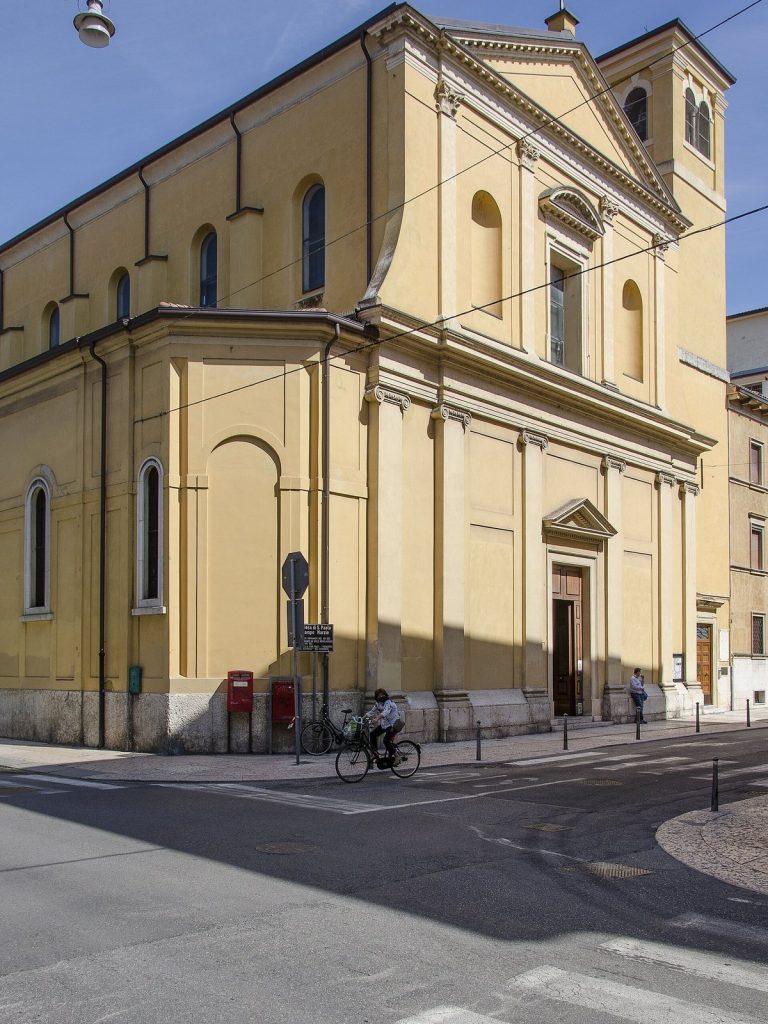
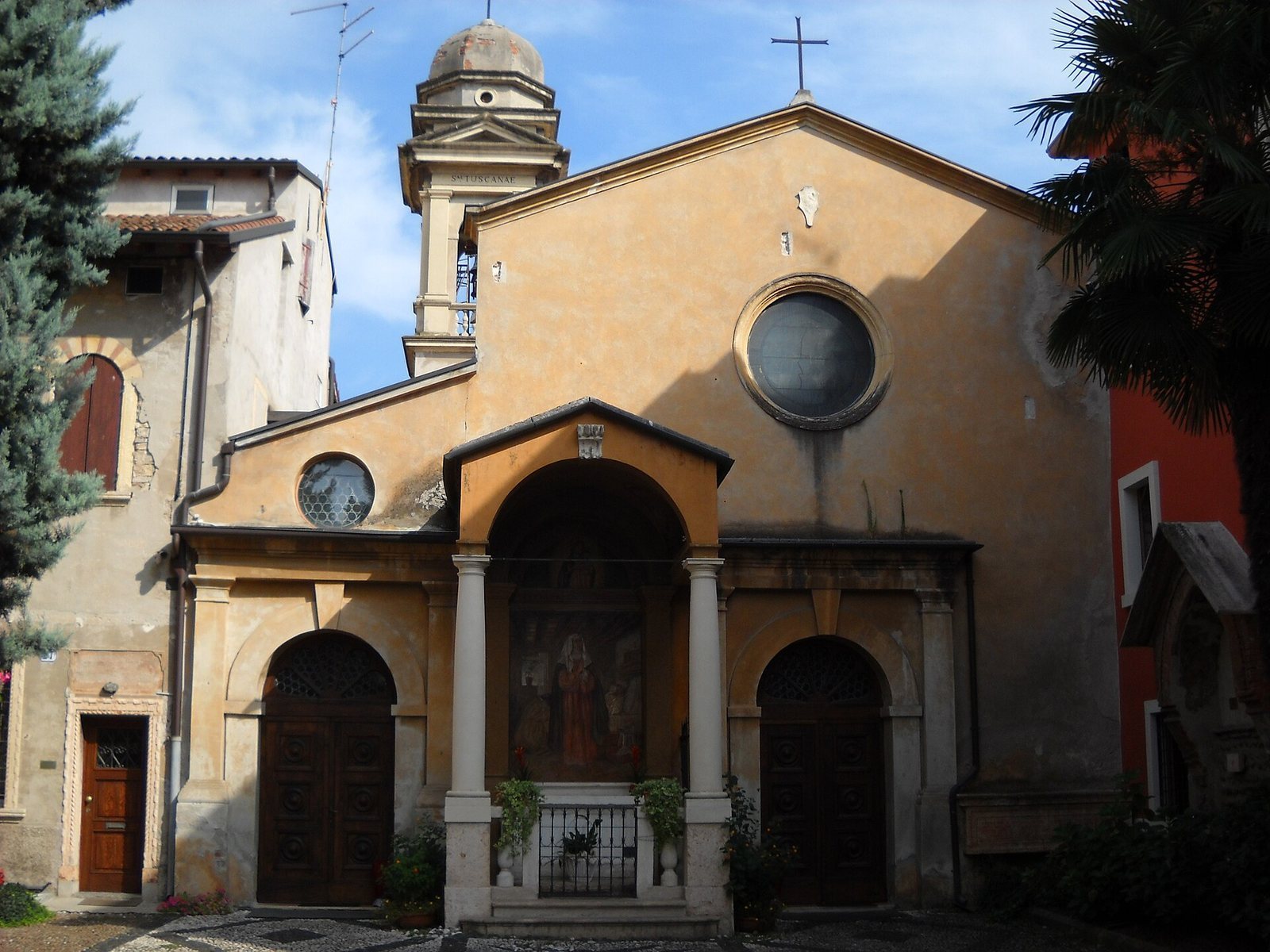
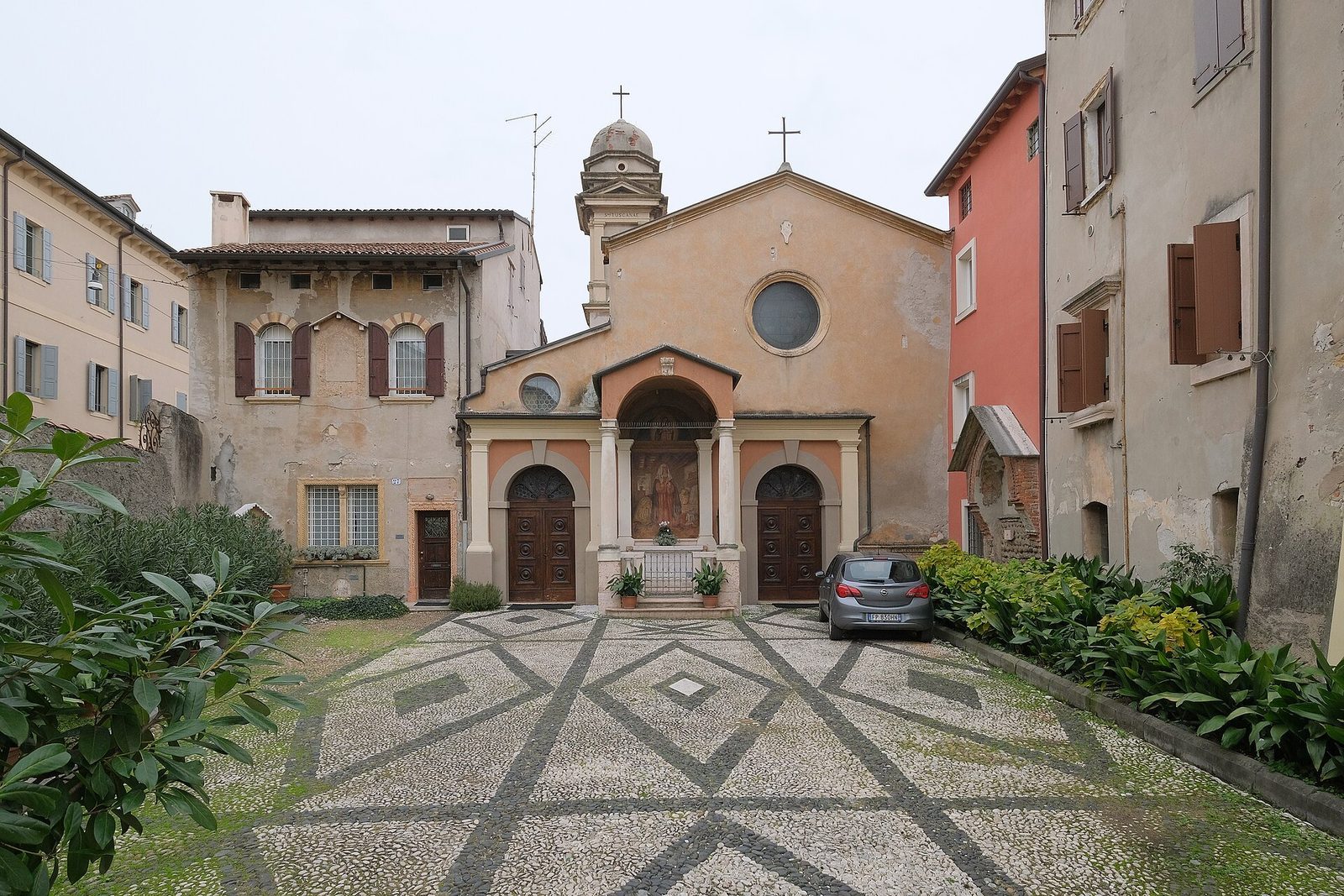
The west-facing facade is asymmetrical. Its central round-arched doorway has two pilasters, flat attached columns, supporting a plain horizontal entablature. A second doorway to the left, aligned with the side aisle, repeats the design. Between them, a niche holds a fresco of Santa Toscana, painted on wet plaster, while a small circular window lights the nave. A square-plan bell tower is attached to the north side of the presbytery. Its bell chamber resembles a small temple and carries a dome on an eight-sided supporting base.
Interior arrangement and artworks
Nave and presbytery
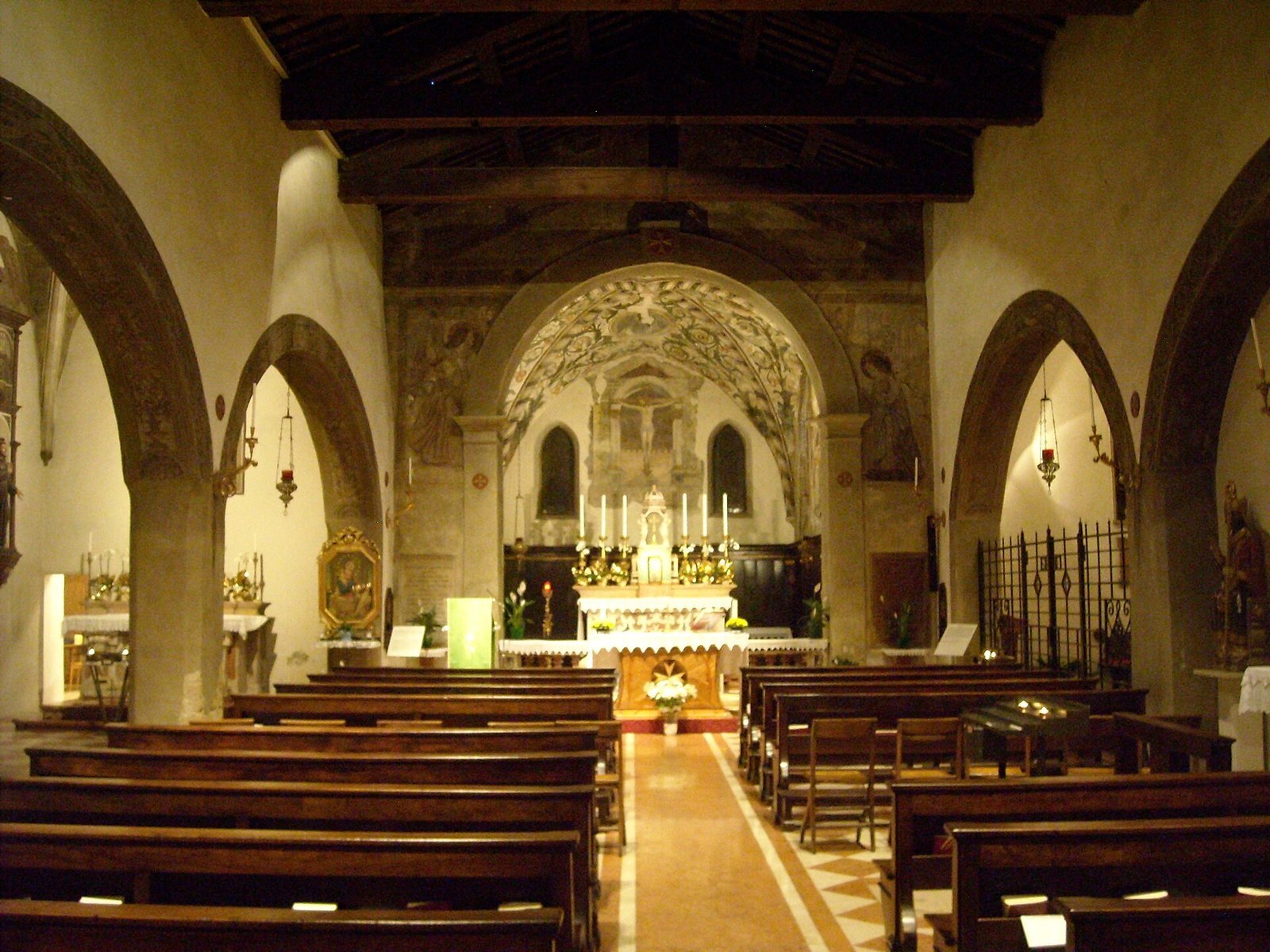
The main nave has three segmental arches along each side, arches with a flatter curve than a semicircle. An exposed timber-truss roof, a supporting framework of beams, covers the nave. At its far end, the presbytery, the area around the main altar, stands one step higher and is enclosed by a balustrade. The smaller chapels and presbytery have intersecting-barrel-vault ceilings, known as groin vaults, decorated with 15th-century frescoes.
Side aisle and chapels
The narrow aisle on the left ends at the Chapel of the Crucifix. Across the church is the Chapel of Santa Toscana. A Chapel of the Holy Sepulchre opens from the left aisle near its center and contains a 16th-century sculptural group showing the Lamentation over the dead Christ.
Paintings and sacred furnishings
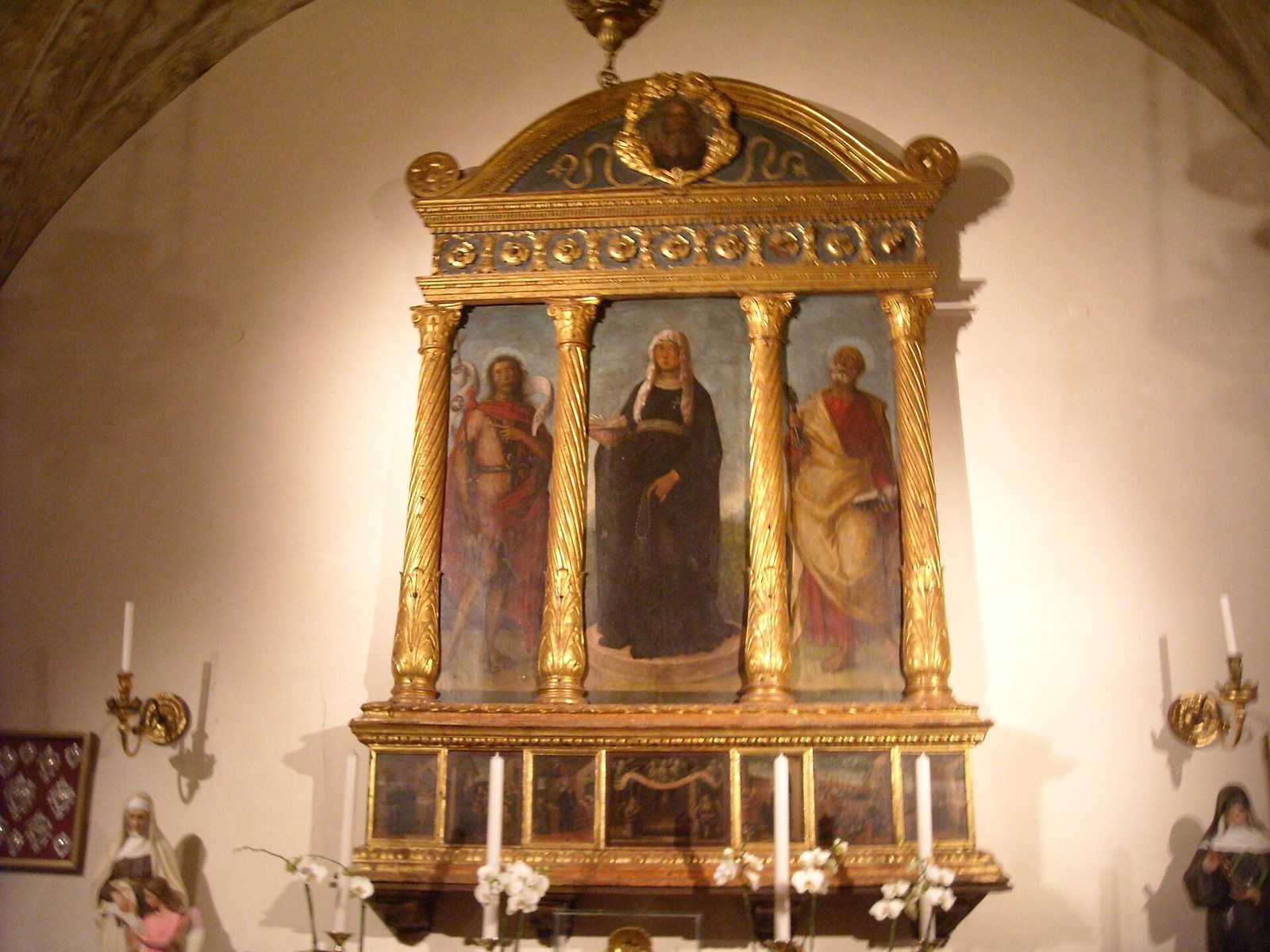
A fresco of the Annunciation, the angel Gabriel’s announcement to Mary that she would bear Jesus, and God the Father spans the arch leading to the presbytery. Giuseppe Zancolli painted it in 1932. An early-16th-century Crucifixion occupies the presbytery’s rear wall; another, showing the Virgin Mary and Mary Magdalene, is at the end of the left aisle. Above Santa Toscana’s reliquary is an early-16th-century three-panel painting by Liberale da Verona, depicting the saint between John the Baptist and Peter. Her remains are held in the red-marble container.