Santa Maria delle Grazie: Sanctuary and Minor Basilica in San Giovanni Valdarno


Site at a Glance
- Rating
- 4.7
- Popularity
- Low
- Country
- Italy
- Primary era
- Early Modern
- External website
- Open
- Eras represented
- Medieval, Early Modern, Modern
- Civilizations
- Grand Duchy of Tuscany, Italian, Republic of Florence
- Site type
- Religious
- Remains
- Basilica
On this page8 sections
History
Origins in the Miracle of 1478
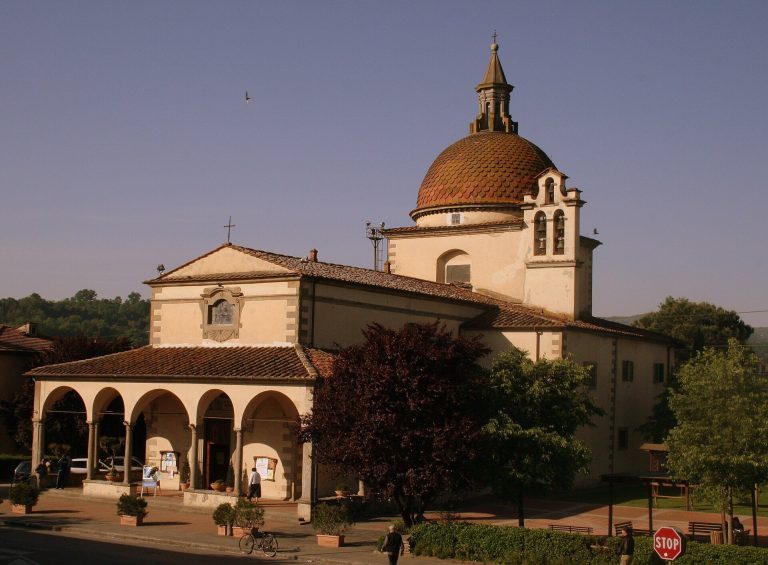
Santa Maria delle Grazie is a Catholic sanctuary and church in Italy, in San Giovanni Valdarno within the Diocese of Fiesole. Its present church was completed in 1523 after construction began with a chapel in 1484, and its interior arrangement follows Renaissance models of Florentine origin. The complex stands above the earlier Church of San Lorenzo and developed around the site of the former San Lorenzo city gate.
The sanctuary began with a traditional miracle during the plague of 1478. The epidemic followed the passage of troops led by Ferdinand I of Naples and Pope Sixtus IV, who were campaigning against Florence and Lorenzo de’ Medici, the leading Florentine statesman and patron of the arts of the late fifteenth century. Monna Tancia, a local woman and grandmother, prayed before an image of the Madonna painted in a tabernacle above the city gate. She asked for help for her three-month-old grandson Lorenzo, whose mother had died of plague. Tradition holds that, despite her advanced age, Monna Tancia was enabled to nurse the child.
The story attracted increasing numbers of worshippers. A wooden tabernacle was installed to protect the image, and a platform above the road through the gate allowed the faithful to approach it. These arrangements soon proved too small for the growing devotion, leading to the construction of a chapel in 1484. When the chapel also became inadequate, a full church was built and completed in 1523.
Sixteenth-Century Expansion and Reconstruction
Work continued throughout the sixteenth century. The sacristy later known as the Old Sacristy was constructed between 1564 and 1569, while the church continued to acquire new spaces and furnishings. In 1596, a fire destroyed the wooden high altar. Its replacement was reconstructed through the work of Bernardo Buontalenti, Matteo Nigetti, and Giulio Parigi.
The rebuilding after the fire also shaped the presentation of the fourteenth-century fresco of the miraculous Madonna. The image was placed on the high altar at the rear of the church, whose decoration included a Glory of Angels. Payments identify Giulio Parigi as the artist of this work, which is his only known pictorial production.
Baroque Additions and Later Alterations
New altars and furnishings were added during the seventeenth century. The vaults received frescoes between 1698 and 1704, and a new facade was inaugurated in 1704, although that structure did not survive. A large chapel on the south side of the church was built between 1720 and 1725. Its high altar received Giovanni Mannozzi’s Beheading of Saint John the Baptist in 1729, but the chapel was later destroyed during the Second World War.
The eighteenth-century facade was dismantled, and a Neoclassical facade was constructed between 1840 and 1856. The wartime destruction of the southern chapel ultimately led to its replacement by the present large rotunda, built in the late 1950s. In January 1929, Pope Pius XI elevated the church to the status of a minor basilica, a papal distinction recognizing a church’s religious and historical importance without placing it in the separate category of major basilicas associated with Rome.
Remains
Facade, Entrance, and Plan
The complex has an articulated plan shaped by its growth over the former city gate, where the miraculous image was originally located. A loggia forms the base of the nineteenth-century facade. Behind it, an inner atrium contains a double staircase leading to the church. The facade is crowned by a pediment, the triangular upper section of a classical or Neoclassical facade, with contemporary statues of Saint Augustine, Saint John the Baptist, Saint Lawrence, and Saint Francis.
The central doorway is topped by a lunette, a semicircular field above an opening, made by Giovanni della Robbia around 1510 to 1513. It shows the Madonna giving the girdle to the Apostle Saint Thomas, accompanied by Saint John the Baptist and Saint Lawrence. The doorway leads into the former Chapel of the Miracle, preserving the connection between the entrance complex and the devotional story that gave rise to the sanctuary.
Interior Structure and Painted Decoration
The church has three naves, meaning a central longitudinal division flanked by two lateral divisions. Columns support twelve domes across the interior. The architect is not recorded, but the arrangement derives from Renaissance models associated with Florence. The Old Sacristy, a room used to prepare for worship and store liturgical furnishings, belongs to the sixteenth-century expansion of the complex.
Between 1698 and 1704, Vincenzo Ferrati, a pupil of Giuseppe Nicola Nasini, decorated the vaults with painted architectural frameworks and perspective effects. Nasini painted the Mysteries of the Rosary in the arches above the high altar in 1699. The high altar itself, made after the fire of 1596, frames the fourteenth-century fresco of the Madonna delle Grazie beneath the Glory of Angels attributed to Giulio Parigi. On the wall to the left, Luberto da Montevarchi painted the Miracle of Monna Tancia in 1510.
Altars, Chapels, and Works of Art
The church contains a Madonna and Child with Saints John the Baptist and Bernard degli Uberti by an unknown painter, probably a late-sixteenth- or early-seventeenth-century derivation from Andrea del Sarto. A Crucifixion from the late sixteenth or early seventeenth century follows a style between Cigoli and Pagani and may be by Michelangelo Vestrucci. Other paintings include Annibale Niccolai’s signed and dated Apparition of Jesus to Saint Anthony of Padua from 1661 and Jacopo Ciacci’s Transit of Saint Joseph from 1720 to 1725. Ciacci was a pupil of Gabbiani.
A Saint Joseph with the Christ Child by Giovanni Mannozzi, dated 1630, remains in the church. Other furnishings associated with the basilica were transferred to the adjoining museum. They include Mannozzi’s frescoes of the Marriage of the Virgin and the Annunciation, both dated 1621, and Gregorio Pagani’s Saint Lawrence and Saint John the Baptist, formerly positioned beside the high altar. Mannozzi’s Beheading of Saint John the Baptist, given to the basilica in 1729 for the high altar of the eighteenth-century chapel, is also among the works connected with the museum.
A niche contains a Mascioni pipe organ, opus 816, built in 1963. The instrument has 31 stops, controls that select different groups of pipes and tonal colors, distributed across two manuals and a pedalboard operated by the feet. The present large rotunda occupies the place of the chapel built between 1720 and 1725 and destroyed during the Second World War, incorporating the later history of the southern side into the surviving complex.