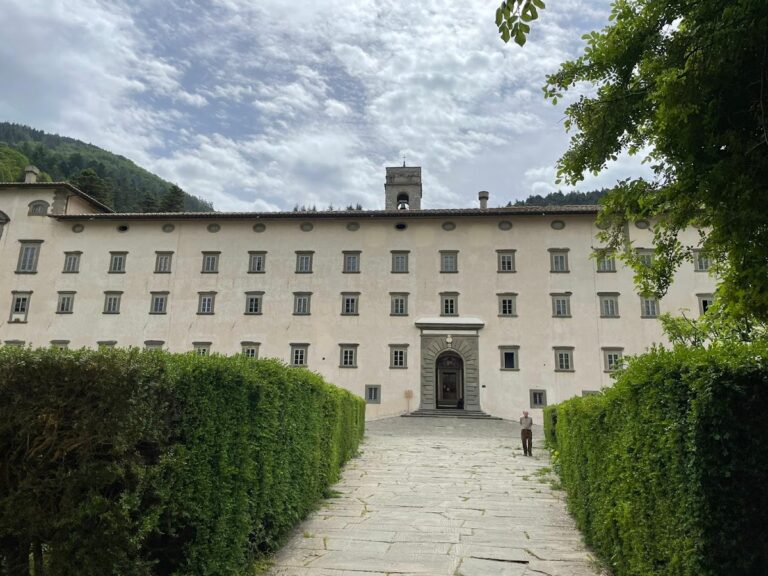
Collegiata di Santa Maria: The Collegiate Church of Figline Valdarno


Site at a Glance
- Rating
- 4.7
- Popularity
- Very Low
- Country
- Italy
- Primary era
- Medieval
- Eras represented
- Medieval, Early Modern, Modern
- Civilizations
- Grand Duchy of Tuscany, Italian, Republic of Florence
- Site type
- Religious
- Remains
- Church
On this page16 sections
History
Collegiata di Santa Maria is the principal Catholic church in Figline Valdarno, Italy, and belongs to the Diocese of Fiesole, following the Roman rite. Built by the Florentines between 1252 and 1257 as a new parish church in the Gothic period, it replaced a parish church that had stood within the town castle since 1175. The castle was destroyed by Florence in 1250, and the new church rose on the site of an earlier place of worship.
Foundation and collegiate status
The church was consecrated in 1257, although its overall completion extended into the nineteenth century. Its early history reflects the reorganization of religious life after the destruction of the castle. In 1493, Pope Alexander VI, the papal name of Rodrigo Borgia, elevated Santa Maria to collegiate status. A collegiate church was administered by a chapter of clergy rather than solely by a parish priest. At Figline, the chapter comprised twelve canons and a provost, who served as its head.
The large altarpiece now near the rear of the nave also preserves evidence of the church’s medieval connections. Its Franciscan saints suggest that it originally came from the nearby church of San Francesco. The work includes Saint Louis of Toulouse, a Franciscan bishop canonized in 1317, and therefore dates from no earlier than that year, probably from the early 1320s.
Seventeenth- and eighteenth-century changes
During the seventeenth century, Santa Maria acquired new side altars, a sacristy, a bell tower, and the adjoining canonry, a residence and institutional building for members of the chapter. The church’s facade also took the gabled form associated with this period. In the following century, the floor and marble balustrade of the presbytery were remade, while the apse was rebuilt in a restrained Baroque style.
The nineteenth century brought further work, including construction of the Chapel of the Blessed Sacrament. The chapel became one of the church’s distinct interior spaces, with a circular plan and a dome carried by ten Corinthian columns.
Restoration and museum formation
A restoration campaign in 1913 established much of the church’s present appearance and removed the seventeenth-century altars. The Gothic-style structure surrounding the Annunciation was reorganized in 1930 and 1931. Postwar restoration also removed two triangular panels that had once been attached to the principal altarpiece.
In 1983, the Museo d’arte sacra opened in three rooms adjoining the church. The museum brought together works transferred from other local religious institutions, including paintings from Sant’Andrea at Ripalta and from the former Confraternity of San Lorenzo at Figline’s Serristori Hospital. This arrangement keeps artworks associated with the area’s religious institutions alongside the church that remains their principal setting.
Remains
Facade and adjoining buildings
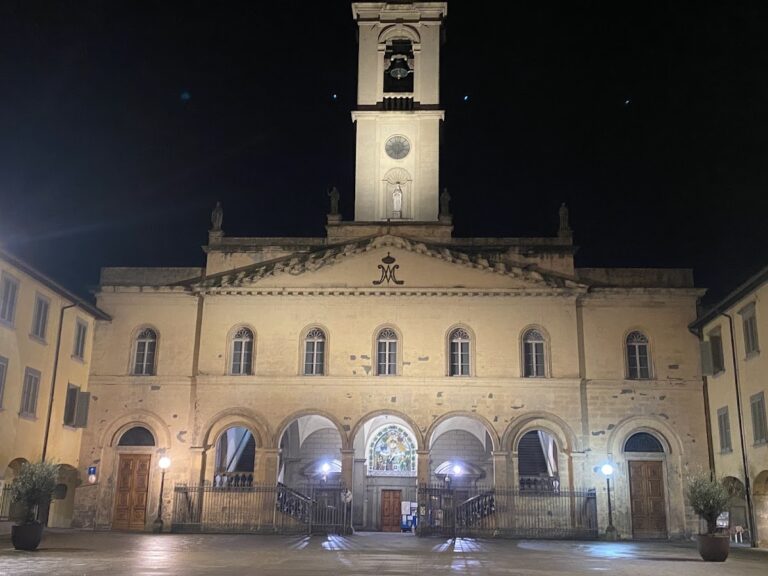
Collegiata di Santa Maria presents a seventeenth-century gabled facade. At its center, a marble portal is crowned by a lunette, the semicircular field above the opening, supported by two Tuscan columns. A relief of the Madonna and Child with two angels fills the lunette. Above the portal is a circular rose window, a window with radiating tracery, and the facade terminates in a simple triangular pediment.
The canonry stands to the right of the facade and faces the square with a double loggia. Its lower level has round arches carried by Tuscan columns, while the upper level uses arches supported by piers. Behind the canonry is the contemporary bell tower, which has a square plan.
Interior architecture
Nave and apse
The interior is arranged as a single nave, the principal lengthwise space of the church. Timber roof trusses of Gothic appearance span the nave and were restored in 1913. Four tall pointed-arch windows, each formed as a single opening, illuminate the left wall. At the eastern end, the apse, the rounded termination of the church, was rebuilt in the eighteenth century in a restrained Baroque manner. It contains a high altar of polychrome marble and a large carved wooden crucifix.
Chapel of the Blessed Sacrament
The nineteenth-century Chapel of the Blessed Sacrament has a circular plan. Its dome rests on ten Corinthian columns, and an ambulatory, or passage around the sanctuary, contains arched windows. A glazed terracotta sculpture in the style of the Della Robbia workshop, depicting Saint Joseph, formerly stood in the chapel and is now preserved in the adjoining museum.
Paintings, sculpture, and liturgical furnishings
Madonna Enthroned with the Child
Near the rear of the nave stands the large painted panel known as Madonna Enthroned with the Child between Saints Louis of Toulouse and Elizabeth of Hungary. It is attributed to the Master of Figline, who may have been Giovanni di Bonino, although that identification remains debated. The painter is generally regarded as being of non-Florentine origin. The work combines artistic models associated with Assisi and Giotto with strong Gothic features, including flowing lines, elaborate detail, and limited attention to spatial depth.
The panel was reframed in the late fifteenth century with two triangular panels showing angels in flight. These additions are now attributed to Bartolomeo di Giovanni and may have been produced when the altarpiece was transferred to Santa Maria after its elevation to collegiate status in 1493. The two panels are preserved in the sacred-art museum.
Annunciation and baptismal font
On the left wall, a Gothic-style aedicule, or small architectural frame resembling a shrine, surrounds a fresco of the Annunciation modeled on the Annunciation in Florence’s church of Santissima Annunziata. Only the Virgin Annunciate is ancient, dating from the first decade of the fifteenth century. The surrounding structure was reorganized in 1930 and 1931.
In front of the Annunciation is a baptismal font dated 1569. Its relief of the Baptism of Christ is accompanied by the coat of arms of the Ardimanni family.
Other paintings
Farther toward the entrance is a fragmentary fresco of the Crucified Christ, made around 1380 to 1390 by a painter working in a Neo-Giottesque tradition, a later revival of Giotto’s artistic language. Nearby is Egisto Sarri’s Death of Saint Joseph, a late work dated 1891.
Saint Romulus panel
A painted panel on the right side of the nave dates from 1539 and is attributed to Giovanni Andrea de Magistris of Caldarola. It shows Saint Romulus presenting a model of Figline. Saint Romulus was traditionally regarded as the first bishop and patron saint of Fiesole, while the panel is especially valuable for its representation of the town itself.
Pipe organ
The apse contains Mascioni pipe organ opus 491, built in 1936. It has electric transmission and thirty-five stops, with two consoles, each fitted with three keyboards and a pedalboard. The original console, with a concave-radial pedalboard, remains in the apse for the choir. An auxiliary console with a straight pedalboard stands on the nave floor near the presbytery balustrade. It is fully electronic, linked by radio to the original console’s electric transmission, and includes digital transposition and storage for 1,000 sets of five free combinations. Its controls do not reproduce the Automatic Pedal function of the original console.
Sacred-art museum
The three rooms adjoining the church preserve works connected with Figline’s religious institutions. Among them are the two angel panels removed from the main altarpiece, Andrea di Giusto’s Adoration of the Magi and Saints, transferred from Sant’Andrea at Ripalta, and Cigoli’s Martyrdom of Saint Lawrence, painted in 1590 for the former Confraternity of San Lorenzo at the Serristori Hospital.