Santa Margherita: The Parish Church of Coreno Ausonio, Italy
Site at a Glance
- Rating
- 4.7
- Popularity
- Very Low
- Country
- Italy
- Primary era
- Early Modern
- Eras represented
- Medieval, Early Modern
- Civilizations
- Kingdom of Naples, Spanish
- Site type
- Religious
- Remains
- Church
On this page21 sections
History
Santa Margherita is the principal Catholic church in Coreno Ausonio, Italy, and the seat of the parish of the same name in the Archdiocese of Gaeta. Dedicated to Saint Margaret of Antioch, a Christian martyr and saint traditionally associated with protection and the overcoming of evil, the church was begun in 1395 and developed into a building with Baroque exterior and interior features.
Origins and parish foundation
At the end of the fourteenth century, the population of Coreno Ausonio depended on the parish of San Michele in Fratte, several kilometres from the settlement. The local community worshipped in a chapel dedicated to Santa Maria dei Vignali, but a larger church was needed within the settlement itself.
Construction of the new church dedicated to Saint Margaret of Antioch began in 1395 and continued until 1445. On 15 March 1445, the parish of Santa Margherita was established, giving the community its own parish church and ending its dependence on the more distant parish arrangement.
Alterations and reconstruction
Santa Margherita was restored and enlarged repeatedly in the centuries that followed. Local families contributed donations to some of these works. A serious fire on 25 May 1687 led to a major restoration campaign, after which the church was consecrated on 11 May 1777.
Further interventions took place in 1890 and in 1936. The latter followed severe structural damage caused by the 1915 Marsica earthquake, an earthquake that affected the wider Marsica area and required repairs to the church.
Bombing during the Second World War almost completely destroyed the building. Santa Margherita was rebuilt after the war and reopened for worship in 1950. The central nave was entirely reconstructed during this rebuilding. A restoration campaign in 2000 reinstated some surviving elements of the medieval church.
Remains
Santa Margherita stands in the historic centre of Coreno Ausonio, in Piazza Umberto I. Its exterior is Baroque, while the interior has a restrained Baroque character with simple stucco decoration. The building is arranged around a central nave flanked by two side aisles, with the facade, bell tower, chapels, apse, and organ forming its principal surviving elements.
Facade and bell tower
Facade
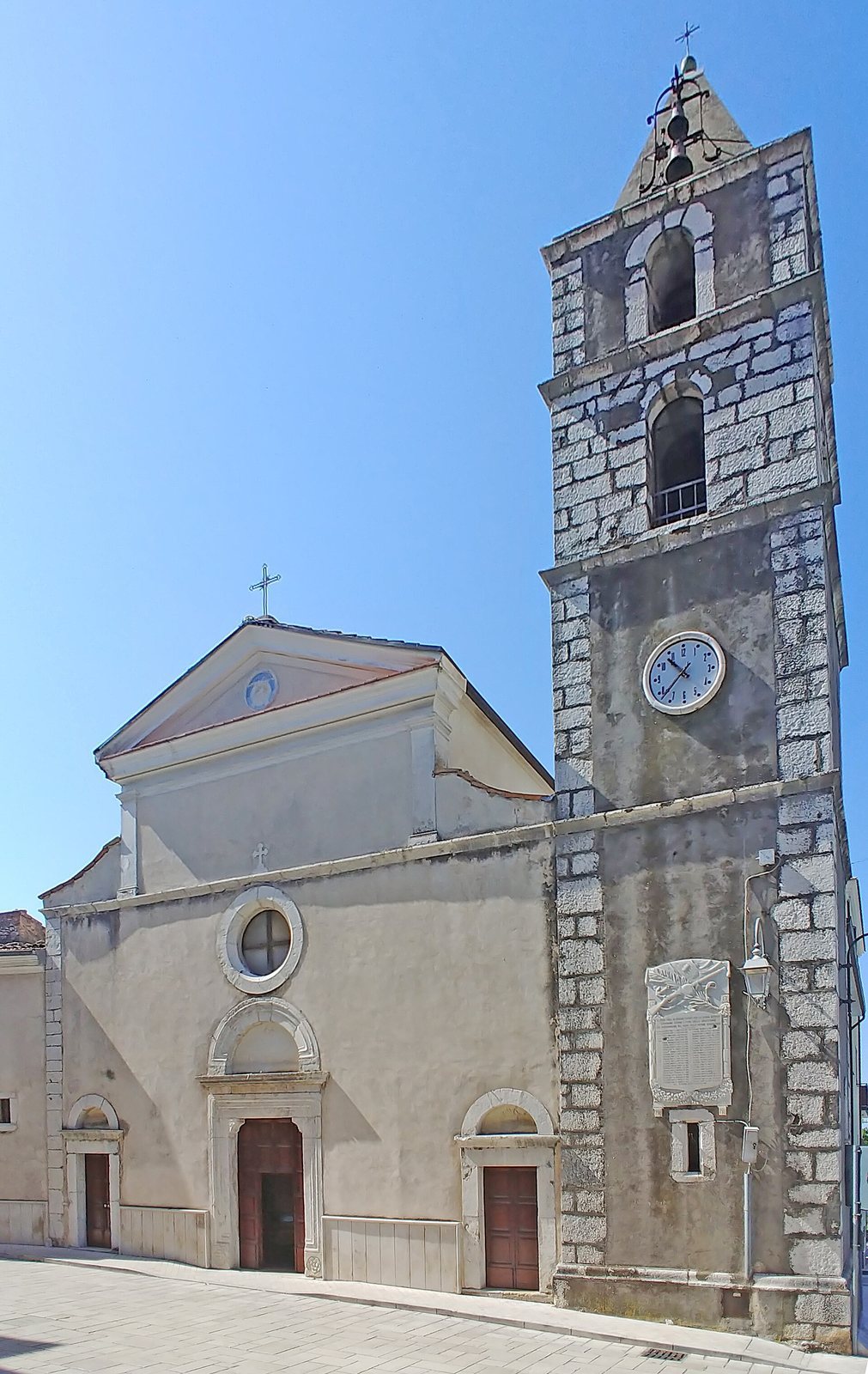
The facade follows the internal arrangement of the church and rises in a stepped profile. Its lower section contains three portals with marble jambs and semicircular lunettes, which are semicircular openings or panels. A circular rose window is placed above the main entrance. The central section ends in a triangular pediment beneath a pronounced cornice.
Bell tower
The square-plan bell tower is constructed from squared stone blocks. Its upper bell chamber has two tiers of round-headed, single-lancet openings and is crowned by a square-based truncated pyramid. Three bells are connected to the public clock.
Nave, apse, and organ
Central nave and apse
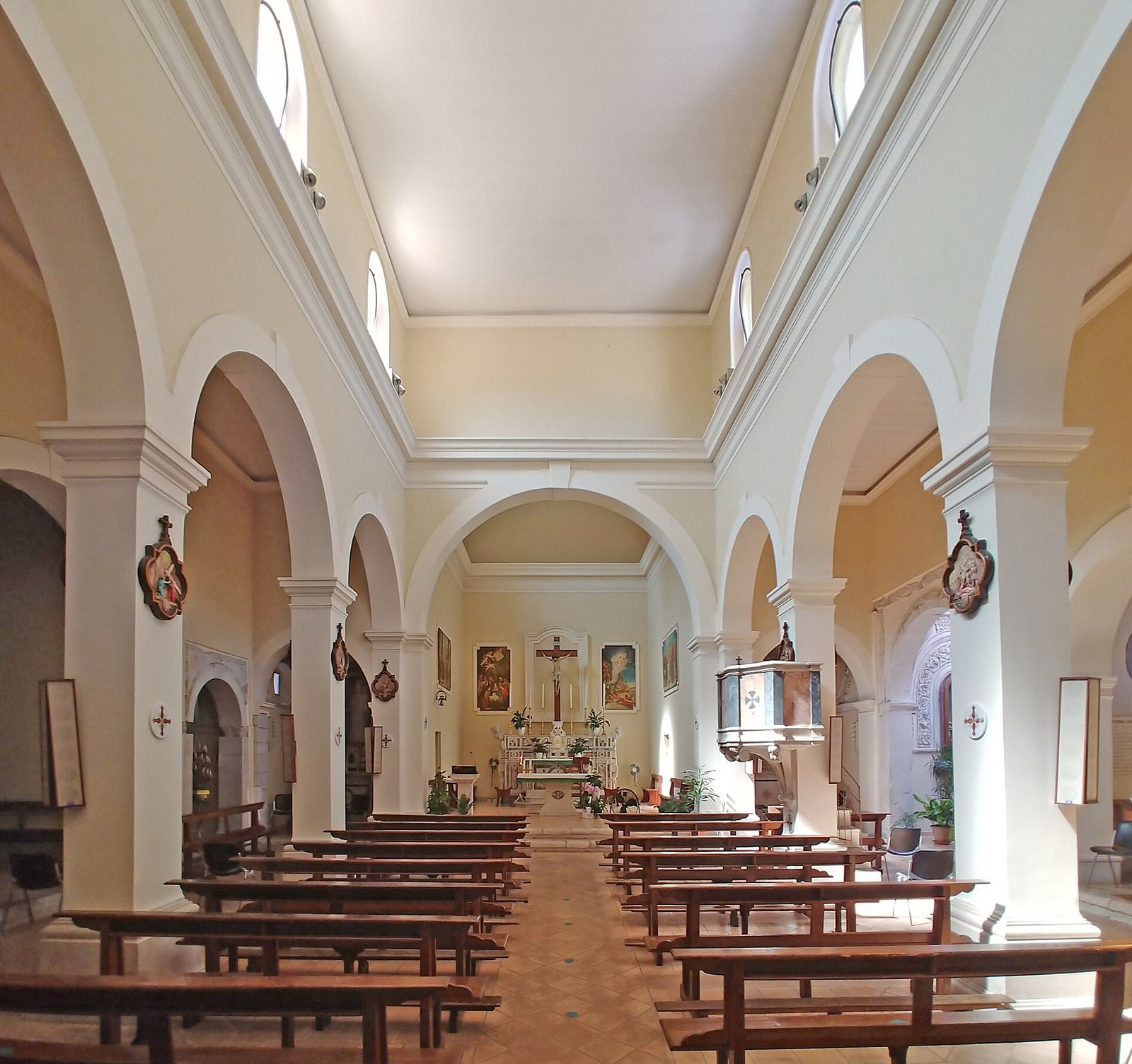
The central nave and the two side aisles are divided by two rows of round-headed arches resting on pillars with square bases. The central nave has a flat ceiling and terminates in a quadrangular apse, the terminal space of the church. The apse contains a Baroque high altar made of polychrome marble and surmounted by a wooden crucifix.
Four modern oil paintings in the apse depict episodes from the history of the Redemption: the Ecce Homo, the Nativity of Jesus, the Resurrection of Jesus, and the Deposition of Jesus.
Pipe organ
The pipe organ stands on the choir loft at the rear of the church. Built by the Pinchi firm in 1962, it has electric transmission with a multiplex system. Its sound-producing apparatus is enclosed in an expressive case with a display of non-speaking principal pipes. The console is positioned on the choir loft against the organ body and has two 61-note keyboards and a concave-radial 32-note pedalboard.
Chapels along the left aisle
Baptistery
The first chapel on the left was formerly dedicated to Saints Christopher and Matthew. It now serves as the baptistery, the place or installation used for baptism.
Chapel of Saint Joseph
The second chapel is dedicated to Saint Joseph. It was built at the end of the seventeenth century by the Confraternity of Saint Joseph, a lay religious association organized around devotional and charitable activities. Its paintings represent the Risen Jesus and the Madonna of the Rosary with the Child Jesus, Saint Dominic, and Saint Catherine of Siena.
Chapel of Saint Margaret
The next chapel is dedicated to Saint Margaret. It contains a polychrome mosaic made in 1990 depicting the Glory of Saint Margaret.
Chapel of Saint Lucy
The fourth chapel on the left is dedicated to Saint Lucy.
Chapel of the Madonna of the Rosary
The chapel at the end of the left aisle is dedicated to the Madonna of the Rosary. Its Baroque ceiling has rich stucco decoration and accompanies a processional wooden statue of the Madonna and Child.
Chapels along the right aisle
Chapel of Our Lady of Lourdes
The first chapel on the right was formerly dedicated to Saint Martin of Tours. It now houses a modern statue of Our Lady of Lourdes and is dedicated to her.
Chapel of Saint Anthony of Padua
The next chapel is dedicated to Saint Anthony of Padua. It contains a polychrome-marble altar and frescoes depicting attributes associated with the saint.
Chapel of Paradise
The third chapel on the right is known as the Chapel of Paradise. It formerly housed a statue of Saint Anthony and now contains a statue of Our Lady of Mount Carmel. Its elaborate stucco and fresco decoration is largely deteriorated. Above the chapel, an octagonal drum originally carried a dome and is now closed by a glazed window.
Chapel of the Blessed Sacrament
At the end of the right aisle is the Chapel of the Blessed Sacrament. It contains a statue of the Sacred Heart of Jesus and has a groin vault decorated with stucco.