Santa Balbina: A Roman Catholic Minor Basilica on Rome’s Aventine Hill


Site at a Glance
- Rating
- 4.5
- Popularity
- Very Low
- Country
- Italy
- Primary era
- Classical
- Eras represented
- Classical, Medieval, Early Modern
- Civilizations
- Roman
- Site type
- Religious
- Remains
- Church
On this page9 sections
History
Santa Balbina is a Roman Catholic titular church and minor basilica in Rome, Italy, on the Aventine Hill, dedicated to Saint Balbina of Rome. Its development began within a large Roman residence and continued through late antique Christian renovation, medieval expansion, and repeated restoration. The church is also a rectoral church of the parish of Santa Sabina and a station church for the second Tuesday of Lent, while its liturgical feast is celebrated on March 31.
From Roman residence to Christian basilica
Before becoming a basilica, the site formed part of the residence of Lucius Fabius Cilo, a wealthy Roman aristocrat of the late second century. Emperor Septimius Severus, who ruled from 193 to 211, gave the residence to Cilo. The complex appears on the Forma Urbis Romae, an ancient marble plan of Rome whose surviving fragments preserve evidence for the city’s buildings and layout. The church also stands above an earlier house dated by its brick stamps to the reign of Emperor Hadrian.
Later tradition places the beginnings of Christian worship in the house of Saint Balbina, although the historical evidence for this legendary Roman martyr is uncertain. The church’s earliest title is likewise unclear. Titulus Tigridae appears in 499 and may refer to an early patron or founder, while Titulus Balbinae is first recorded in 595. Another possibility preserved by tradition is that a woman named Balbina founded the church and was subsequently honoured as its patron saint.
Around 370, Christian use brought major changes to the building. The walls were raised and the interior was reorganized in a form resembling the present church. The basilica was rebuilt during the fifth century and enlarged in the eighth. Tradition also holds that Emperor Constantine bade farewell there to Pope Sylvester I before leaving to establish Constantinople as a major imperial capital.
Medieval development and ecclesiastical role
In the eighth century, Pope Gregory III, who led the Roman church from 731 to 741, consecrated the basilica to Saint Balbina. Her legend places her death around 130 CE. Since late antiquity, Santa Balbina has served as a cardinal-priest titular church, meaning that it is assigned to a cardinal-priest as his symbolic ecclesiastical title.
The adjoining monastery includes fortified buildings and a medieval defensive tower. Its founder and date are unknown, although a foundation in the late sixth century is considered possible. Saint Dorothy became its patron in the nineteenth century. In 1875, the Franciscan priest Simpliciano of the Nativity founded the Franciscan Sisters of the Sacred Heart at the church.
Santa Balbina also preserves connections with the medieval Hungarian church. Stephen Báncsa, the first known Hungarian cardinal, was buried there in 1270. During the thirteenth century, Pál, Bishop of Paphos, established an altar dedicated to Saint Nicholas and made offerings commemorated by a surviving plaque.
Later alterations and restoration
The basilica underwent successive interventions in the early modern period. Work was carried out under Pope Paul II in 1464, followed by restoration in 1489 and further intervention under Cardinal Pompeo Arrigoni in 1600. The church was first associated with the Augustinians and was later placed in the care of secular priests from Naples during the pontificate of Pope Innocent XII, who was pope from 1691 to 1700.
A major restoration took place between 1927 and 1930, within a broader campaign during the 1930s, under Antonio Muñoz. The work sought to recover the basilica’s earlier appearance. It revealed medieval frescoes on the side walls, and an ancient sarcophagus found during the restoration was adapted for use as a baptismal font.
Santa Balbina remained a cardinal-priest titular church into the modern period. Péter Erdő, Archbishop of Esztergom and Primate of Hungary, held the title from 2003 until March 2023. He associated the basilica’s Hungarian connections with his appointment and expressed a special responsibility for the building. As its physical condition deteriorated, he became cardinal-priest of Santa Maria Nuova in March 2023.
Remains
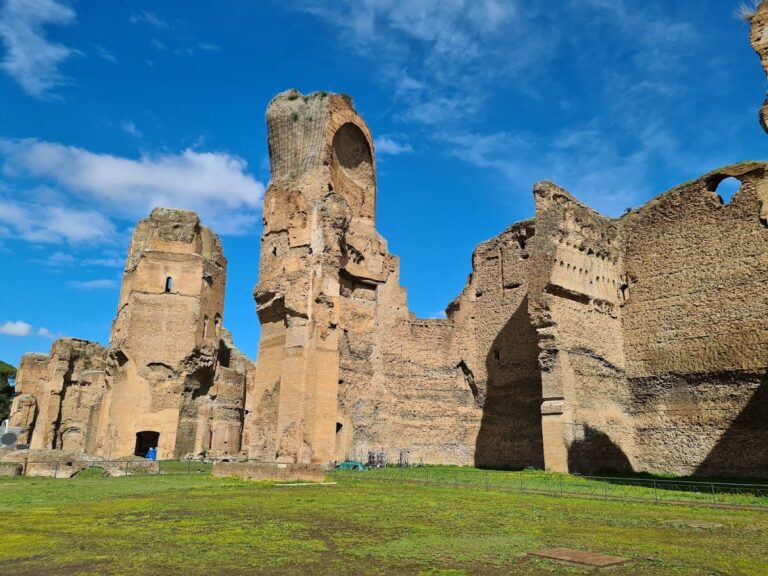
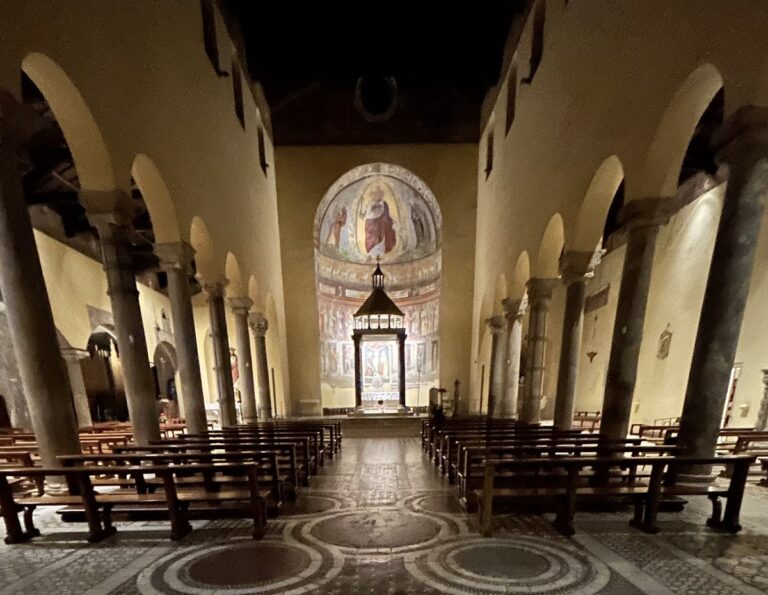
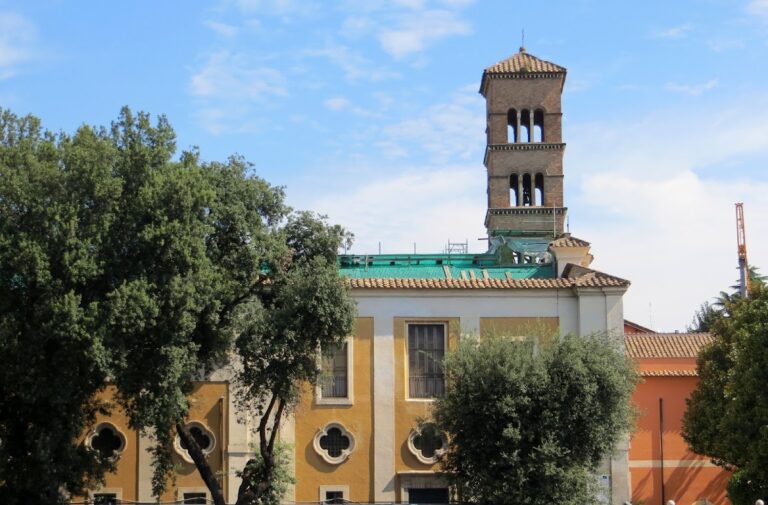
Santa Balbina occupies the area of an ancient Roman residence beside the Baths of Caracalla on the Aventine Hill. The surviving church has a hall-type plan, with niches set into the lateral walls and an apse at the eastern end. A campanile is associated with the basilica. The adjoining monastery forms a related group of fortified structures and includes a medieval defensive tower.
Church interior
Layout and liturgical furnishings
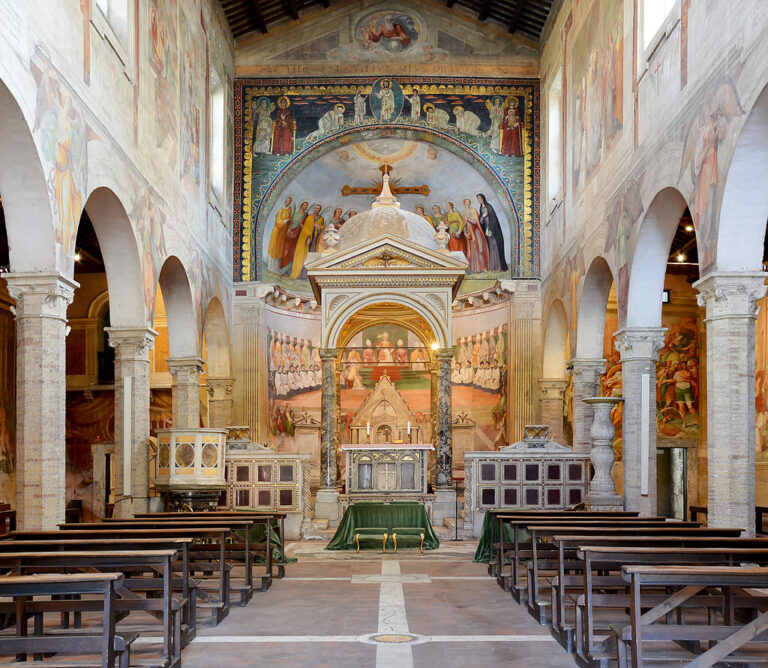
The interior retains the basilica’s hall arrangement and its sequence of wall niches. The main altar dates from 1742 and contains an urn holding relics of Saint Balbina, Saint Felicissimus, and other martyrs. Behind the altar stands a thirteenth-century episcopal chair decorated in the Cosmatesque manner, a medieval Roman technique that uses small pieces of coloured marble and stone to form geometric designs.
Apse and sculptural decoration
The apse contains a Baroque fresco by Anastasio Fontebuoni, painted around the transition from the sixteenth to the seventeenth century. It shows the Redeemer in glory with Saint Balbina, Saint Felicissimus, Saint Quirinus, and a pope. Saint Balbina also appears among martyrs in the apse, while the triumphal arch carries figures of Saints Paul and Peter.
The fourth niche on the right contains a marble relief of the Crucifixion attributed to the Renaissance sculptors Mino da Fiesole and Giovanni Dalmata. Frescoes dating from the ninth to the fourteenth centuries were revealed on the side walls during the twentieth-century restoration.
Monastery and archaeological remains
The monastery beside the church contains fortified buildings and a medieval defensive tower. Within the basilica, the ancient sarcophagus uncovered during the twentieth-century restoration was reused as a baptismal font. A commemorative plaque preserves the memory of Pál, Bishop of Paphos, and his offerings to the church.