Santi Nereo e Achilleo: An Early Christian Titular Church in Rome


Site at a Glance
- Rating
- 4.6
- Popularity
- Low
- Country
- Italy
- Primary era
- Medieval
- External website
- Open
- Eras represented
- Medieval, Early Modern
- Civilizations
- Papal States
- Site type
- Religious
- Remains
- Basilica
On this page22 sections
History
Santi Nereo e Achilleo is a church in Rome, Italy, dedicated to Saints Nereus and Achilleus. Its early Christian predecessor, the Titulus Fasciolae, was built around 369 under Pope Damasus I, while the present three-aisled basilica derives largely from a rebuilding around 814 in the Carolingian Renaissance style, a revival of Roman and early Christian forms during Carolingian rule. The church remains a titular church, meaning that it is assigned to a cardinal priest as the symbolic seat of his title.
The early Christian titular church
The name Titulus Fasciolae was traditionally connected with the story of Saint Peter losing the bandage from his injured foot while escaping the Mamertine Prison. A fourth-century funerary inscription at San Paolo fuori le Mura commemorates Cinnamius Opas, a lector of the church. In 499, the acts of Pope Symmachus’s synod recorded five priests serving the institution.
By 595, the church was known as the Titulus Sanctorum Nerei et Achillei. This change indicates that its dedication to Nereus and Achilleus probably dates from the sixth century. Nereus and Achilleus were imperial soldiers who were martyred for their Christian faith during the reign of Diocletian, probably around 295.
Rebuilding and decline
Pope Leo III rebuilt the old titular church around 814 on the same site, placing it at a higher level. The building gradually declined after the surrounding area became deserted during the thirteenth century. In 1228, Pope Gregory IX ordered the relics of Nereus, Achilleus, and other saints to be transferred to Sant’Adriano on the Roman Forum.
The Catalogue of Turin indicates that around 1320 the titular church no longer had a priest and had apparently been abandoned. Pope Sixtus IV restored it for the Jubilee of 1475, shortening the nave and removing the portico. The restoration altered the medieval building while preserving its role as a place of Christian worship.
Baronio’s restoration
Cardinal Cesare Baronio, an Italian cardinal, church historian, and antiquarian, became cardinal priest of Santi Nereo e Achilleo in 1596. He directed a major restoration connected with the Jubilee of 1600. The work reconnected the church with Rome’s religious life and made it a stopping place for pilgrims visiting the city’s seven pilgrimage churches.
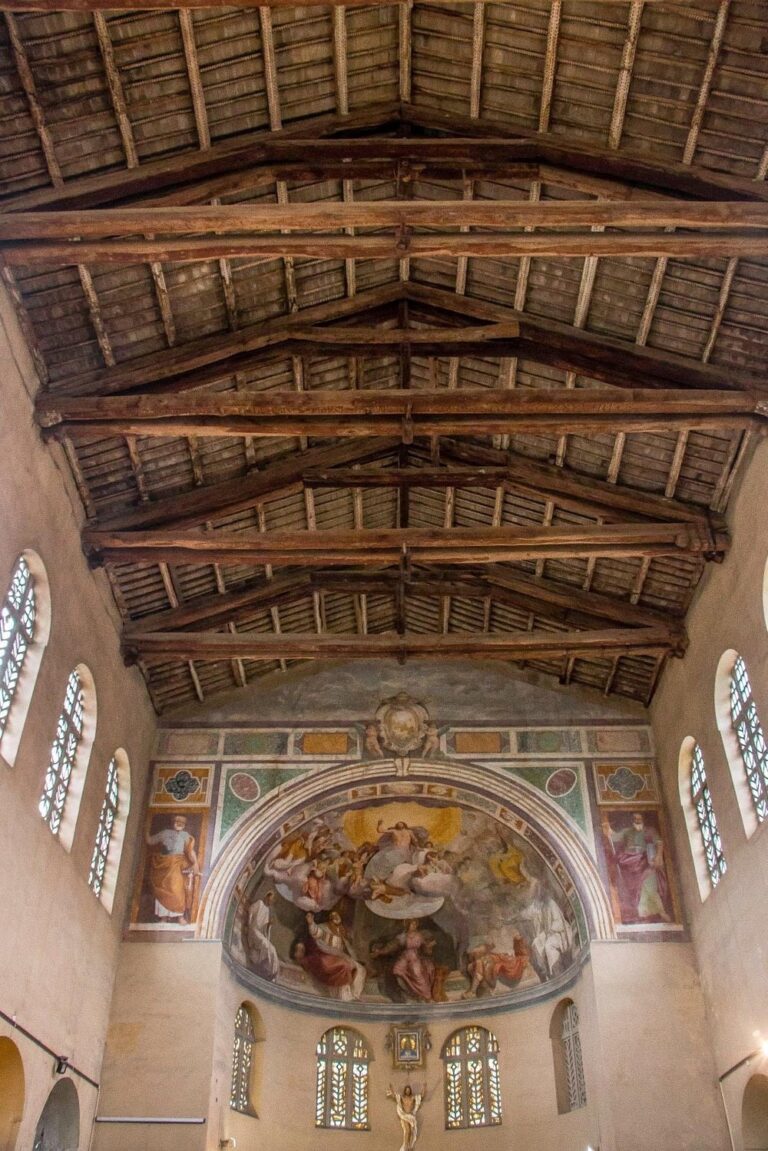
In 1597, Baronio obtained papal permission to bring the relics of Nereus, Achilleus, and other saints back from Sant’Adriano in a solemn procession. The restoration renewed the roof, clerestory windows, campanile, high altar, ciborium, confessio, and episcopal throne. It also preserved surviving mosaic decoration, while a damaged apse mosaic was replaced with a fresco on the same subject.
The church today
Santi Nereo e Achilleo remains a titular church. Since 28 November 2020, its titular cardinal has been Celestino Aós Braco. The church forms a detached part of the parish of Chiesa Nuova rather than the local parish of San Saba and is served by Oratorians, members of the Congregation of the Oratory of Saint Philip Neri, as a satellite of the Roman Oratory.
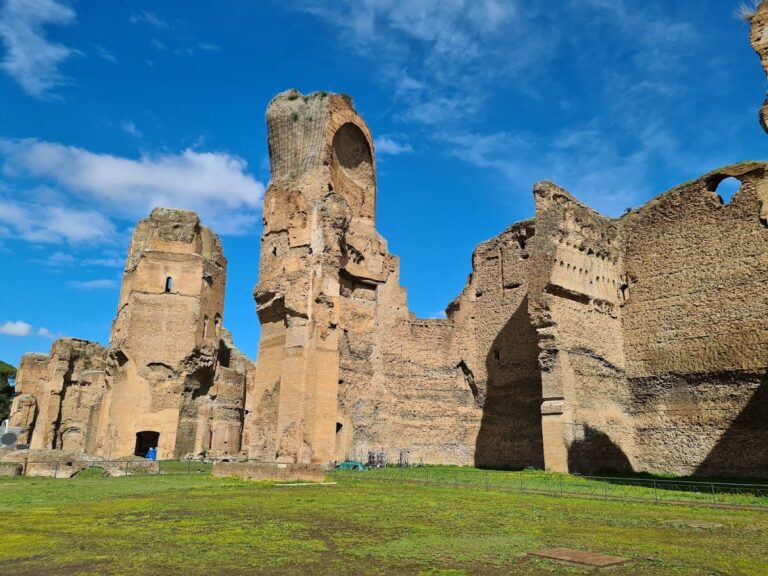
The church stands on Viale delle Terme di Caracalla, approximately 100 metres northwest of the Baths of Caracalla, with its facade facing northwest. It is distinct from the underground basilica dedicated to the same saints in the Catacombs of Domitilla on the Appian Way, rediscovered in the 1870s by the archaeologist Giovanni Battista de Rossi. A major facade restoration in 2025, carried out with archival research and on-site investigation, revealed substantial decorative areas partly damaged by the passage of time.
Remains
The surviving building is a three-aisled basilica without a transept, approximately 23 by 18 metres in size. It has six bays in each aisle, a semicircular apse at the southwest end, and a narthex, or entrance hall, at the northeast. The interior and exterior preserve elements from the ninth-century rebuilding, the fifteenth-century restoration, the medieval Roman decorative tradition, and Baronio’s intervention around 1600.
Exterior and entrance
Facade
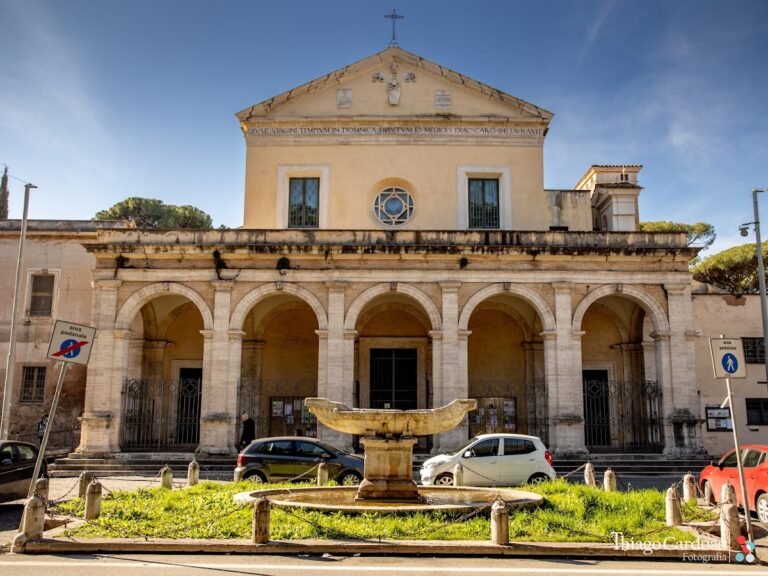
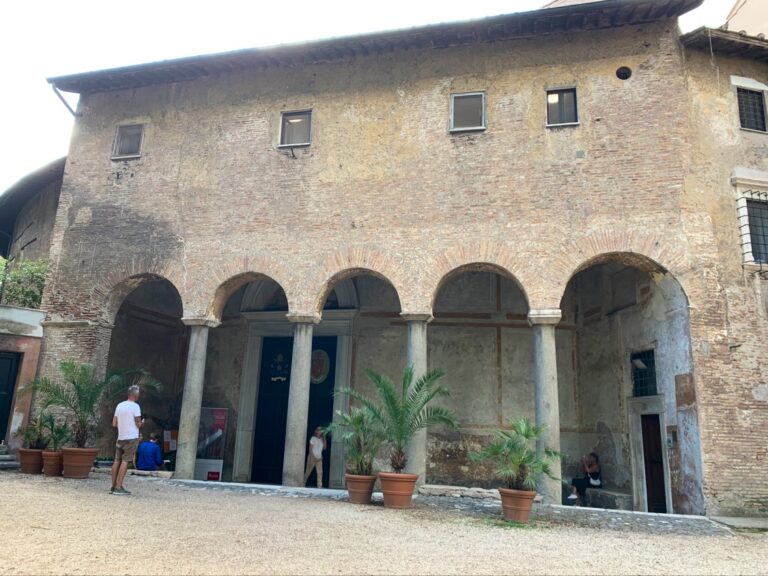
The largely undecorated facade is arranged with superimposed architectural orders, a horizontal string course, and delicate side volutes. Its Tuscan-order aedicule portal, a small shrine-like architectural frame, bears the heraldic shields of the reigning pope and the cardinal priest. Above it, a window framed by an openwork segmental pediment forms the principal decoration of the upper facade. Traces of paintings from different centuries remain on the facade. False upper niches contain symbolic images of Saint Nereus and Saint Achilleus, while a niche beneath the central window probably represented Saint Domitilla. The pediment carries an image of Madonna della Vallicella.
Portico and bell tower
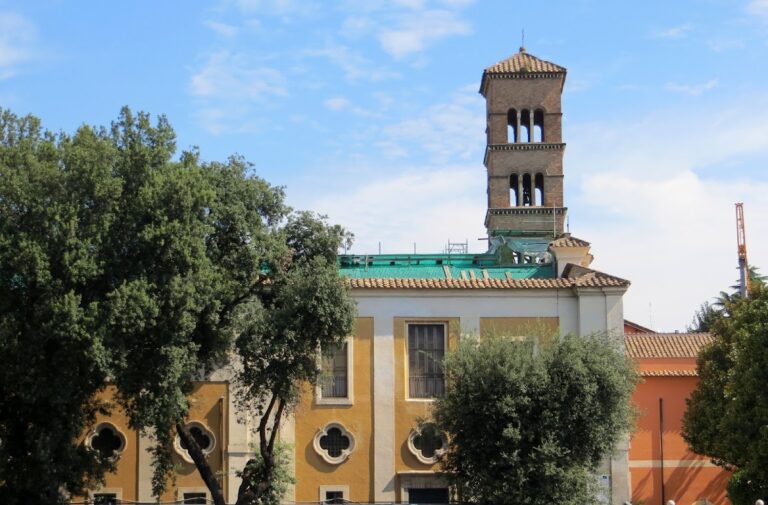
The marble portico is supported by two Corinthian columns and topped by a triangular marble pediment. It originally had three pointed-arch windows. Only the central opening remains open, and that window was rebuilt in the Baroque style. A narrow Baroque bell tower stands beside the former tower on the left.
Apse and former towers
Apse
The apse formerly had three single-lancet, round-arched windows. They were later blocked and remain visible mainly from the exterior, where three blocked round-arched openings can still be seen. Its marble architrave and reused stone elements decorated with leaves, flowers, and a mask came from the nearby Baths of Caracalla.
Former apse towers
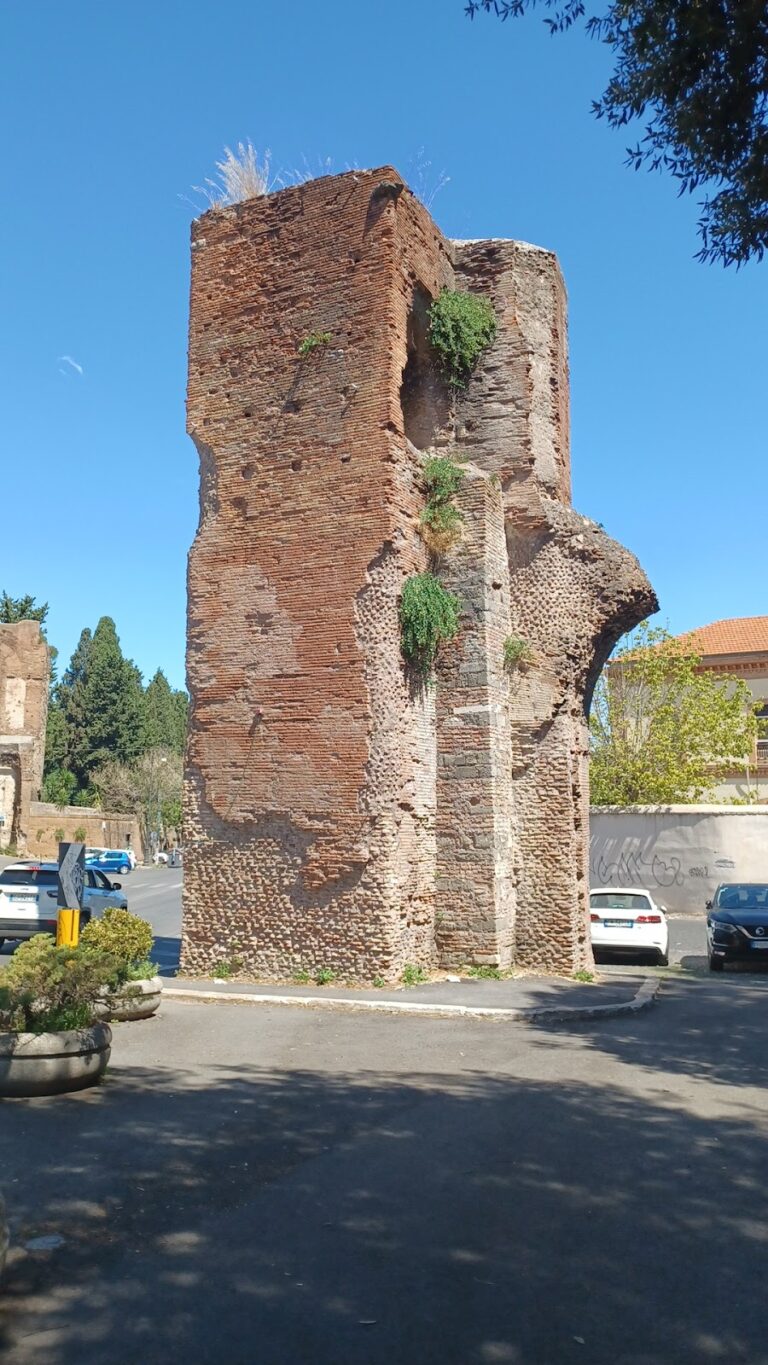
Two rectangular towers originally stood beside the apse, an arrangement without other known Roman examples of the same kind. The former towers survive as low structures. The one on the right was later used as a priest’s residence, while the one on the left became a sacristy. Passages from the side aisles lead toward these structures.
Interior structure and furnishings
Basilica interior
The interior retains the three-aisled arrangement of the basilica. During the fifteenth-century restoration, the original supports were replaced by octagonal pillars with capitals. The side aisles terminate flat, with passages leading toward the former towers beside the apse.
Altars and relic shrine
The high altar is formed from three Cosmatesque panels. Cosmatesque work uses geometrically arranged pieces of coloured stone and glass, and here it contains the relics of Nereus, Achilleus, and Flavia Domitilla, a Christian martyr traditionally associated with the imperial Flavian family and the late first century. Beneath the altar is a vaulted confessio, a shrine associated with the burial or display of relics, created by Cardinal Baronio.
The ciborium, a canopy over an altar, rests on four marble columns, including elements made of African marble. The two medieval ambos, raised platforms used for reading scripture, came from San Silvestro in Capite. The choir screen, parts of the presbytery floor, the high altar, and the episcopal throne preserve Cosmatesque work from the twelfth and thirteenth centuries.
Episcopal throne and other furnishings
The episcopal throne behind the altar was assembled under Baronio’s direction from reused lions whose style is associated with the Vassalletto school, a prominent Roman workshop tradition in Cosmatesque decoration. Its back bears the opening and closing words of the twenty-eighth homily of Pope Gregory the Great, a sixth-century pope and theologian.
The inscription reflects the mistaken belief that Gregory the Great preached the homily in this church before the relics of Nereus and Achilleus on their feast day. Baronio did not know that the relics had originally been buried in the underground basilica at the Catacombs of Domitilla. A large fifteenth-century Easter candlestick acquired by Baronio and a white-marble candelabrum brought from San Paolo fuori le Mura are also preserved in the church. Beside the altar, two pagan stones depict winged spirits and were reused from a nearby temple. One medieval ambo is mounted on a large porphyry urn taken from the Baths of Caracalla.
Organ
A positive organ, a small generally stationary organ, stands on the nave floor. Dated 1760 and attributed to Johann Konrad Werle, it has mechanical action, a 45-note keyboard with a short first octave, and a permanently coupled nine-note short-octave pedalboard without independent stops.
Paintings and mosaics
Nave and side-aisle frescoes
The nave contains a large cycle of late Mannerist frescoes showing episodes from the lives and martyrdoms of Domitilla, Nereus, and Achilleus. Cardinal Baronio commissioned the cycle for the Jubilee of 1600. It has traditionally been attributed to Niccolò Circignani, known as Il Pomarancio, although that attribution is disputed.
Frescoes between the nave arcades depict angels of notable elegance and may have been painted by another artist. The side aisles contain a separate late-sixteenth-century cycle from the Roman school, with violent scenes of the martyrdoms of other saints.
Side altars
The painting on the left side altar shows Domitilla with Nereus and Achilleus. It was made by Cristoforo Roncalli, also known as Il Pomarancio, probably around 1598. The right side altar has a Madonna with angels by Durante Alberti.
Triumphal-arch mosaic
The surviving mosaic on the triumphal arch dates from around 815. It represents the Transfiguration on Mount Tabor, with Christ appearing as the true light within a mandorla, an almond-shaped aureole surrounding a sacred figure. Elijah, Moses, and the apostles Peter, John, and James accompany him. The apostles kneel or prostrate themselves and shield their eyes from the radiance.
The outer sections contain the Annunciation and the Theotokos, a title for Mary meaning “Bearer of God,” beside an angel. The figures wear predominantly white garments. Mary, seated on a golden throne, wears red. Most of the figures have halos, while Elijah and Moses do not. Red monograms identify the apostles, although the initial for James was apparently lost during the last restoration.
Apse decoration
The original apse mosaic, removed in 1596, is known through a sixteenth-century tempera copy. It showed a large jeweled cross above a mountain with the four rivers of Paradise, set against red drapery and flanked by groups of three sheep. The composition omitted the customary throne and used an unusually simplified arrangement.
The replacement apse fresco of 1596 retains the central theme and adds groups of saints, including Nereus, Achilleus, Domitilla, Sulpitius, Servilianus, Caesarius, Euphrosyna, Theodora, Feliciana, and Plautilla. The figures hold martyr’s palms, and Domitilla wears a crown. A lower fresco refers to a Mass traditionally believed to have been celebrated in the church by Gregory the Great.