San Gregorio Magno al Celio: A Roman Titular Church and Camaldolese Monastery


Site at a Glance
- Rating
- 4.6
- Popularity
- Low
- Country
- Italy
- Primary era
- Early Modern
- External website
- Open
- Eras represented
- Classical, Medieval, Early Modern
- Civilizations
- Papal States, Roman
- Site type
- Religious
- Remains
- Church
On this page18 sections
History
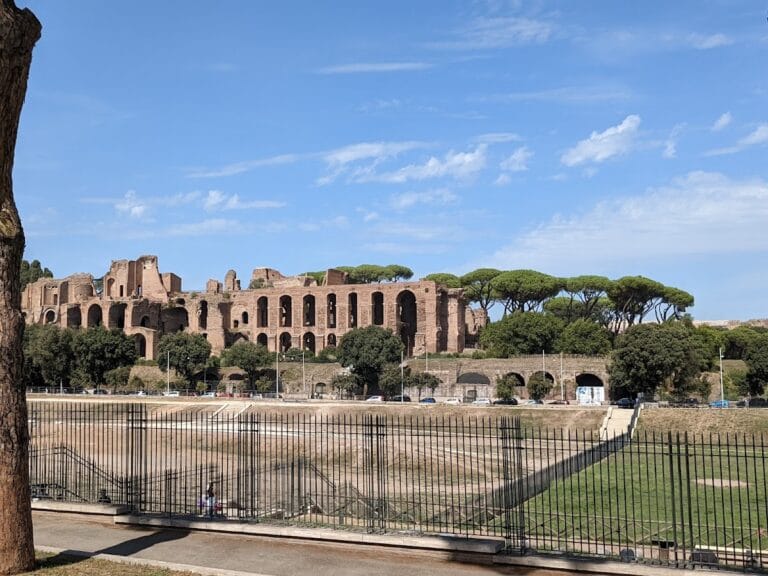
San Gregorio Magno al Celio is a Roman Catholic church and Camaldolese monastery in Rome, Italy, on the Caelian Hill opposite the Palatine and beside the Circus Maximus. Its origins lie in a small oratory attached to the suburban family villa of Pope Gregory I, later known as Gregory the Great. Around 575 to 580, before his election as pope in 590, Gregory converted the villa into a monastery dedicated to the Apostle Andrew. The present church reflects a major Baroque rebuilding of this early Christian foundation.
Gregory’s monastery and the Gregorian mission
The monastery was closely connected with Gregory’s religious and administrative work. Augustine of Canterbury served as its prior before Gregory encouraged and sent him to lead the mission to the Anglo-Saxons. Gregory, a sixth-century pope, organized the enterprise that converted or consolidated Christianity among the Anglo-Saxons, while Augustine became its appointed missionary leader.
Early medieval documents continued to use the dedication to Saint Andrew. After about 1000, however, the institution was generally recorded as dedicated to Saint Gregory “in Clivo Scauri.” The name referred to the ancient Clivus Scauri, an uphill Roman road running between the Palatine and Caelian hills. It therefore identified the monastery by both its patron and its position along an established route.
Medieval restoration and papal election
After Gregory the Great’s death, the monastery was abandoned. Pope Gregory II, who reigned from 715 to 731, restored the community and built an earlier church that honored Saint Gregory as well as Saint Andrew. The complex later suffered during the Norman military campaign of Robert Guiscard, whose sack and destruction of Rome in 1084 damaged the church. It was restored during the pontificate of Paschal II, pope from 1099 to 1118.
The church also entered papal history in 1130, when it hosted the meeting that elected a new pope. On 14 February, a commission of cardinals led by Cardinal Aymery de la Châtre chose Cardinal Gregorio Papareschi, who took the name Innocent II. This election took place amid the institutional importance that Roman churches could have as settings for the city’s clergy and papacy.
Camaldolese administration and seventeenth-century rebuilding
In 1573, Pope Gregory XIII transferred the decayed church and its small attached monastery to the Camaldolese, a Benedictine congregation founded in the early eleventh century. Camaldolese observance combines communal monastic life with an emphasis on solitude and contemplation. The monks continue to occupy the monastery.
At the beginning of the seventeenth century, Cardinal Cesare Baronio commissioned three oratories in the garden as commemorations of Gregory’s original monastery. Cardinal Scipione Caffarelli-Borghese had their interiors decorated in 1609. He also commissioned the rebuilding of the present church on its earlier site. Giovanni Battista Soria directed the work from 1629 to 1633, using travertine for the exterior. Construction stopped after Borghese’s death and resumed in 1642. Francesco Ferrari later redesigned and redecorated the interior between 1725 and 1734.
The Camaldolese preserved and studied the institutional history of the monastery. Their abbot Gian Benedetto Mittarelli published its archives in the Annales Camaldulenses ordini S. Benedicti ab anno 970 ad anno 1770, issued between 1755 and 1773. A further restoration in 1830 repaired damage attributed to the French invasion, with the work paid for by Cardinal Giacinto Zurla.
War, charity, and continuing religious use
During the Second World War, Nazi-Fascist authorities detained several prominent public figures in the adjacent monastery, including Senator Alberto Bergamini and Roberto Suster. Suster escaped on 28 January 1944. In the 1970s, the Camaldolese allowed Mother Teresa to establish a soup kitchen for Rome’s poor in an ancillary monastery building. The Missionaries of Charity continue to maintain the facility and operate a shelter for homeless people beside the church.
On 10 March 2012, San Gregorio hosted First Vespers for the millennium of the Camaldolese congregation’s foundation in 1012. Pope Benedict XVI and Rowan Williams, then Archbishop of Canterbury, jointly led the service before Anglican and Catholic prelates. The church remains a Roman titular church within the Diocese of Rome. A titular church is assigned to a cardinal, linking him institutionally with the Roman clergy and the papacy.
The church also preserves older devotional traditions associated with Gregory. Masses celebrated at the altar of Saint Gregory were connected with the Gregorian suffrage tradition, prayers and Masses offered for the dead through the intercessory power attributed to the saint. They were believed to cost twice as much as ordinary masses because of their special indulgences. A traditional Roman expression associated with the church probably referred to an old privilege that allowed Mass to be celebrated there an hour after noon for latecomers.
Remains
The church and its approach
Entrance court and portico
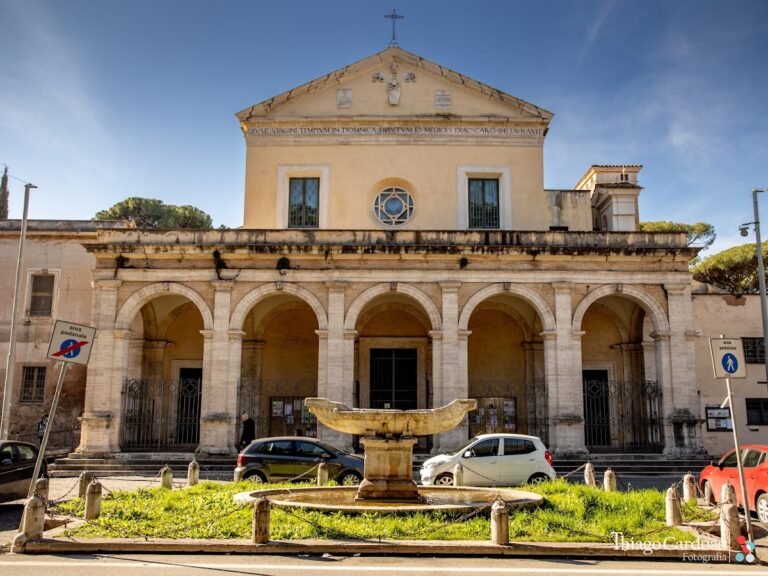
San Gregorio is approached from Via di San Gregorio by a broad, lengthy staircase. The street separates the Caelian Hill from the Palatine. Soria’s travertine exterior, created in 1629 to 1633, resembles the façade of San Luigi dei Francesi, but the visible front is not the church’s actual façade. It forms the entrance to a forecourt, or peristyle, behind which a portico and second façade lead to the church.
The portico contains several tombs moved there during Borghese’s construction. Among them was the tomb of Imperia, a courtesan associated with the banker Agostino Chigi in 1511. The monument was later replaced or adapted for the burial of Lelio Guidiccioni, a seventeenth-century prelate and canon of Santa Maria Maggiore. A Latin inscription commemorates Sir Edward Carne, ambassador of Mary I of England and a scholar of ancient Greek language and culture.
Nave, aisles, and pavement
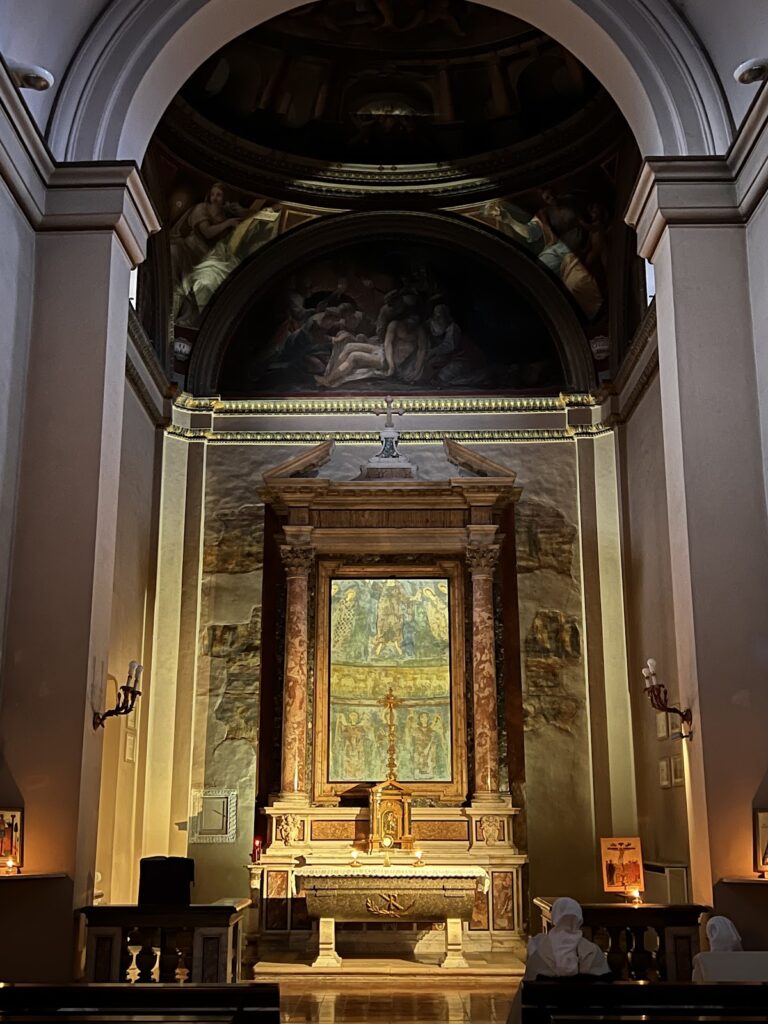
The church has a basilican plan, with a central nave flanked by two lower side aisles and followed by a deep presbytery aligned with the nave. Sixteen reused ancient granite columns and pilasters divide the nave from the aisles. The interior carries Francesco Ferrari’s stucco decoration, dating approximately to 1725, above a medieval Cosmatesque pavement. This inlaid floor, attributed to the thirteenth century, was extensively integrated during the eighteenth-century interior works.
The central vault contains Placido Costanzi’s 1727 fresco of the Glory of Saint Gregory and Saint Romuald and the Triumph of Faith over Heresy. The main altarpiece is Antonio Balestra’s Madonna with Saints Andrew and Gregory, painted in 1734. On the left, the second altar holds Pompeo Batoni’s Madonna Enthroned with the Child and Saints and Blesseds of the Gabrielli Family of Gubbio, from 1732 to 1733. The figures include Blessed Forte, Blessed Pietro, Saint Rodolfo, and Blessed Castora. The same side also contains Francesco Mancini’s 1745 Immaculate Conception.
On the right, the second altar has Mancini’s 1751 painting of Saint Peter Damian receiving discipline from Pope Alexander II. The third altar contains Francesco Fernandi’s, known as l’Imperiali, depiction of the death of Saint Romuald. An organ built by Balbiani-Vegezzi-Bossi in the second quarter of the twentieth century stands on the choir loft in the counter-façade. It has electro-pneumatic action, two keyboards of 61 notes each, and a 32-note pedalboard.
Chapel and room of Saint Gregory
The right apsidal chapel is dedicated to Saint Gregory the Great. Its altarpiece by Sisto Badalocchio shows the saintly pope assisted by the Holy Spirit. A predella above the altar is attributed to the school of Pinturicchio or Luca Signorelli, while the marble altar frontal is attributed to Luigi Capponi.
The chapel leads to the room where tradition holds that Gregory rested. A marble chair associated with him is preserved there. Its decoration includes lion-griffin protomes, modeled heads or foreparts of animals and mythical creatures, together with acanthus scrolls. The chair, dated to the first century BC, has been compared with three marble thrones in Boston, Berlin, and the Acropolis Museum. Gisela Richter proposed that these thrones reproduce a lost late Hellenistic original.
Salviati Chapel
Francesco da Volterra designed the Salviati Chapel, which Carlo Maderno completed in 1600 for Cardinal Antonio Maria Salviati, then commendatory abbot of the Camaldolese monastery. A commendatory abbot held the title and associated revenues of a monastery without necessarily residing there or governing it as a regular monastic superior. Giovanni Battista Ricci supplied frescoes and a domed decorative program. The chapel also contains an ancient fresco of the Madonna, traditionally said to have spoken to Gregory, and a marble altar made by Andrea Bregno and his pupils in 1469.
A copy of Annibale Carracci’s painting of Saint Gregory at prayer is preserved in the chapel. French forces confiscated the original during the occupation of Rome in 1798, and it was later destroyed in London during the bombing of 1941. The Salviati Chapel is used by Rome’s Romanian community for worship according to the Byzantine rite.
Garden oratories
Oratory of Saint Andrew
Three oratories are grouped around a garden to the left of the church. The central Oratory of Saint Andrew retains its original dedication and contains frescoes by Domenichino, Guido Reni, Cristoforo Roncalli, known as il Pomarancio, and Giovanni Lanfranco. Their subjects include the Flagellation of Saint Andrew, Saint Andrew being brought to the temple, Saints Peter and Paul, the Virgin with Saints Andrew and Gregory, and Saint Silvia with Saint Gregory.
Four ancient columns support the portico on the left side of the nave, which leads to the former Benedictine burial ground planted with ancient cypresses. On the opposite side, four more ancient columns were reused by Flaminio Ponzio in 1607 for the porch of the central oratory facing the burial ground.
Oratory of Saint Silvia
The Oratory of Saint Silvia, probably built over her tomb, is dedicated to Gregory’s mother. Its paintings include Reni’s Concert of Angels and Sisto Badalocchio’s David and Isaiah. Nicolas Cordier’s statue of Saint Silvia also forms part of the decoration.
Oratory of Saint Barbara
The Oratory of Saint Barbara contains Antonio Viviani’s frescoes of 1602. Its design represents a reconstruction of the triclinium, a formal dining room or dining arrangement in the Roman world, traditionally associated with Gregory’s daily charitable meal for twelve poor Romans. The large marble table rests on ancient Roman bases. Its supports take the form of paired winged lions whose heads produce goat horns.
John the Deacon related that an angel joined the twelve poor at the meal. The oratory therefore combines a physical representation of charitable hospitality with a tradition concerning Gregory’s daily religious and social practice.
Archaeological remains and movable heritage
Library of Agapitus and Roman structures
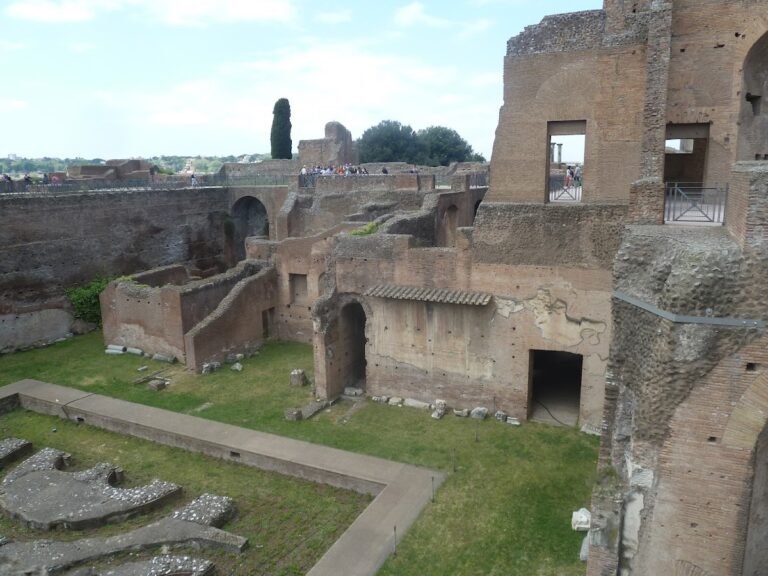
The garden oratories incorporate remains of the Library of Agapitus and substructures from the Roman imperial period. Some of these spaces may have been Roman shop units. One room has features interpreted by some specialists as those of an early Christian meeting place and baptismal pool. These remains form part of the archaeological fabric beneath and around the later monastic buildings.
Aphrodite of Menophantos
The monastery foundations yielded the Aphrodite of Menophantos, a Greco-Roman marble Venus of the Capitoline Venus type. The statue bears the signature of the Greek sculptor Menophantos, who appears to have been active in the first century BC. It later passed into the possession of the Chigi family and was discussed by Johann Joachim Winckelmann in his 1764 History of Ancient Art. The sculpture is now displayed in the National Roman Museum.
Nearby sites