Sanctuary of the Madonna di Pietraquaria: A Marian Shrine in Avezzano, Italy
Site at a Glance
- Country
- Italy
- Primary era
- Early Modern
- Eras represented
- Medieval, Early Modern, Modern
- Civilizations
- Italian, Kingdom of Naples, Kingdom of Sicily, Kingdom of the Two Sicilies, Spanish
- Site type
- Religious
- Remains
- Sanctuary
On this page18 sections
History
The Sanctuary of the Madonna di Pietraquaria stands on Mount Salviano in Avezzano, Italy. This Marian shrine centers on devotion to the Madonna, a title for the Virgin Mary. Rebuilt from its foundations and enlarged in 1614, the sanctuary’s construction was completed in the seventeenth century. Its architecture combines Baroque and neoclassical features, and its history grew from a medieval community’s veneration of a sacred image.
Medieval settlement and devotion
Before 1268, Pietraquaria was a fortified settlement within the County of Albe, a medieval territorial lordship. Its church was dedicated to Saint Mary, and nearby churches honored Saint John and Saint Peter. Local people and residents of the surrounding area venerated an image of the Virgin Mary kept in the church.
The Battle of Tagliacozzo, fought in 1268 on the Palentine Plains, pitted Charles I of Anjou against Conradin of the Hohenstaufen dynasty. Their conflict formed part of the struggle for control of southern Italy. Angevin forces probably destroyed Pietraquaria after the battle, and its inhabitants moved to lower Pantano Square in Avezzano, later known as San Bartolomeo Square. Historian Tommaso Brogi connected the name Pietraquaria with an old Italian expression meaning water stone.
Local tradition tells that the Virgin appeared on Mount Salviano to a shepherd boy who was deaf and unable to speak. As he watched his flock and looked toward Lake Fucino, she appeared dressed in white and riding a mule. She spoke to him, and he heard her. The Virgin asked the people of Avezzano to rebuild her church; the boy then urged the parish priest to restore Saint Mary’s church and return the sacred image to its altar.
Rebuilding and the 1779 procession
The church was rebuilt from its foundations and enlarged in 1614, as devotion to the Madonna di Pietraquaria spread. Work on the sanctuary was completed during the seventeenth century, though the church underwent further rebuilding and enlargement over time.
In 1779, after a long drought had brought hardship and food shortages, Avezzano’s residents carried the image from the sanctuary to the town in procession. On 27 April, as the procession passed along Via Napoli, heavy rain fell. The dry spell ended and cultivation could resume. The annual feast was thereafter fixed on 27 April. Earlier celebrations had taken place on the fourth Sunday of May and also in September, with both religious and civic observances. Offerings and donations from residents funded another enlargement of the church that year.
Nineteenth-century devotion and community
Devotees credited the Madonna with protecting Avezzano during the French invasion of 1799 and with delivering the town during the French sack of 1800, when French forces sought to drive out brigands occupying it. They also attributed the cessation of Fucino’s floodwaters in 1836 and protection from cholera in 1837 to her. In recognition of graces attributed to the Virgin, the Vatican Chapter, the collegiate body of clergy associated with St Peter’s Basilica, solemnly crowned the image in 1838.
Lay hermits lived at the monastery before Capuchin Friars, a branch of the Franciscan religious order, took charge of the sanctuary in 1878. The Confraternity of Maria Santissima di Pietraquaria, a religious association for devotional and charitable activity, was founded in 1891.
Earthquake, war, and recent history
The 1915 Marsica earthquake badly damaged the sanctuary. The monastery accommodated religious personnel who came to assist survivors, and the church reopened for worship in 1969. A local oral tradition holds that on 27 April 1944 a thick cloud over Avezzano diverted Anglo-American Flying Fortresses, American B-17 heavy bombers, toward Cassino instead of the city. Avezzano was an important railway junction and had already suffered severe wartime destruction.
Maria Santissima di Pietraquaria was proclaimed patron saint of Avezzano on 1 January 1978. The Domus Mariae, built in the 1950s, was entrusted to the Benedictine Sisters of Charity in 1983. Pope John Paul II visited the Marsica, the area of Abruzzo centered on the Fucino basin, on 24 March 1985. On 22 October 2023, Giovanni Massaro, bishop of the Marsi, formally recognized the sanctuary as a diocesan sanctuary, a religious site recognized within the authority of a diocese. In 2025, a congregation of women religious devoted to promoting the Sacred Heart took over care of the Domus Mariae.
Remains
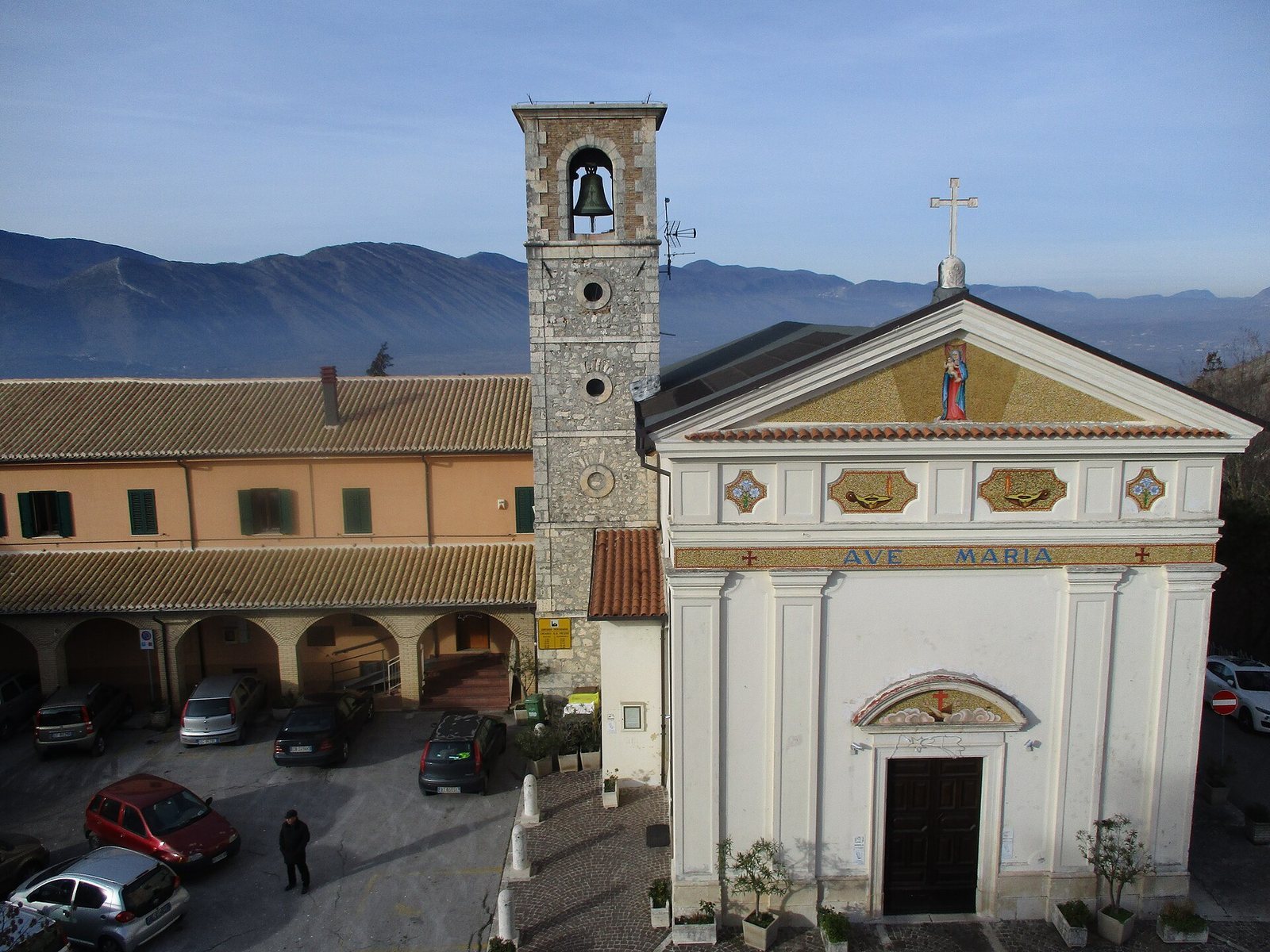
The sanctuary complex stands at about 1,000 metres above sea level within the Monte Salviano nature reserve, in the municipal territory of Avezzano. Its principal church has a cross-shaped plan, with a long central nave crossed by a transept, and a single nave. The complex also includes a bell tower, a residence, a monastery, and the separate Domus Mariae.
The church
Exterior
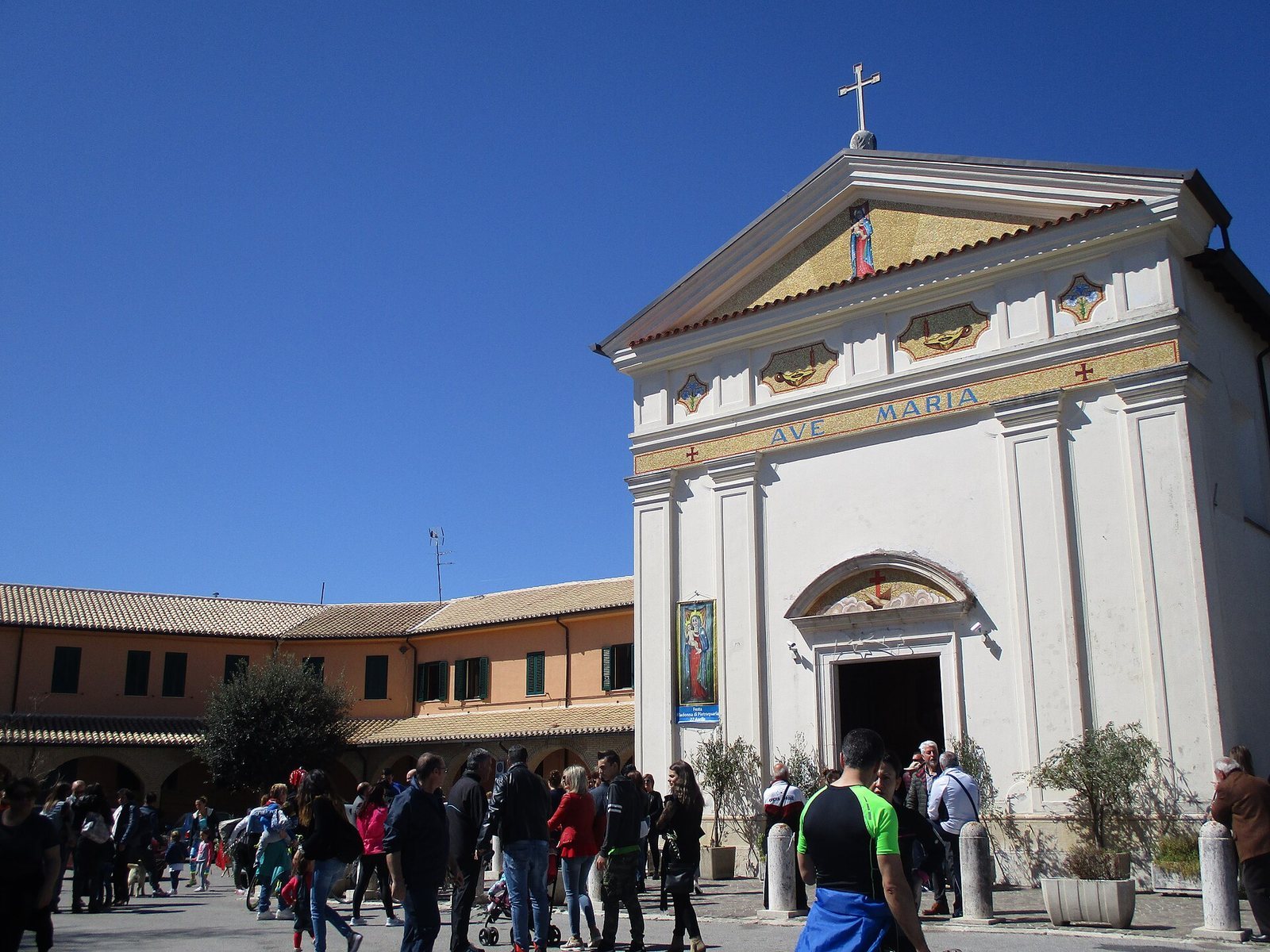
The church’s white-plastered facade has four small projecting supports beneath a cornice decorated with gold mosaic and the words AVE MARIA. A mosaic of the Madonna occupies the horizontal band above the entrance. A rough-stone bell tower without a spire stands to the church’s left. Beside it, a portico leads to an irregular rectangular building used as a residence for Capuchin fathers and pilgrims.
Interior
Inside, white plaster covers the vaulted ceilings, and the enlarged apse, the recessed sanctuary end, has geometric decoration. The church contains three altars and two additional niches. Some frescoes depict the Virgin’s appearance to the shepherd and graces attributed to her; works made by Ermanno Toccotelli in 1969 include these subjects.
A large original painting of the Madonna and Child sits in an onyx niche on the rear wall of the apse. The painting’s age is unknown, and its style is described as Byzantine. Stained-glass windows made by Marcello Ercole in 1992 show scenes inspired by Francis of Assisi’s devotional poem The Canticle of the Creatures, which praises God through creation.
Associated buildings
Monastery
A monastery was erected in 1840. It could accommodate religious personnel, including those who came to assist survivors after the 1915 earthquake.
Domus Mariae
The Domus Mariae occupies a separate part of the complex and is used mainly for spiritual retreats and pastoral care.
Other devotional and archaeological features
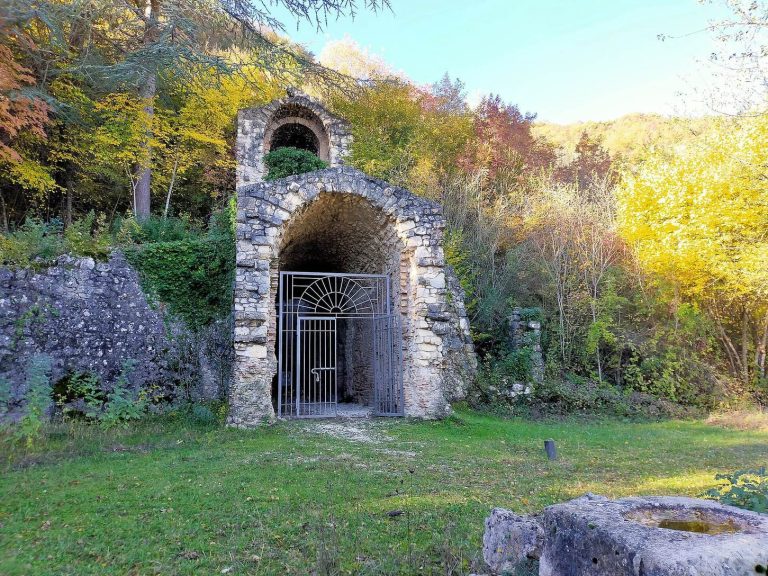
Chapel of the Apparition
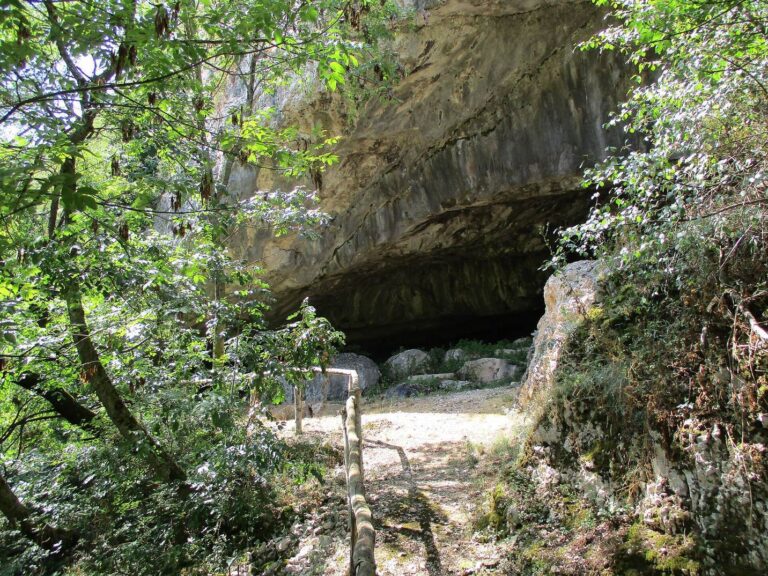
The Chapel of the Apparition lies along the Way of the Cross, a devotional route recalling Jesus’s journey toward crucifixion. It preserves an impression in the rock traditionally attributed to the blow of the Virgin’s mule’s hoof.
Forecourt water installations
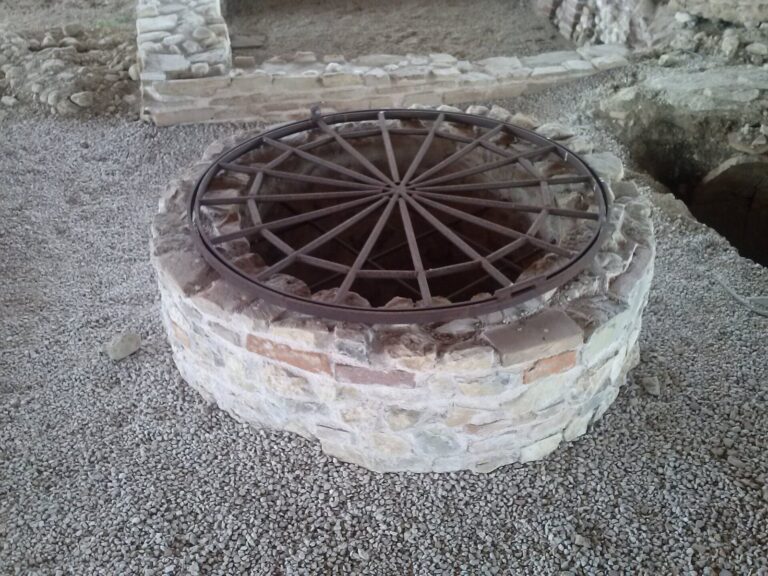
Excavation and rock removal during enlargement of the forecourt exposed separated, cistern-like chambers and stone channels. The channels are thought to have carried water away from reservoirs.
Memorial mosaic and objects
In front of the sanctuary, a mosaic by Rita Monaco portrays Pope John Paul II, also known as Karol Wojtyla. It was inaugurated for the thirtieth anniversary of his 1985 visit to the Marsican area. A nearby case holds objects associated with that visit and preserved as relics because of their connection with a person or event regarded as sacred.
Summit cross
A large iron cross stands on the summit of the rock opposite the sanctuary. It was installed on 10 December 1967 and restored in 2022.
Confraternity offerings
Rooms belonging to the Confraternity display about one hundred ex votos, offerings made in fulfilment of vows or in gratitude for favors believed to have been received from the Virgin.