Sanctuary of St. Jadwiga in Trzebnica: A Silesian Monastic and Pilgrimage Complex
Site at a Glance
- Rating
- 4.7
- Popularity
- Medium
- Country
- Poland
- Primary era
- Medieval
- External website
- Open
- Eras represented
- Medieval, Early Modern, Modern
- Civilizations
- Habsburg, Holy Roman Empire, Kingdom of Prussia
- Site type
- Religious
- Remains
- Monastery
On this page14 sections
History
The Sanctuary of St. Jadwiga in Trzebnica, Poland, is a medieval monastic and pilgrimage complex founded in 1202 by the Silesian Piast duke Henry I the Bearded at the urging of his wife, Hedwig of Andechs, later known as St. Hedwig of Silesia. Its Romanesque basilica was built mainly during the early thirteenth century, with major work between 1208 and 1219 and completion around 1240 or 1241. A papal bull issued by Innocent III on 22 November 1202 placed the monastery under special protection. The foundation became the first women’s monastery in Poland, a center of aristocratic education, and the burial place of members of the Silesian Piast dynasty.
Foundation and Cistercian Rule
The foundation charter was issued in 1203, and Benedictine nuns arrived from Bamberg on 13 January of that year. The first abbess was Petrussa, who had previously taught Hedwig at Kitzingen. In 1218 the community adopted the Cistercian rule, a form of Western monastic life based on the Rule of St. Benedict and marked by communal discipline and liturgical observance. Trzebnica remained subordinate to the Cistercian monastery at Łubiąż.
Henry and Hedwig endowed the monastery with land, revenues, and privileges. It stood on Henry’s own property and was established at his expense for the salvation of his father, himself, and his relatives. Prisoners were employed in the construction as an act of penance. The community gained further importance when the founders’ daughter Gertrude entered the monastery in 1212 and became abbess in 1232. The Czech princesses Agnes and Anna lived and were educated there from 1214; Anna later married Henry II the Pious.
Hedwig and the Piast Mausoleum
After being widowed in 1238, Hedwig lived at Trzebnica until her death there in 1243. She was canonized in 1267, and the monastery became a major center of devotion associated with her tomb. It was recognized as a sanctuary, a sacred site connected with the veneration of a saint or relic, by at least the early fourteenth century.
The basilica also became a mausoleum of the Silesian Piasts, the medieval ruling dynasty of Silesia and other Polish territories. Twenty-two members of the dynasty were buried there. They included Henry I the Bearded, who died in 1238, Hedwig, whose remains were transferred to the Chapel of St. Hedwig after her canonization, and other members of the ducal family. Gertrude remained abbess until her death in 1268, reinforcing the monastery’s connection with the ruling dynasty.
War, Fire, and Decline
The monastery endured repeated crises. Famines were recorded in 1315, 1338, 1434, and 1617. Hussite forces damaged the monastery and its estates in 1432 and 1433, while the army of Matthias Corvinus caused further destruction in 1475. A lightning strike destroyed the roof of the Chapel of St. Hedwig in 1464, and serious fires affected the complex in 1486, 1505, and later periods.
The Reformation and the religious conflicts of Silesia brought a prolonged decline. During parts of the Thirty Years’ War, the nuns took refuge in Poland, and they fled again in 1663 because of the Ottoman threat. Abbesses came from the Piast princely family until 1515 and afterward from the high nobility.
Secularization and New Uses
After the First Silesian War, Trzebnica came under Protestant Prussian rule in 1742. The monastery lost its political and economic privileges, and Prussian secularization abolished it in 1810. At that time, its possessions included one town, 73 villages, 25 manors, and ten patronage churches. Valuable liturgical objects, furnishings, artworks, vestments, books, and archival materials were sold or auctioned in March 1811. Many objects were purchased by people connected with the monastery, while paintings and archival materials went to institutions in Wrocław.
The church continued as a Catholic parish church. The former monastery was successively used as a prisoner-of-war camp during the Napoleonic Wars, a military hospital from 1813 to 1816, housing for officials, and a cloth factory from 1817 to 1857. After a proposal to establish a prison failed, parts of the complex were acquired by the Knights Hospitaller in 1870 and by the Sisters of Mercy of St. Charles Borromeo in 1889. They established hospitals there, and from 1899 to 1945 the complex served as the general motherhouse of the Silesian Borromean Sisters.
Twentieth-Century Restoration and Protection
During the Second World War, many German Borromean Sisters were expelled after the region was transferred to Poland, and Polish members of the congregation later took over the complex. In April 1945, Polish authorities took over the former Borromean hospital, which became the Polish District Hospital in Trzebnica.
The basilica was restored in 1903, while conservation work during the interwar period exposed several Romanesque portals. After the Second World War, the crypt and Romanesque sacristy were adapted for public cultural use, including a lapidarium, a display of architectural and sculptural stone fragments, and a museum of sacred art. In 2002 the Borromean Sisters opened a museum devoted to the history of their congregation and its connections with Trzebnica and the Cistercians.
The church became a minor basilica in 1943, a special papal designation granted to churches of particular liturgical, devotional, or historical importance, and it is also an international Catholic sanctuary. The former Cistercian abbey complex was designated a Historic Monument of Poland in July 2014. Borromean charitable and care institutions continue to occupy parts of the complex, including residential care and social support services.
Remains
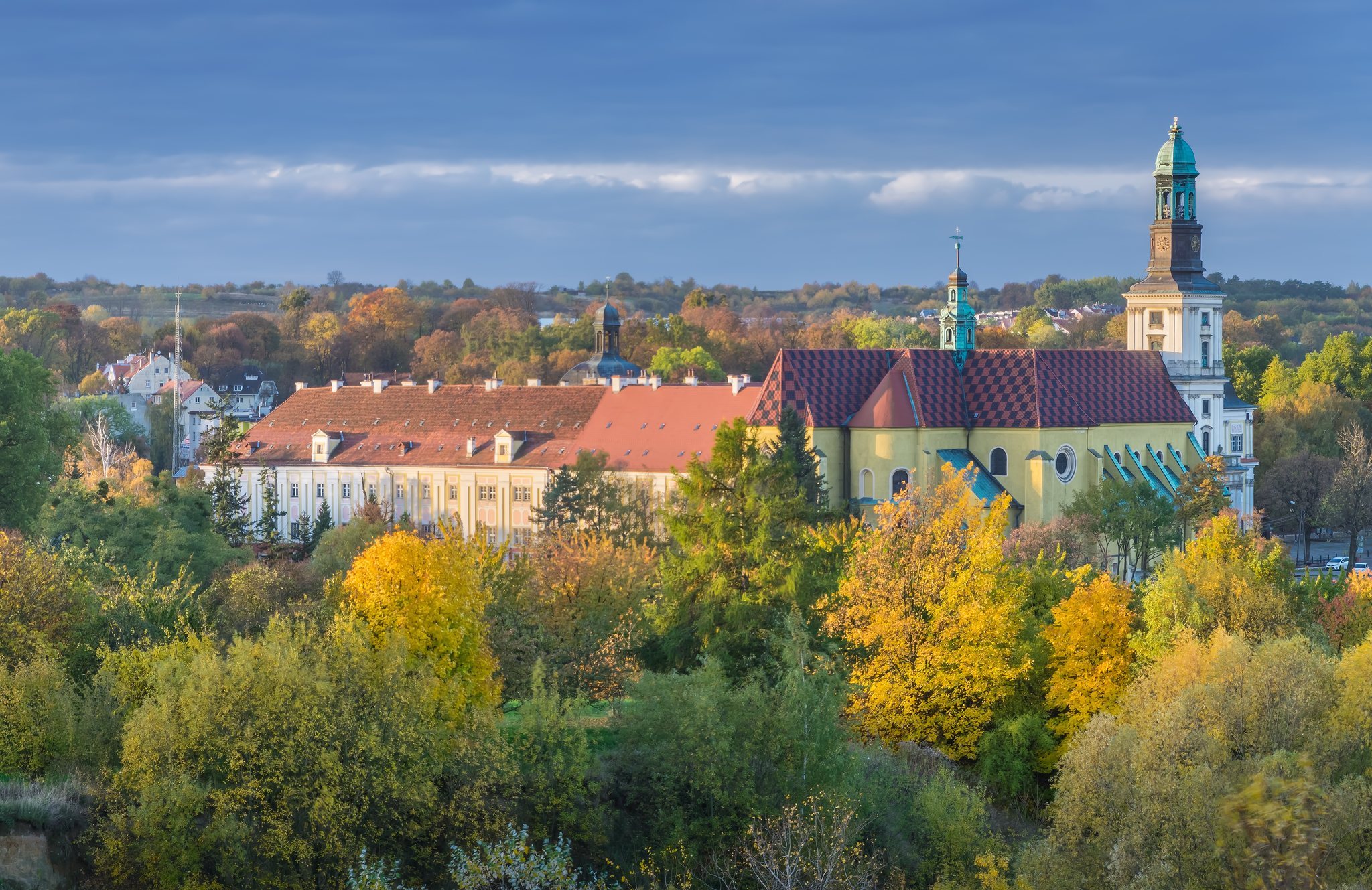
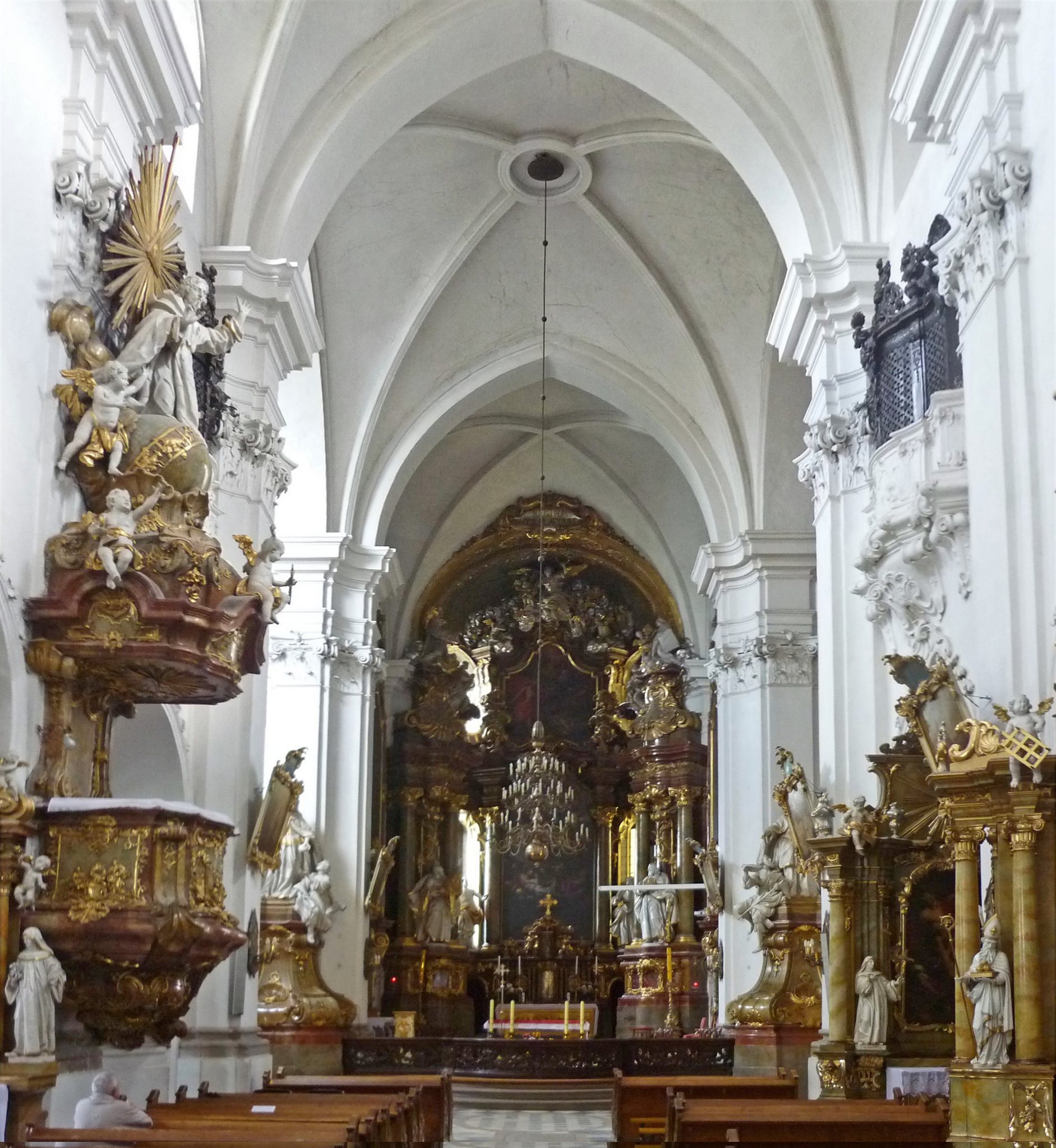
The surviving complex consists of the former Cistercian monastery and the Basilica of St. Hedwig and St. Bartholomew. The church is chiefly Romanesque and built of brick, although Gothic, Baroque, Rococo, and modern elements reflect centuries of rebuilding. The basilica is a three-aisled structure approximately 80.4 metres long and 23.8 metres wide, with a transept about 31.6 metres across. It was consecrated in 1219.
Basilica and Medieval Features
Chapel of St. Hedwig
The Chapel of St. Hedwig occupies the south-apse area and was built in 1268 and 1269 to house the saint’s remains. It is described as the first building in Poland constructed entirely in the Gothic style and is regarded as one of the country’s important thirteenth-century buildings. Hedwig’s present tomb dates from 1679 and 1680. Marcin Bielawski made its marble sarcophagus in 1680 from black Dębica and pink Paczółtowice marble, placing it beneath a canopy supported by fourteen columns. An alabaster statue by Franz Joseph Mangoldt later replaced Bielawski’s figure, which was moved to the Chapel of St. John the Baptist.
Piast Tombs
The church preserves the tomb of Henry I the Bearded and a double tomb joining Henry’s remains with those of Konrad von Feuchtwangen, a thirteenth-century grand master of the Teutonic Order, a Catholic military-religious order founded during the Crusades. Made in the second half of the seventeenth century, the double tomb was intended to symbolize the triumph of Christianity over Islam. The marble sarcophagus for Henry was made by Marcin Bielawski in 1685. The tomb of Charlotte of Legnica-Brieg, identified as the last Silesian Piast, stands beside Hedwig’s tomb.
Crypt and Romanesque Portals
The Romanesque crypt of St. Bartholomew was completed in 1214. Its three-aisled space has an apse and was altered in the seventeenth and twentieth centuries. It contains the early fifteenth-century tombstone of Duke Conrad II of Oels, Baroque altar and freestanding sculptures, and a lapidarium of Romanesque sculptural fragments.
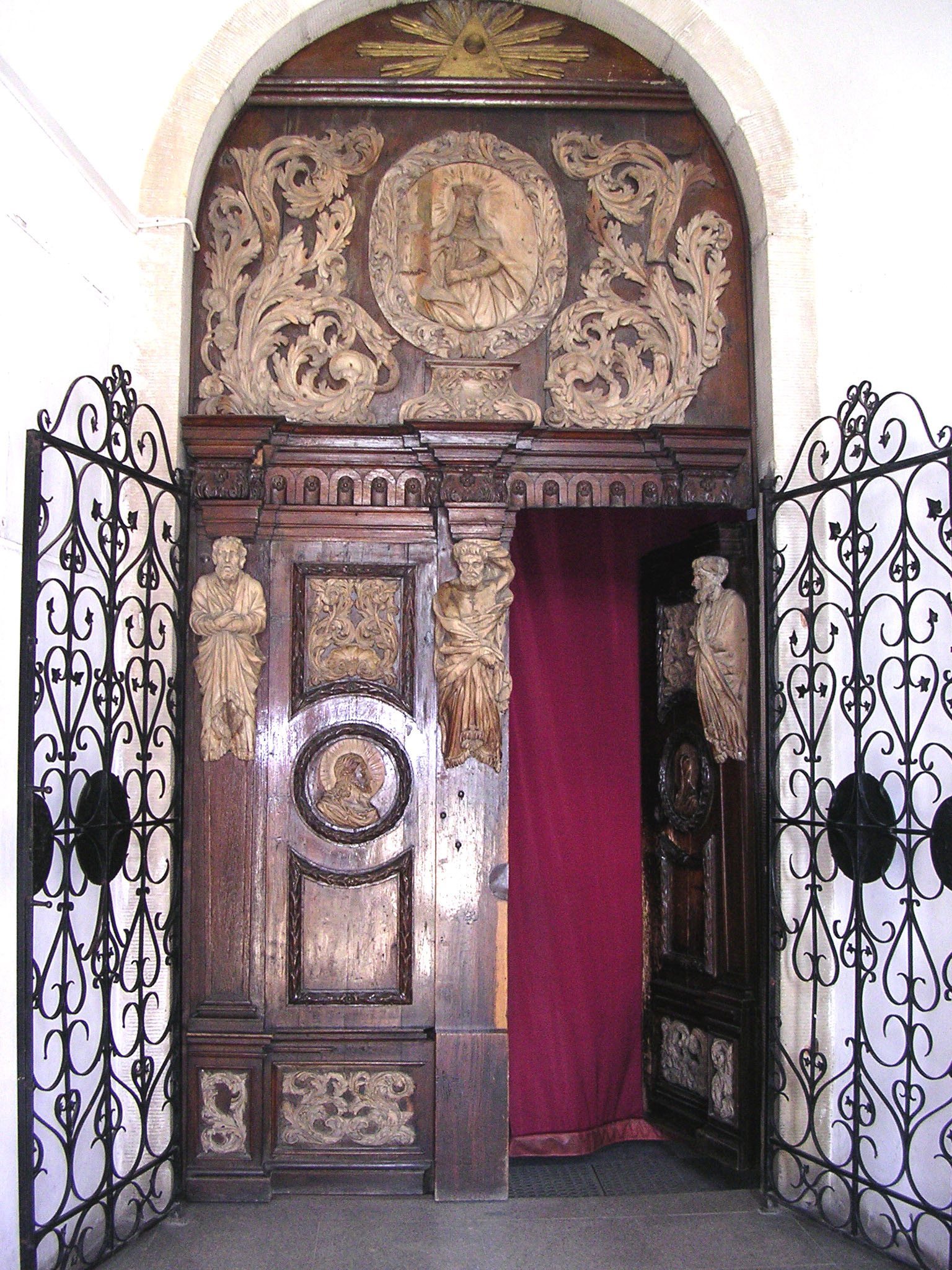
Interwar restoration revealed several medieval portals. One, dated before 1250, has a tympanum, the decorated field above a doorway, showing the Adoration of the Virgin and Child. Another Romanesque portal, dated 1218 to 1230, has a tympanum depicting King David. The early Gothic portal of the Chapel of St. Hedwig contains a double-sided late-thirteenth-century Romanesque tympanum. Its side facing the basilica shows the Crucifixion, while its chapel-facing side shows the Coronation of the Virgin.
Romanesque Sacristy
The two-storey Romanesque sacristy now houses a museum of sacred art dating from the thirteenth century to the present. Its collections include a reliquary made in Wrocław in 1553 that contains Hedwig’s skull.
Baroque and Rococo Transformation
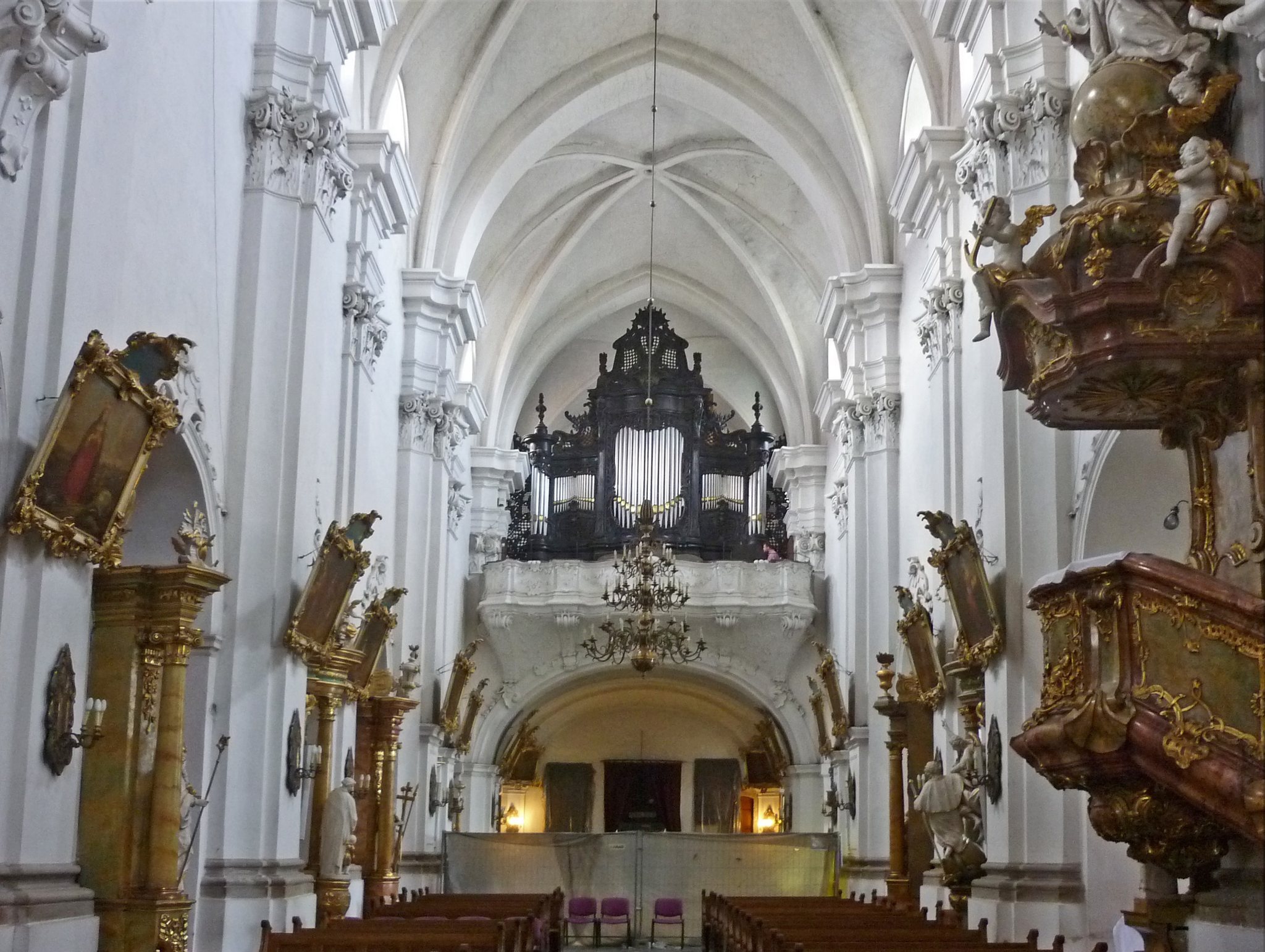
The church underwent major Baroque changes in the late seventeenth and eighteenth centuries, especially between 1680 and 1685 and from about 1730 to 1760. The wider rebuilding is dated to approximately 1740 to 1785. Earlier furnishings were replaced, and much of the Gothic interior was altered. The resulting Baroque and Rococo furnishings included new high altars for the basilica and the Chapel of St. Hedwig, sixteen side altars in the basilica, five in the chapel, and monumental pulpits.
A cycle of twenty oil paintings depicting the life of St. Hedwig was commissioned from the workshop of Michael Willmann, who also painted The Martyrdom of St. Bartholomew in 1685. Franz Joseph Mangoldt created the basilica’s high altar, pulpit, full-length sculptures of St. Hedwig and St. Elizabeth, an alabaster figure of St. Hedwig, and one side altar between 1739 and 1745. Christian Philipp Bentum painted major works in 1747 and 1748, including the high-altar paintings of the Assumption of the Virgin Mary and the Trinity, images of Abbess Gertrude and the Death of St. Hedwig, and a copy of Willmann’s Death of St. Benedict. Felix Anton Scheffler painted images of St. Anne and St. Joseph in the chapel.
The Chapel of St. Hedwig also contains a large epitaph to Charlotte of Legnica-Brieg, produced by the workshops of Rauchmiller and Paul and Peter Strudel. The basilica’s surviving medieval artworks include a late Gothic fifteenth-century sculpture of the Virgin and Child and a late Gothic altarpiece painting of the same subject.
Tower, Grounds, and Monastery
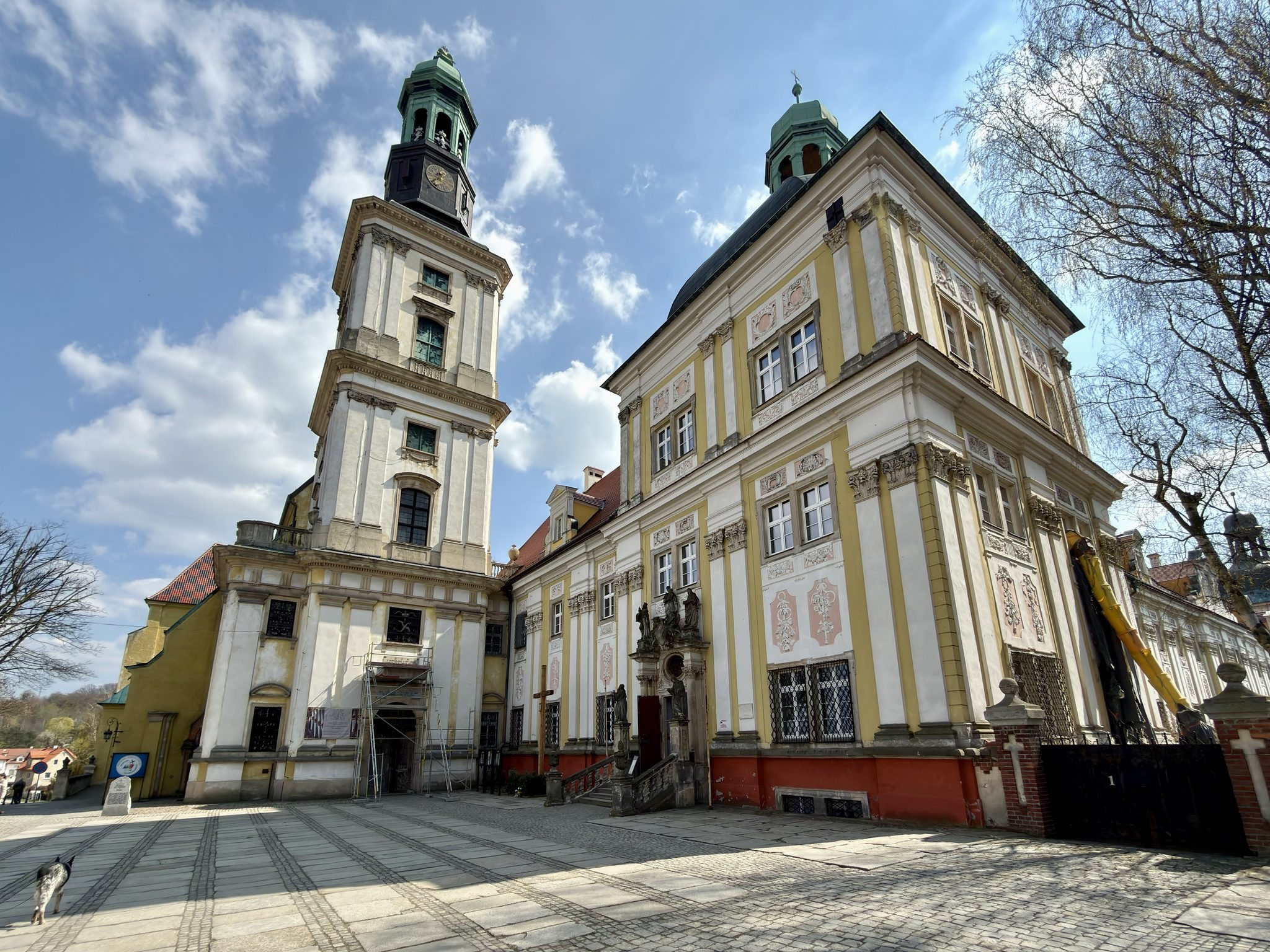
A north porch was added in 1690. The former western Romanesque entrance was replaced by a large tower designed by the Wrocław architect Dahn. The 68-metre tower was begun in 1780 and completed in 1785. A ten-metre Baroque column crowned by a statue of St. John Nepomuk was erected in front of the church in 1738. A Way of the Cross was completed on the surrounding hills in 1734, and a large copy of the Lourdes grotto, constructed from blocks of local iron ore, was built there in 1926 and 1927.
The original monastery buildings were erected between 1202 and 1218. They were demolished in 1697 after becoming too small and costly to repair, and a late-Baroque complex designed by the Wrocław architect Kalkbrenner was built between 1697 and 1726. Hospital and service buildings were added later. In 1903 the basilica received a restored chapel pulpit, a large ornamental clock on the tower, and decorative forged grilles. Schwarzbach and Hans Poelzig built a music gallery, which received an organ made by the Schlaga firm of Świdnica; Poelzig designed its organ front.