Palace in Strzeszów: A Historic Silesian Palace Complex in Poland

Site at a Glance
- Rating
- 4.3
- Popularity
- Very Low
- Country
- Poland
- Primary era
- Early Modern
- External website
- Open
- Eras represented
- Early Modern, Modern
- Civilizations
- German, Holy Roman Empire
- Site type
- Domestic
- Remains
- Elite Residence
On this page7 sections
History
Palace in Strzeszów is a historic palace complex in Poland, whose sixteenth-century residence was built on the site of a ducal manor and became the seat of the Rehdiger family. Its history extends from a medieval farmstead through wartime destruction, rebuilding, aristocratic expansion, and postwar state use.
Medieval Estate and Rehdiger Ownership
A farmstead at Streseuic was recorded in 1321, when the dukes of Oels, a historical Silesian principality centered on present-day Oleśnica, granted it as a fief. A wooden defensive or hunting manor may have preceded the later palace.
Niklas von Rehdiger acquired the estate from the Duke of Oels as a pledge in 1559 and received it as private property in 1567. In that same year, he built a moated palace on the site of the ducal residence. The building became the Rehdiger family seat. In 1588, Niklas established a fideicommiss, a hereditary estate arrangement intended to keep property within a designated family line. The estate consequently passed to his sons and remained with the family until Albrecht von Rehdiger died in 1904.
Destruction and Rebuilding
The Russian army destroyed the palace during the Seven Years’ War, the eighteenth-century conflict that involved Prussia, Russia, Austria, France, and other European powers. After 1761, the residence was rebuilt as a two-storey palace, and its interiors were modernized around 1800.
Further expansion and remodeling took place in 1900–1902, during the ownership of Albrecht von Rehdiger. The last owner was Colonel Georg Adolf von Witzendorff-Rehdiger (1863–1945), who was married to Marga von Brandt-Lauchstädt. From 1914, he used the combined surname Witzendorff-Rehdiger in memory of his grandmother Elise von Rehdiger and for the period of his ownership of Strzeszów.
Twentieth-Century Changes
In 1937, the Strzeszów estate covered 484.54 hectares and was managed by Gotthard von Witzendorff. Since 1908, it had held the status of a free estate, meaning a landed property exempt from certain feudal obligations under a special legal arrangement.
After the Second World War and the transfer of the area to Poland in 1945, the palace became a headquarters of the Soviet army and a collection point for German officers captured during the siege of Wrocław. Until 1947, it also housed a Red Army military hospital.
After 1947, the stripped building passed to a state agricultural enterprise, a government-run farm created under Poland’s postwar state-socialist system. The palace later contained, among other facilities, a community room and a kindergarten. Following the dissolution of the state farm, it stood empty and was looted and vandalized. Its privatization in 1995 helped prevent its complete ruin. The palace entered the heritage register in 1980, while the park was registered in 1979 and again in 2009.
Remains
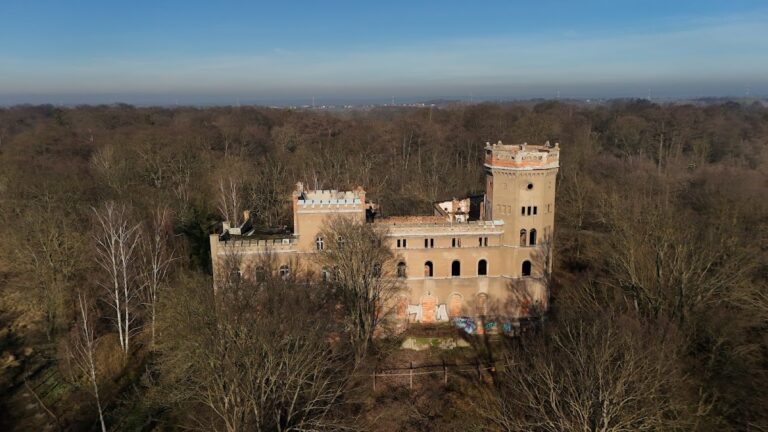
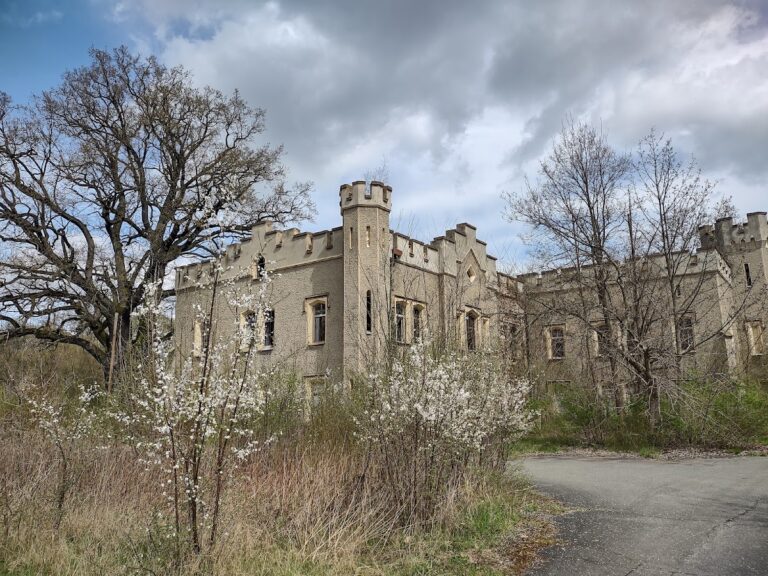
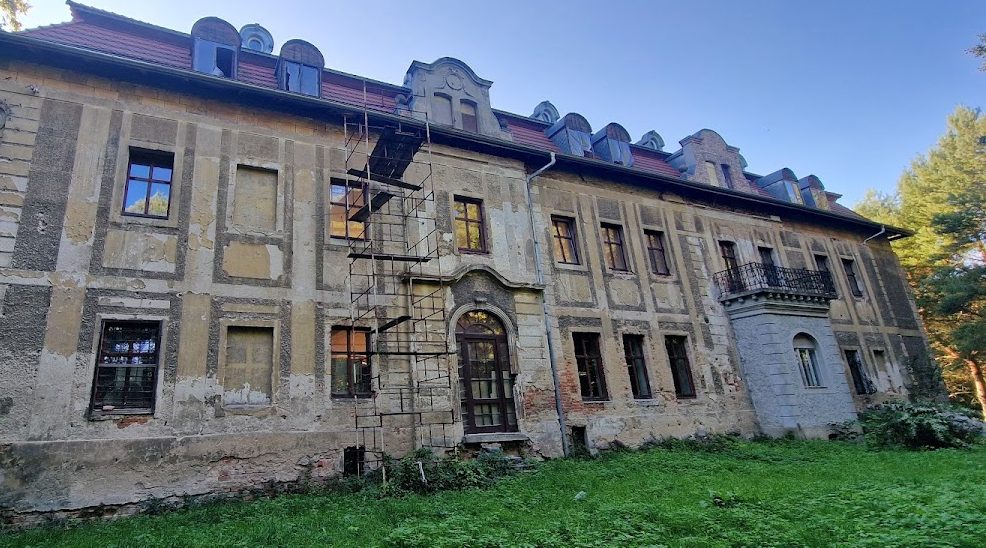
Palace in Strzeszów survives as a palace-and-park complex. The residence occupies an L-shaped plan and has two storeys, reflecting the rebuilding carried out after 1761. A moat originally surrounded the palace, while the grounds also include a park.
Palace Structure
A three-storey Baroque round tower was inserted into the angle between the palace wings. A balcony stands above the entrance portal, and a decorative date appears on the western elevation of the right wing. These elements belong to the building’s surviving architectural composition, which also preserves the relationship between the two wings and the tower.
Park
The historic complex includes a park alongside the palace. Its registration as part of the protected heritage of Strzeszów reflects the preservation of the palace grounds as an element of the estate.
Nearby sites