Sanctuary of Our Lady of Valleluogo: A Marian Shrine in Italy

Site at a Glance
- Rating
- 4.7
- Popularity
- Very Low
- Country
- Italy
- Primary era
- Early Modern
- External website
- Open
- Eras represented
- Early Modern, Modern
- Civilizations
- Italian, Kingdom of Naples
- Site type
- Religious
- Remains
- Sanctuary
On this page7 sections
History
The Sanctuary of Our Lady of Valleluogo is a Marian sanctuary in Italy, located near Ariano Irpino in the Diocese of Ariano Irpino-Lacedonia. A Marian sanctuary is a Christian shrine dedicated to the Virgin Mary, often connected with an apparition, miracle, sacred image, or longstanding pilgrimage. The sanctuary’s origins are traditionally placed in the Late Middle Ages, the later medieval period generally associated with the fourteenth and fifteenth centuries, although the date of its first construction is unknown.
Origins and Marian tradition
The sanctuary’s original name was Sancta Maria belli loci, meaning “Holy Mary of the beautiful place.” It later became Santa Maria di Valleluogo, while its official diocesan designation has been Sanctuary Salus Infirmorum, or “Health of the Sick,” since 1957.
According to tradition, the Virgin Mary appeared in the valley to the deaf and mute daughter of a local miller. The girl is said to have immediately gained hearing and speech, after which Mary requested that a chapel be built at the site. A simple tabernacle was installed first. As worshippers increased and reports of healing and divine favor attracted further devotion, a chapel was built and supported by substantial voluntary offerings.
Pilgrimage and twentieth-century development
During its early centuries, the sanctuary drew worshippers throughout the year. From the nineteenth century, larger numbers of pilgrims, including visitors from beyond the diocese, increasingly gathered for the three-day celebration of Pentecost, the Christian feast commemorating the descent of the Holy Spirit.
Eighteenth-century records refer to “comfortable lodgings” for the numerous faithful who came to the shrine. In the mid-twentieth century, a larger accommodation facility was built as the mother house, or principal residence, of the Silenziosi Operai della Croce. This Catholic organization of the faithful was founded by Blessed Luigi Novarese, an Italian Catholic religious figure associated with pastoral care for sick and disabled people, and was recognized by the former Pontifical Council for the Laity. The facility was intended to receive sick people and pilgrims.
Remains
The sanctuary stands in the Campanian Apennines, about 3 kilometres north of Ariano Irpino, at an elevation of 530 metres above sea level. It occupies a vegetation-rich valley beside a stream and an old mule track leading toward Montecalvo Irpino. The surviving complex brings together the small chapel, the historic water mill associated with the apparition tradition, and the mid-twentieth-century accommodation facility.
Chapel and sacred image
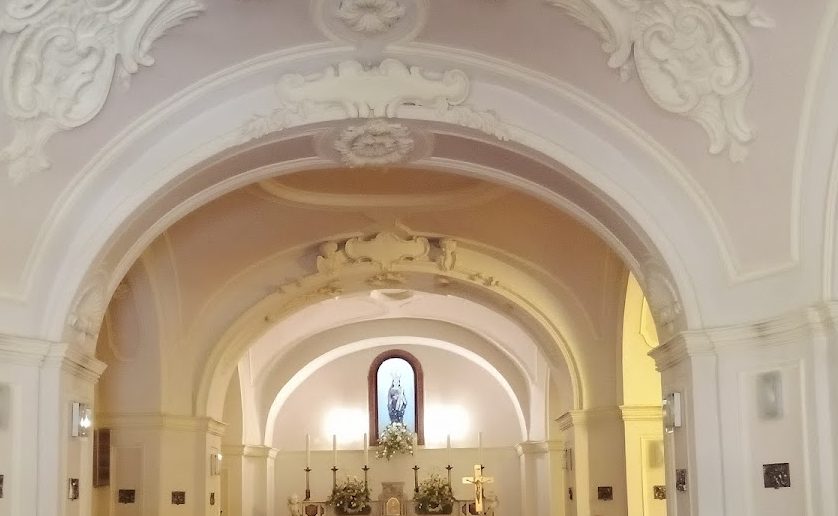
The church is a small chapel with an interior decorated in the Baroque style, a European artistic and architectural style known for rich ornament and dramatic religious expression. It houses a fifteenth-century statue of the Madonna, preserving a medieval image within the later decorated interior.
Water mill and valley setting
A water mill stands near the chapel in the same valley, where tradition places the apparition. After many centuries of abandonment, the mill was restored during the Jubilee Year 2000, fulfilling an aspiration expressed during Blessed Luigi Novarese’s lifetime. Its survival preserves the setting associated with the sanctuary’s founding story.
Pilgrim accommodation
The complex also includes the mid-twentieth-century mother house of the Silenziosi Operai della Croce. Built to receive sick people and pilgrims, it continues the sanctuary’s long association with organized accommodation and care, which is already reflected in the eighteenth-century references to lodgings for visiting worshippers.