Saint Helena’s Church, Trnava: A Medieval Gothic Hospital Church in Slovakia


Site at a Glance
- Rating
- 4.8
- Popularity
- Very Low
- Country
- Slovakia
- Primary era
- Medieval
- External website
- Open
- Eras represented
- Medieval, Early Modern
- Civilizations
- Habsburg, Hungarian
- Site type
- Religious
- Remains
- Church
On this page10 sections
History
Saint Helena’s Church, Trnava, is a Roman Catholic church in Slovakia founded in the fourteenth century as a Gothic hospital church. It stands among the oldest monuments in Trnava and belongs to the Trnava Archdiocese, the Trnava Deanery, and the Trnava–Saint Nicholas parish.
Foundation and dedication
The church was established alongside a municipal xenodochium, a charitable institution that provided care and shelter for the sick, elderly, poor, or travellers. The adjoining institution was probably founded in the mid-fourteenth century and was rebuilt in the Classicist style during the first half of the nineteenth century.
The church may originally have been dedicated to Saint Michael the Archangel, a Christian figure associated with protection and the defeat of evil. Its dedication changed to Saint Helena, the fourth-century Roman empress traditionally linked with the discovery of the True Cross, either during the fourteenth or fifteenth century.
Later development
The earliest surviving written reference to the church dates from 1490. It records damage to the building and its furnishings, providing evidence of an early period of upheaval in the church’s history.
The building was remodelled during the Baroque period, when chapels were added on both sides of the nave. Since 2010, it has also served as the parish church of the Greek Catholic Parish of Saint Luke the Apostle and Evangelist in Trnava. The church was registered as a Slovak national cultural monument on 17 September 1963.
Remains
Gothic structure and exterior
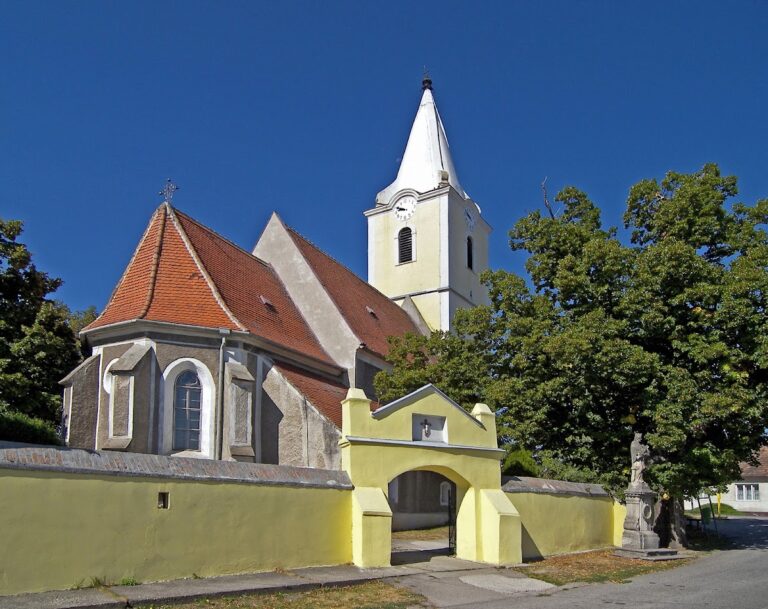
Saint Helena’s Church stands on Hlavná Street at the southern end of Trnava’s historic old town. It is an oriented masonry building with a single nave, a polygonally closed presbytery, and gabled roofs. The church has no main tower. Its Gothic character is expressed especially by the ribbed cross vaults covering both the nave and presbytery.
Presbytery and north turret
The presbytery was probably the earliest part of the building. A Gothic stone sacramentarium, a wall recess for sacred vessels or the Eucharist, is set into its wall and is closed by a forged metal grille. On the north side stands an octagonal Gothic turret with tracery windows and a tower roof. It contains the Saint Elizabeth bell from 1766 and the Saint Helena bell from 1771.
Entrance portal and facade cross
Above the Gothic entrance portal is a stone tripartite edicule containing sculptures of Saint Elizabeth, Saint Helena, and Saint Barbara. The central figure of Saint Helena is Gothic and dates from around 1400. Beside the facade stands a massive stone cross carved in 1739 by Ignác Melczer, a local stonemason.
Chapels and interior furnishings
Baroque chapels are attached to the two sides of the nave. Coloured stained glass fills the windows, while the simple main altar is Neo-Gothic and dates from the end of the nineteenth century. The organ was made before 1900 by Karl Neusser of Nový Jičín.
Southern chapel altar
The southern chapel contains an altar of the Man of Sorrows dating from around 1700. Its central sculpture represents the Sacred Heart, a Christian devotional image of Jesus’s heart expressing love and compassion. The altar’s side wings are Late Gothic and date from around 1500. Together, these elements form the only winged panel altar in Trnava.
Northern chapel altar
The northern chapel contains a side altar with a painting of Our Lady of Loreto dating from 1725–1728. This Baroque work forms part of the later furnishing associated with the chapel additions to the medieval church.