Gallo-Roman Sanctuary of Villards-d’Héria in France
Site at a Glance
- Popularity
- Low
- Country
- France
- Primary era
- Classical
- Eras represented
- Classical
- Civilizations
- Celtic, Roman
- Site type
- Religious
- Remains
- Sanctuary
On this page11 sections
History
The sanctuary in antiquity
The Gallo-Roman Sanctuary of Villards-d’Héria is an ancient sacred complex in France associated with the Sequani, a Celtic people of eastern Gaul. Gallo-Roman describes a culture shaped by Roman rule and local Gallic traditions. The sanctuary’s monumental remains date from the 1st to 3rd centuries CE. The site developed around the point where the Héria stream resurfaces and was probably connected with temples beside Lake Antre, about 1 km upstream to the southeast, where the stream disappears underground.
Study and conservation
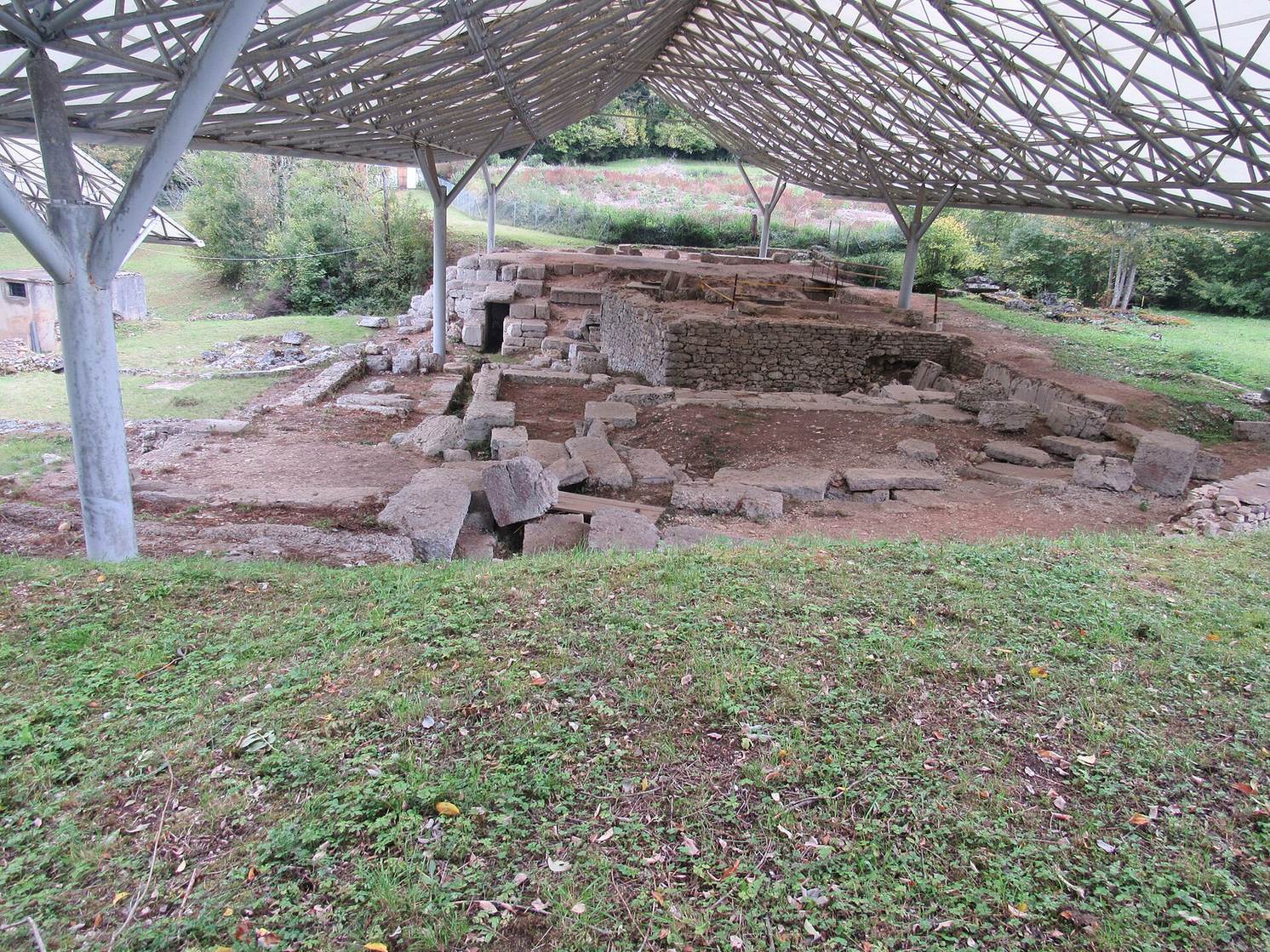
The site attracted attention by the 16th century, and the French historian and antiquarian Pierre-Joseph Dunod studied it in the late 17th century. Scientific excavations began in 1960 under the archaeologist Lucien Lerat and continued until 1982; new campaigns began in 2019. The sanctuary was classified as a historic monument in 1965. Its associated aqueduct had been registered for protection in 1948, and other remains were registered in 1992. Protective structures suffered weather damage in 2013. A conservation scheme proposed roofs over the excavated areas rather than permanent reconstruction, with the aim of protecting the remains while limiting visual impact.
Remains
The complex follows the Héria valley. A bridge crosses the stream, while galleries and platforms connect the sanctuary area to its bathing complex. Further Gallo-Roman remains extend along the valley toward the confluence of the Héria and Bienne.
Sanctuary precinct
Bridge and temple
The Pont des Arches bridge spans the Héria and forms part of the sanctuary complex. A temple is another principal element of the site.
The Roman well
A sacred spring or fountain within the sanctuary is known as the “Roman well.”
Bathing complex
The bathing complex includes two ritual pools and offering boxes. A portico, a roofed colonnade or porch, has an apse, a curved end to a building. Large drains run outside the complex’s walls, particularly beside the portico.
Fountain sanctuary and related remains
Fountain sanctuary
A fountain sanctuary, also described as a monumental fountain associated with a water source, is another principal feature of the complex.
Aqueduct and valley remains
An aqueduct is associated with the sanctuary. Additional Gallo-Roman remains stretch through the Héria valley between Villards-d’Héria and Jeurre, near the point where the Héria joins the Bienne.