Abbaye du Grandvaux: A Medieval Augustinian Abbey in France


Site at a Glance
- Rating
- 4.6
- Popularity
- Low
- Country
- France
- Primary era
- Medieval
- Eras represented
- Medieval
- Civilizations
- French, Holy Roman Empire, Spanish
- Site type
- Religious
- Remains
- Church
On this page8 sections
History
Abbaye du Grandvaux is a former religious foundation in France, near Saint-Laurent-en-Grandvaux in the present commune of Grande-Rivière, with origins in the sixth century and a major rebuilding as an Augustinian abbey in 1172. Its history reflects the changing control of religious institutions in the Jura lake region, where the foundation eventually became dependent on the powerful Abbey of Saint-Oyand, later known as Saint-Claude.
The sixth-century foundation
The earliest foundation was established around 523–531, when the abbot of Saint-Oyand sent monks into the Jura lake region. Aubert and his companions founded a priory dedicated to Notre-Dame on a small peninsula in the lake later called the Lac de l’Abbaye. The beginnings of this community are poorly documented and remain debated.
The monks cleared and developed the surrounding territory, which lies at nearly 900 metres above sea level, and encouraged colonists to settle there. The foundation remained limited in size and declined over time. It probably disappeared during the tenth or eleventh century.
The Augustinian abbey
In 1170, Thibert de Montmorot revived the monastery and invited Augustinian canons from Abondance Abbey in Savoy. Augustinian canons regular were clergy who lived together according to the Rule of Saint Augustine. New buildings were begun at the north-eastern end of the lake, and the monastery was completed in 1172.
In March 1172, Géraud I de Mâcon, also identified as Girard de Vienne and the local suzerain, confirmed the foundation and approved its elevation to abbey status. The new abbey remained under the authority of Abondance Abbey. It received substantial endowments, including forests and pastures in Grandvaux and vineyards near Lons-le-Saunier.
Grandvaux remained an Augustinian institution from its elevation in 1172 until its reduction in 1244. It then became a small priory associated with Saint-Oyand Abbey. A priory was a smaller religious house that was normally subordinate to an abbey.
Disputes and absorption by Saint-Claude
The community soon became involved in disputes with the Carthusians of Bonlieu, local lords, and especially Saint-Oyand Abbey. A Carthusian charterhouse was a monastery of the Carthusian order, whose communities were generally organised around secluded houses and individual cells. At Grandvaux, the conflicts concerned possessions, territorial rights, and rights of justice. Saint-Oyand also demanded substantial payments based on its earlier claims in the area.
In 1226, Pope Honorius III placed the abbey under the direct protection of the Holy See in an attempt to strengthen its position. The disputes with Saint-Claude continued, particularly over the alleged usurpation represented by Grandvaux’s refoundation. The foundation was eventually absorbed by its more powerful neighbour.
In November 1244, Abondance Abbey concluded an exchange of territories, with the agreement of the archbishop of Besançon and Humbert de Montmorot. Pope Innocent IV approved the exchange in a brief dated 1250. A papal bull issued from Avignon in 1276 then united the Grandvaux priory and its dependencies with Saint-Oyand Abbey.
The reduced priory and the Revolution
The territorial boundaries with Bonlieu Charterhouse were settled in 1301 under the authority of Jean I de Chalon-Arlay. The prior of Grandvaux nevertheless resisted the merger for many years. A papal bull of December 1388 finally transferred Saint-Oyand’s control over the monastery, together with its usages, rights, and prerogatives. Possession was taken in February 1389.
After 1389, the institution was reduced to a priory with only two monks, a prior and a sacristan. Its dependence on Saint-Claude continued after that abbey was secularised in 1742 and lasted until the Revolution. The priory was eventually abandoned, although the date is uncertain. Saint-Claude retained territorial rights, including mainmorte, a feudal institution that restricted the inheritance or transfer of property held by dependent populations, until the Revolution.
At the Revolution, the priory disappeared along with the Abbey of Saint-Claude and was sold as national property. Monastic occupation ceased, while the church became the centre of a large parish. The site’s memory survives in the name Lac de l’Abbaye, and the former foundation remains associated with the Jura department of Bourgogne-Franche-Comté.
Remains
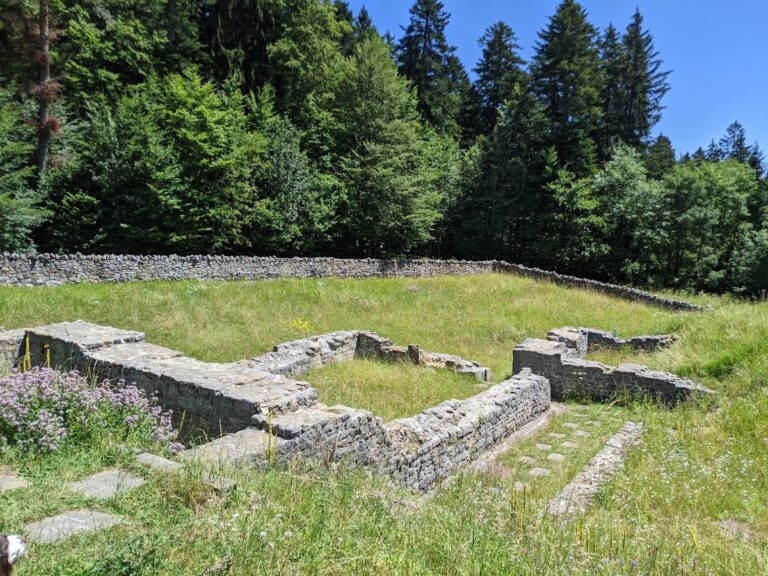
The surviving site combines the lake setting of the early foundation with the later buildings established at the lake’s north-eastern end. The sixth-century priory occupied a small peninsula in the lake. The twelfth-century monastery was a compact enclosure consisting of a square cloister and a church, surrounded by a wall and a ditch equipped with a drawbridge.
The later monastic buildings
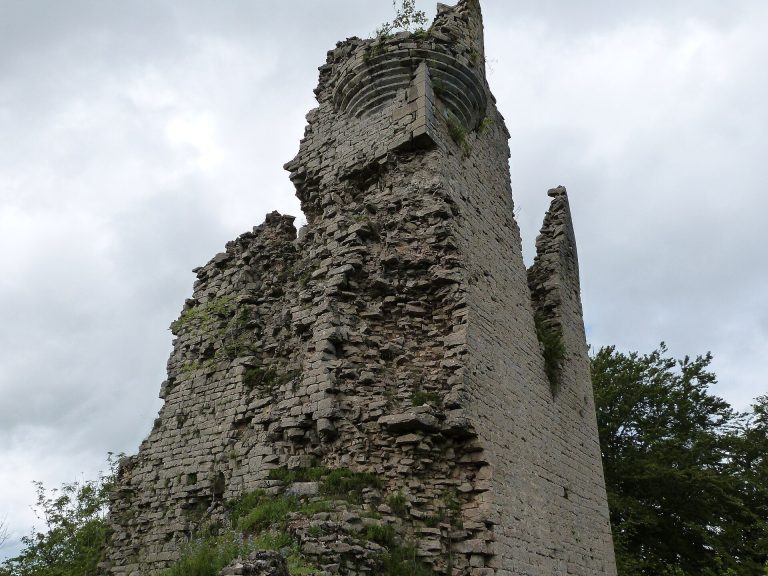
The medieval conventual buildings have disappeared or fallen into ruin. Abbots of Saint-Claude later erected a building known as the priory beside the church, as well as a barn and an abbatial house. Subsequent occupants altered these structures, and the abbatial house was converted into a presbytery.
The parish church
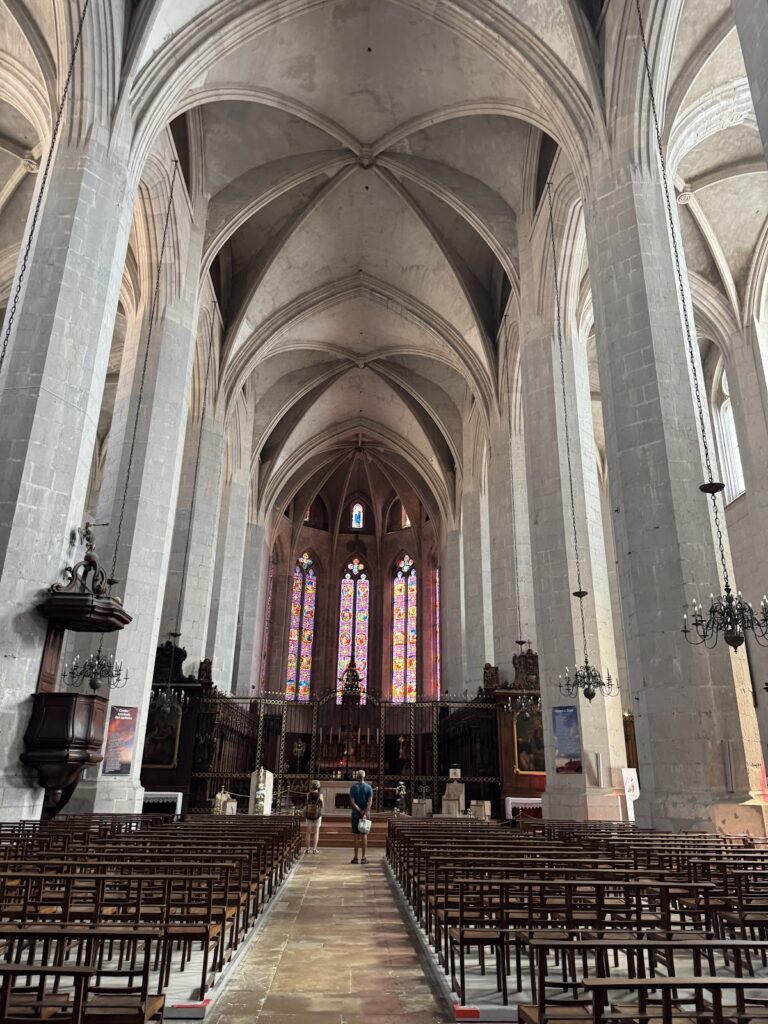
The parish church was rebuilt in the seventeenth century after the Ten Years’ War and completed in the eighteenth century. It is the only important surviving architectural remnant of the former Grandvaux Abbey and preserves the site’s later religious continuity after monastic occupation had ended.