San Salvi: A Vallombrosan Abbey Church in Florence


Site at a Glance
- Rating
- 4.4
- Popularity
- Low
- Country
- Italy
- Primary era
- Medieval
- External website
- Open
- Eras represented
- Medieval, Early Modern
- Civilizations
- Grand Duchy of Tuscany, Holy Roman Empire, Republic of Florence
- Site type
- Religious
- Remains
- Monastery
On this page15 sections
History
San Salvi, also known as the Church of San Michele in San Salvi, is a Roman Catholic church in Florence, Italy, built around 1048 by the Vallombrosans, a Benedictine reform order founded by Giovanni Gualberto. The medieval abbey church developed in open countryside outside Florence’s walls and became one of the city’s oldest parish churches beyond its fortifications. It is dedicated to the Archangel Michael, while the adjoining monastery retained its dedication to Saint Salvio.
Foundation and Vallombrosan reform
Giovanni Gualberto founded San Salvi on the site of an earlier chapel. The choice of location was associated with an apparition of Saint Salvio, a seventh-century bishop of Amiens. The new abbey became an important religious center in the Florentine countryside and a stopping place on the pilgrimage route to Santissima Annunziata, Florence’s major Marian sanctuary.
San Salvi also played a part in Giovanni Gualberto’s campaign for stricter ecclesiastical discipline. From the abbey, he led a reform movement that contributed to the expulsion of Pietro Mezzabarba, a bishop accused of simony, the illicit buying or selling of church offices or spiritual privileges. The monastery subsequently became a center of Vallombrosan reform, a tradition that emphasized monastic discipline and religious renewal. In 1463, this movement produced the Sansalvini congregation, a congregation within the wider Vallombrosan order.
Expansion, siege, and reconstruction
During the early sixteenth century, the monks began enlarging the monastery. Their plans included a refectory, a lavabo or monastic washing installation, kitchens, and new cells. The cells were not completed because the project was interrupted by the Siege of Florence in 1529–1530, a military campaign that brought imperial forces against the Florentine Republic.
The church and monastery were damaged during the siege but survived. A longstanding tradition holds that San Salvi was the only church outside Florence’s walls spared by both sides. Florentine forces were creating a defensive scorched-earth zone, while the imperial troops are said to have respected the complex because of widespread admiration for Andrea del Sarto’s Last Supper fresco.
In 1534, the damaged and roofless complex was entrusted to enclosed Vallombrosan nuns from Faenza. Their former monastery had been affected by construction of the Fortezza da Basso, a sixteenth-century fortress in Florence. The nuns restored or completed much of the decoration visible today, built the portico, and raised the church floor to reduce the danger posed by recurrent flooding. They also assembled a substantial collection of artworks.
Suppression, collections, and modern restoration
Tuscan religious institutions were progressively suppressed during the political changes of the eighteenth and early nineteenth centuries. The nuns of San Salvi were suppressed in 1817, and the property of the order passed to the state through the Grand Duke.
During the French occupation, Vivant Denon, a French diplomat, administrator, and art director involved in Napoleonic cultural seizures, removed Raffaellino del Garbo’s Coronation of the Virgin with Four Saints from San Salvi and sent it to France. The painting is now preserved in the Louvre. After the Napoleonic suppression of Santa Maria a Monticelli, Carlo Portelli’s Adoration of the Shepherds was transferred to San Salvi. It was placed on the high altar after Raffaellino del Garbo’s painting was removed in 1812.
The church was severely affected by the flood of 1966 and underwent major restoration during the 1980s. During this work, the floor, which had been raised in the early modern period, was returned to its original level. The adjoining Museo del Cenacolo di San Salvi now occupies the former monastic refectory. Its collection focuses particularly on Florentine Mannerist painting, a sixteenth-century style associated with elongated forms, complex compositions, and deliberate artificiality.
Remains
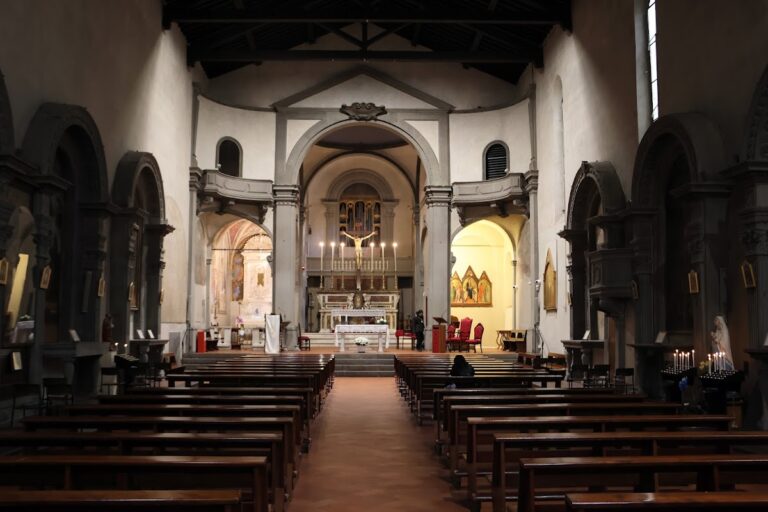
San Salvi preserves a medieval church arranged on an east-west axis, together with parts of its medieval masonry and the adjoining monastic complex. The church has a single nave in a Latin-cross plan, meaning that a long central space is crossed by a shorter transept. Its surviving structure includes a rectangular apse and a trussed roof supported by an exposed framework of roof timbers. The comparatively simple architecture is accompanied by frescoes, sculpture, and paintings that reflect the former wealth of the abbey.
The church structure
Plan and exterior
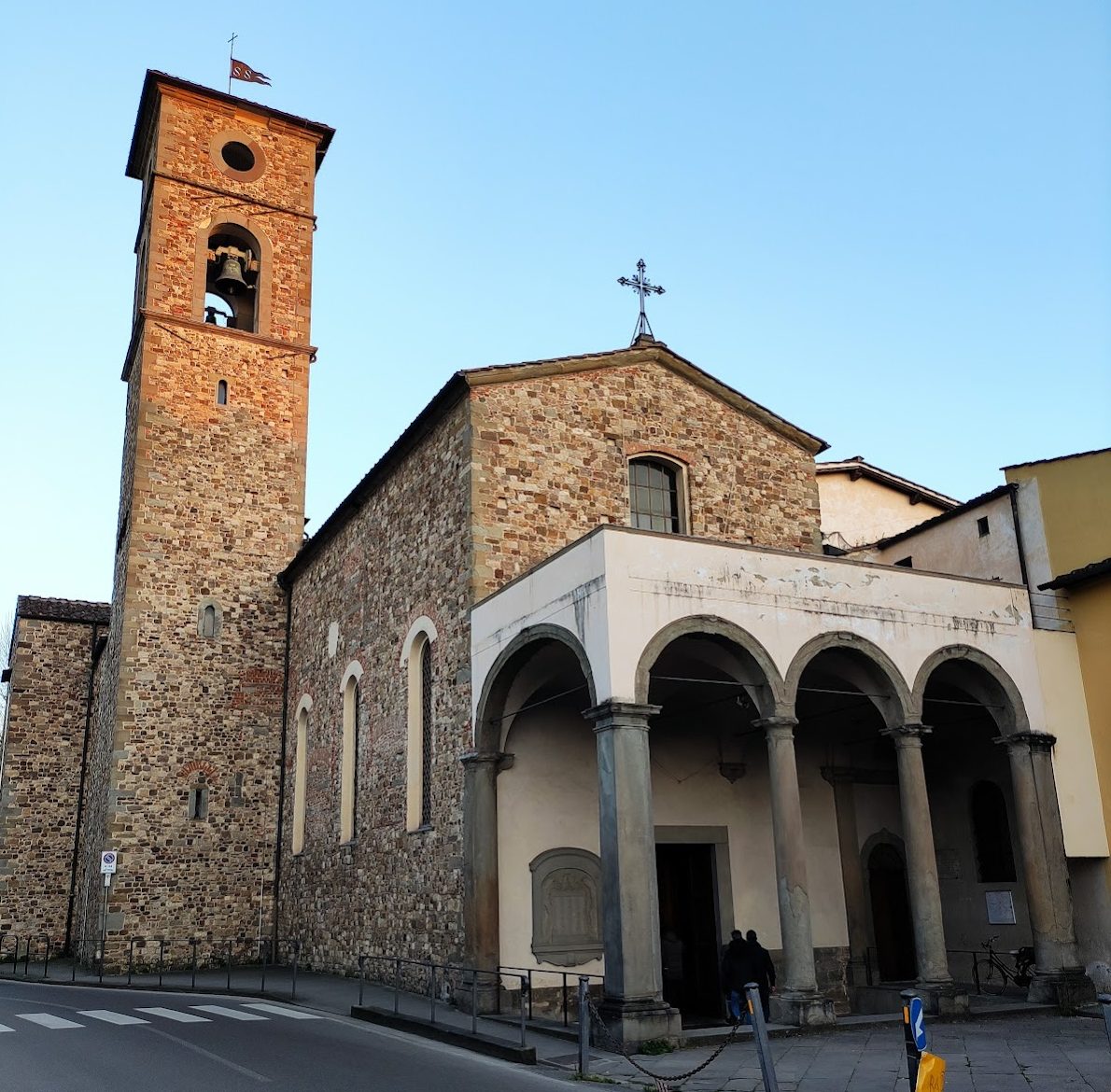
The church retains its medieval layout, with the nave leading eastward to the transept and rectangular apse. The principal change to the original exterior is the sixteenth-century portico, formed by three arches and added during the reconstruction after the siege. Parts of the earlier masonry remain within the later fabric, while the floor is now at the level established by twentieth-century restoration.
Nave and presbytery
Two fourteenth-century holy-water stoups stand at the entrance to the nave. In its second bay, a vault fresco by Vincenzo Meucci shows Saint Salvio in Glory and dates to approximately 1760–1764. Frescoes from the same period survive in the presbytery dome, the area around the main altar reserved for the clergy. They form surviving traces of the largely vanished Baroque arrangement.
Chapels and transepts
The right nave wall holds Fabrizio Boschi’s Madonna and Child with Saints. The nearby altar contains Domenico Cresti, known as Passignano, Miracle of the Child Resuscitated by Blessed Humility, painted in 1623–1624. The right transept leads to the Chapel of San Giovanni Gualberto, where fragmentary frescoes by an unidentified Florentine painter depict episodes from the saint’s life. In the adjoining chapel is Andrea Orcagna’s statue of Blessed Humility, while Cosimo Gamberucci’s Nativity of Christ, dated 1603, occupies the right-transept altar.
Two reliefs of Saints Salvio and Michael by Benedetto da Rovezzano stand on either side of the presbytery. They may have formed part of a later dismantled semi-octagonal pulpit. The high altar carries an early sixteenth-century wooden Crucifix, possibly by Baccio da Montelupo, set against a late sixteenth-century canvas of the Virgin and Saint John by a Florentine painter.
The left-transept altar contains Francesco Morandini, known as Il Poppi, Crucifixion and Saints. The Fanfani family erected the altar in 1575, according to the inscription at the base of its columns. Opposite it hangs Carlo Portelli’s Adoration of the Shepherds, painted in 1555 for a side altar at Santa Maria a Monticelli.
The former refectory and monastic buildings
Refectory
The former monastic refectory contains Andrea del Sarto’s monumental Last Supper, painted in 1526. The refectory complex also included the lavabo and kitchens planned during the early sixteenth-century enlargement. The room is now part of the Museo del Cenacolo di San Salvi, whose collection is especially associated with Florentine Mannerist painting.
Cloister
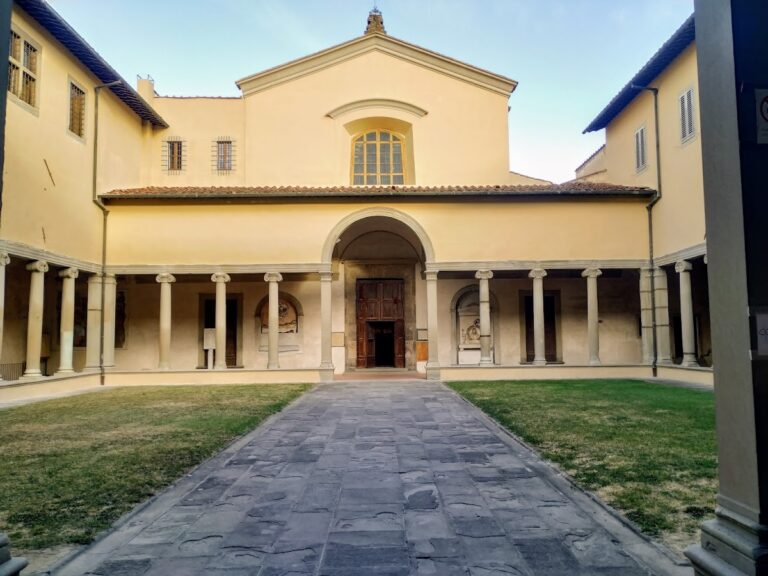
The cloister stands to the right of the church. Its covered walkway around an enclosed courtyard has a fourteenth-century portico and an upper loggia, an open-sided gallery, from the mid-fifteenth century. Above the chapter-house door is Benedetto da Rovezzano’s relief of Saint Giovanni Gualberto between two Vallombrosan monks.
The cloister complex preserves a fourteenth-century fresco attributed to Cenni di Francesco. A room between the cloister and the church contains a medieval fresco with animals, a rare example of this type of painted decoration within the complex.
Paintings and movable works
Frescoes and altarpieces
The counterfacade, the interior wall opposite the main entrance, preserves detached frescoes of the Madonna and Child by Lorenzo di Bicci, made with the collaboration of Bicci di Lorenzo around 1414. They came from the Madonnone Tabernacle. The church’s paintings also include works associated with Bartolomeo di Giovanni, Antonio del Ceraiolo, Giovanni Antonio Sogliani, the Master of Memphis, Franciabigio, Neri di Bicci, and Raffaellino del Garbo.
Former San Salvi collection
The former San Salvi collection included Verrocchio and Leonardo’s Baptism of Christ, which is now in the Uffizi. Other works associated with the collection include paintings of Saint Jerome, Saint Michael, the Madonna and Child, the Madonna of the Girdle with Saint Anthony of Padua, a Crucifixion with Saints, Noli me tangere, a praying Madonna, and the Holy Trinity with Saints James, Mary Magdalene, and Catherine of Siena. Together with the surviving frescoes and altarpieces, these works preserve the artistic history of the church and its former monastic community.
Nearby sites