Church of Saint Henry and Saint Cunigunde: Prague’s New Town Parish Church


Site at a Glance
- Rating
- 4.8
- Popularity
- Low
- Country
- Czechia
- Primary era
- Medieval
- External website
- Open
- Eras represented
- Medieval, Early Modern, Modern
- Civilizations
- Habsburg, Holy Roman Empire, Kingdom of Bohemia
- Site type
- Religious
- Remains
- Church
On this page16 sections
History
The Church of Saint Henry and Saint Cunigunde is a Gothic parish church in Prague, Czechia, built between 1348 and 1351 during the creation of the city’s New Town. Founded by King Charles IV, the New Town provided the urban setting for the church, which stood near the older settlement of Chudobice and became the principal parish church of the new district.
Foundation and parish establishment
The Knights of the Red Star built and initially administered the church. On 28 February 1351, the boundaries between the parishes of Saint Stephen and Saint Henry were formally established. Archbishop Arnošt of Pardubice consecrated the church in February that year, and it received parish status on 16 March 1351.
The dedication honours Henry II, the German king and Holy Roman Emperor who reigned from 1002 to 1024, and his wife Cunigunde of Luxembourg, who was later venerated as a saint. The church remains a Roman Catholic parish church, serving the local Czech parish as well as Slovak and Hungarian personal parishes in Prague.
Hussite and Utraquist periods
During the Hussite period, when followers of the reform movement associated with Jan Hus took control of many religious institutions, the church came under Hussite administration. The moderate Hussite priest Prokop of Plzeň served there, and the church was later administered by Utraquists, a Hussite branch that emphasized communion under both bread and wine. A parish school was established beside the church.
A prominent literary brotherhood also operated at Saint Henry during the Utraquist period. Such brotherhoods were lay religious associations often connected with the singing and performance of liturgical music. This brotherhood became one of the oldest and wealthiest of its kind in Bohemia, until Emperor Joseph II dissolved it in 1784 and its property was sold.
Seventeenth- and eighteenth-century changes
After the Battle of White Mountain, the church was intended to return to the Knights of the Red Star. The order renounced it in favour of the Barnabites in 1646, but the Barnabites did not accept the transfer. In 1649, Emperor Ferdinand III assigned the church to the municipality of Prague’s New Town.
The church underwent major Baroque changes during this period. Chapels were added and the interior received new furnishings. The surrounding cemetery had been used particularly heavily during plague epidemics, when it became the largest cemetery within Prague’s city area. Burials there ended by 1787.
War damage, restoration, and later use
Prussian bombardment damaged the church and its Gothic tent roof. The roof was later replaced by a simpler Baroque roof. The freestanding bell tower also served a defensive role during the Swedish siege of Prague in 1648, an episode later represented in the church’s main altarpiece.
In the nineteenth century, Joseph II’s prohibition of burials within city walls led to the dissolution of the cemetery. The cemetery, its charnel house, and the Jerusalem Chapel were removed during remodeling, and the former burial ground became a small park. Josef Mocker directed a major Neo-Gothic restoration of the church around 1875 and of the adjoining bell tower in 1879. The church entered the state list of cultural monuments in 1964.
The church is also associated with the baptism of the poet Rainer Maria Rilke, who was baptized there on 19 December 1875. Until 2021, Masses in the extraordinary form of the Roman Rite, the pre-1970 form of the Roman Catholic liturgy, were regularly celebrated under the auspices of the Priestly Fraternity of Saint Peter. This practice ended after Pope Francis’s Traditionis custodes and implementing directives of the Prague archbishopric prevented further celebration of that liturgy there.
On 20 March 2022, premises in the adjoining parish house were blessed for Adalbertinum, a residence for Hungarian students in Prague. It was financed by the Hungarian Bishops’ Conference and operated by the Hungarian personal parish.
Remains
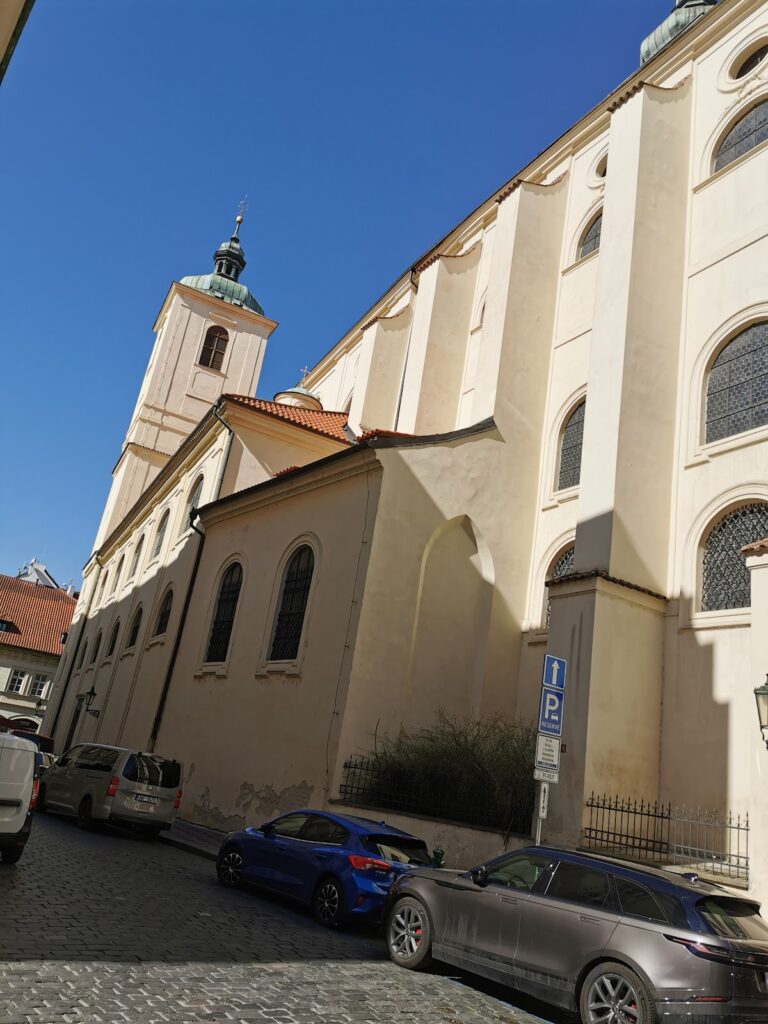
The surviving church is a Gothic stone building arranged in four bays and three aisles of equal height. Its present appearance combines Gothic construction with Renaissance, Baroque, and nineteenth-century Neo-Gothic phases. The buildings and furnishings preserve evidence of repeated changes in religious use, artistic taste, and the physical impact of warfare.
Bell tower and Renaissance additions
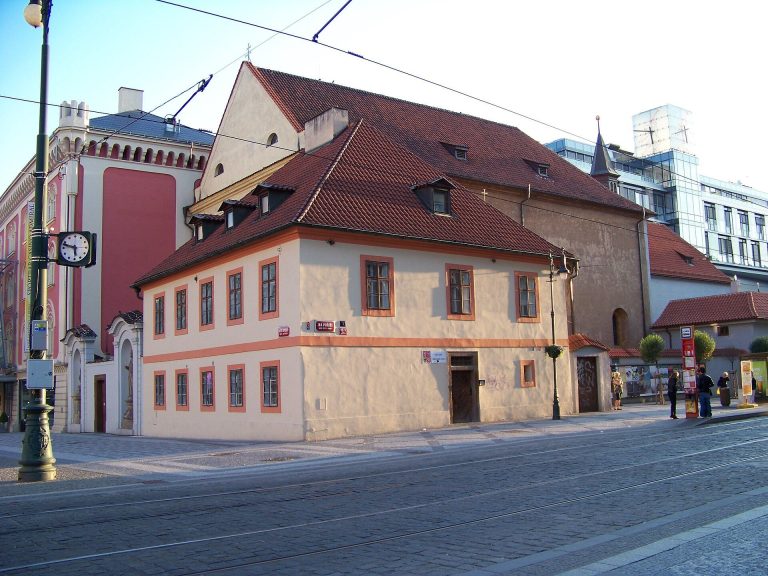
Before the detached bell tower was built, the tower at the church’s southwestern corner probably held the bells. The freestanding Jindřišská Tower was constructed around 1472 to 1476 for larger and heavier bells. Its defensive use during the Swedish siege of 1648 added a military function to the structure. After a fire in 1745, the tower received its present Baroque bell-shaped roof.
A Renaissance remodeling in the 1520s created the church gallery, an elevated platform used for singers or musicians. The work also added a vestibule in front of the entrance and a stone staircase connecting the vestibule with the gallery.
Baroque interior and main altar
Interior furnishings
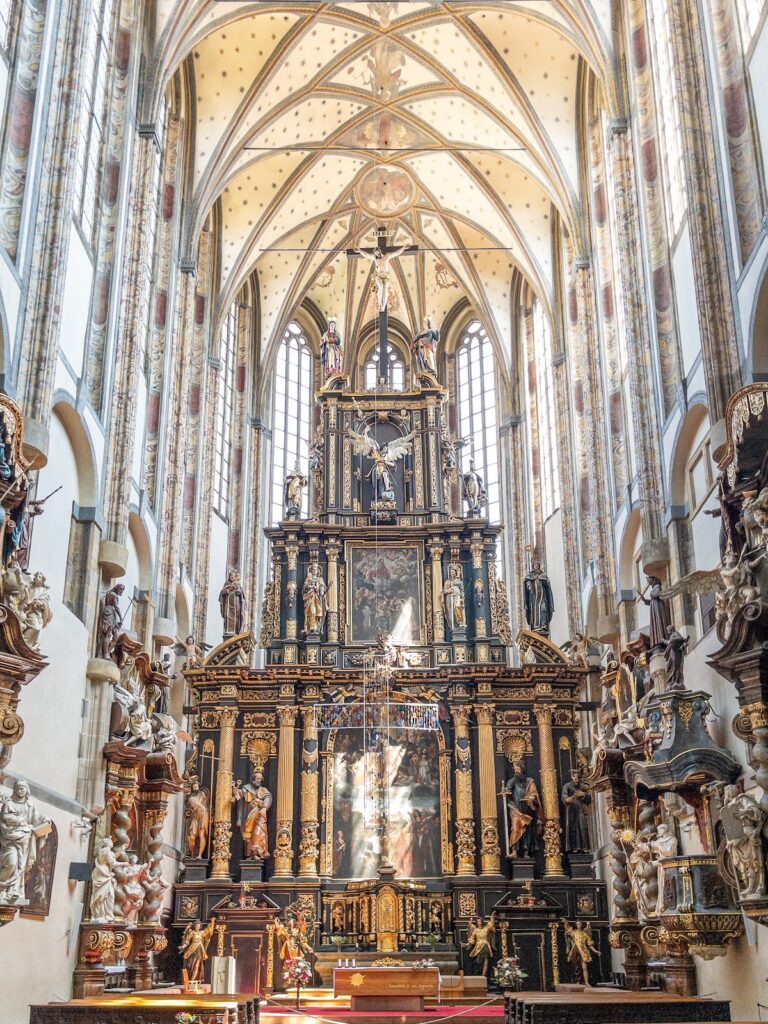
The interior furnishings are predominantly Baroque. Paintings and sculptures by Václav Vavřinec Reiner, Karel Škréta, Jan Jiří Heinsch, and Jan Jiří Bendl were installed progressively between 1738 and 1741. A cycle of wall paintings showing the life of Saint Henry occupies the presbytery, the part of the church surrounding the main altar and historically reserved for clergy. The literary brotherhood financed the cycle, which was created in 1745.
Main altar
The altar architecture behind the main altar came from the former church of the Cyriac Brothers’ Monastery of the Holy Cross in Prague’s Old Town after Joseph II dissolved the monastery. The principal altarpiece is an original 1698 painting by Jan Jiří Heinsch, enlarged several times. It depicts Saint Henry protecting Prague during the Swedish siege and Saint Cunigunde walking over red-hot ploughshares to prove her innocence after an accusation of adultery.
Side chapels
Chapel of Saint Barbara
Built in 1672 as thanksgiving for deliverance from the Swedish siege of Prague, the Chapel of Saint Barbara contains a model of a cannonball and statues of Saint Roch, Saint Sebastian, Saint Joseph, Saint Teresa, Saint Wenceslaus, and Saint John of Nepomuk. Its marble altar dates from 1746 and carries a valuable 1673 painting of Saint Barbara by Matěj Zimprecht. The chapel served as a baptismal chapel from the nineteenth century, while its separate sacristy was later demolished during Mocker’s remodeling.
Chapel of the Virgin Mary
The Chapel of the Virgin Mary, also called the Malanotský Chapel, was built in 1685. Its principal surviving feature is a seventeenth-century Baroque Pietà, placed in an altar niche dating from 1765.
Chapel of Saint Luke
The Chapel of Saint Luke, also known as the Krocín Chapel, was built in 1696. Its altar architecture and painting date from 1700, and Jan Jiří Heinsch painted Saint Luke painting the Virgin Mary. The dedication also made the chapel the guild chapel of New Town’s painters. Beneath the principal painting is a smaller image of the Sacred Heart of Jesus, regarded as one of the oldest surviving representations of the subject in Bohemia.
Neo-Gothic alterations and war traces
Mocker’s incomplete Neo-Gothic remodeling changed the church’s exterior and interior. Gothic and Renaissance sections of the facade were removed by stripping the surface down to bare stone. More than half of the side altars were destroyed by burning, a new organ was installed, a new entrance to the church treasury was made, and new stained-glass windows were inserted into the Gothic windows.
The exposed masonry created by this treatment does not show the original Gothic appearance, since Gothic buildings were normally plastered. Gravestones from the former cemetery were attached to the facade, while other tombstones were placed in the entrance area inside the church. Many cannonballs from the Prussian bombardment remain visible in the vaults, linking the surviving fabric with the damage that also led to the replacement of the original roof.
Statues by the entrance
Beside the entrance stands a 1709 statue of Saint John of Nepomuk by Michal Josef Brokoff. Opposite it is a 1709 statue of Saint Jude Thaddeus by an unknown artist. Both statues were transferred from the former entrance gate to the cemetery, which stood along present-day Jindřišská Street.