San Cosimato: Former Benedictine Monastery and Church in Rome


Site at a Glance
- Rating
- 4.6
- Popularity
- Low
- Country
- Italy
- Primary era
- Medieval
- Eras represented
- Medieval
- Civilizations
- Papal States
- Site type
- Religious
- Remains
- Monastery
On this page8 sections
History
San Cosimato is a former Roman Catholic church and monastery in Rome, Italy, in the Trastevere district, dedicated to Saints Cosmas and Damian. The complex originated in the tenth century as a Benedictine monastery. Cosmas and Damian were early Christian physician martyrs who became patron saints of medicine. The monastery was associated with the designation in mica aurea, linked to the yellowish river sand found in the area, and the name San Cosimato developed through a corruption of the original dedication or designation.
Medieval origins
An interpretation associated with Nibby, Fea, and Canina places the monastery on the site of the Naumachia Augusti, an ancient Roman installation associated with Augustus for staged naval spectacles. In 1233, the monastery passed from Benedictine jurisdiction to the Recluses of Saint Damian, identified with the Poor Clares, a contemplative Franciscan order of nuns also known as the Order of Saint Clare.
Fifteenth-century rebuilding
For the Jubilee of 1475, Pope Sixtus IV della Rovere ordered the church and monastery to be restructured. Sixtus IV was a fifteenth-century pope associated with artistic and building projects. An inscription on the architrave, the horizontal member framing the top of a doorway, records the work on the portal of the fifteenth-century church.
Damage and later changes
General Oudinot’s attack on the Roman Republic in 1849 seriously damaged the church and monastery. The destruction included the complex’s formerly renowned frescoes, among them works by Pinturicchio. The church interior was reconstructed in 1871. In 1891, the city of Rome took over the convent and converted it into a hospice. The nuns moved first to San Gregorio al Celio and later between several monasteries before settling in a new Monastery of San Cosimato near Porta San Paolo in 1933.
From 1960, the former monastic complex housed the Ospedale Nuovo Regina Margherita. The church is no longer listed by the Diocese of Rome and was probably deconsecrated. The hospital and hospice are listed as chaplaincies of the parish church of San Francesco a Ripa. The church and former monastery now form part of the hospital complex on Piazza di San Cosimato.
Remains
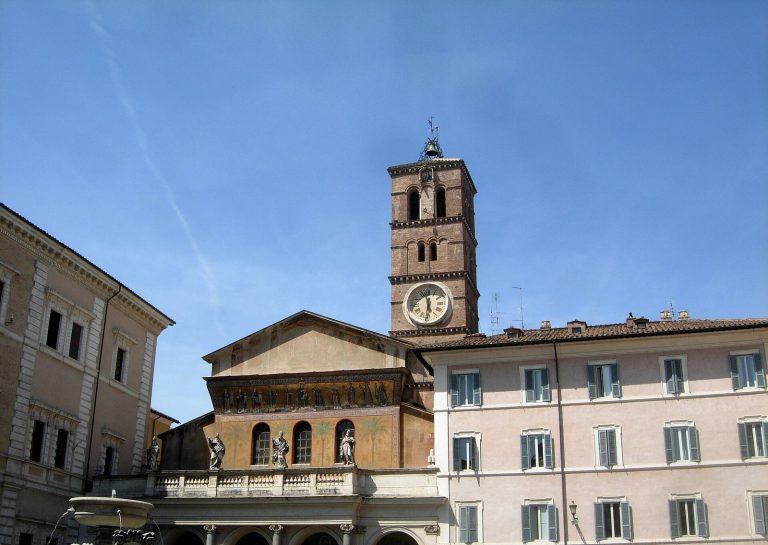
San Cosimato survives as a compact former monastic complex facing Piazza di San Cosimato. Its buildings stand at a level lower than the present street, and the entrance arrangement preserves the relationship between the church, an earlier atrium, and the monastery’s cloisters. Reused materials are incorporated into the projecting medieval portico, while the small church and its adjacent Romanesque campanile remain part of the complex.
Portico and atrium
The facade of the former monastery faces the piazza from below the current street level. A projecting portico, built in the twelfth century with reused materials, precedes the entrance. It formerly opened into an atrium. Directly in front of the church, a large granite bathtub with rings and lion heads remains in situ. The church was reached from the atrium through a portal that is now closed.
Cloisters and monastic rooms
The entrance to the older cloister stood to the right of the atrium. This cloister, built in 1240, originally had two stories, although later renovations enclosed its upper arcades. The same period of work produced the chapter house, the monastery’s meeting room, and a second cloister with pillars and a covered well at its center. Together, these spaces preserve the principal elements of the monastery’s internal organization.
Church interior and bell tower
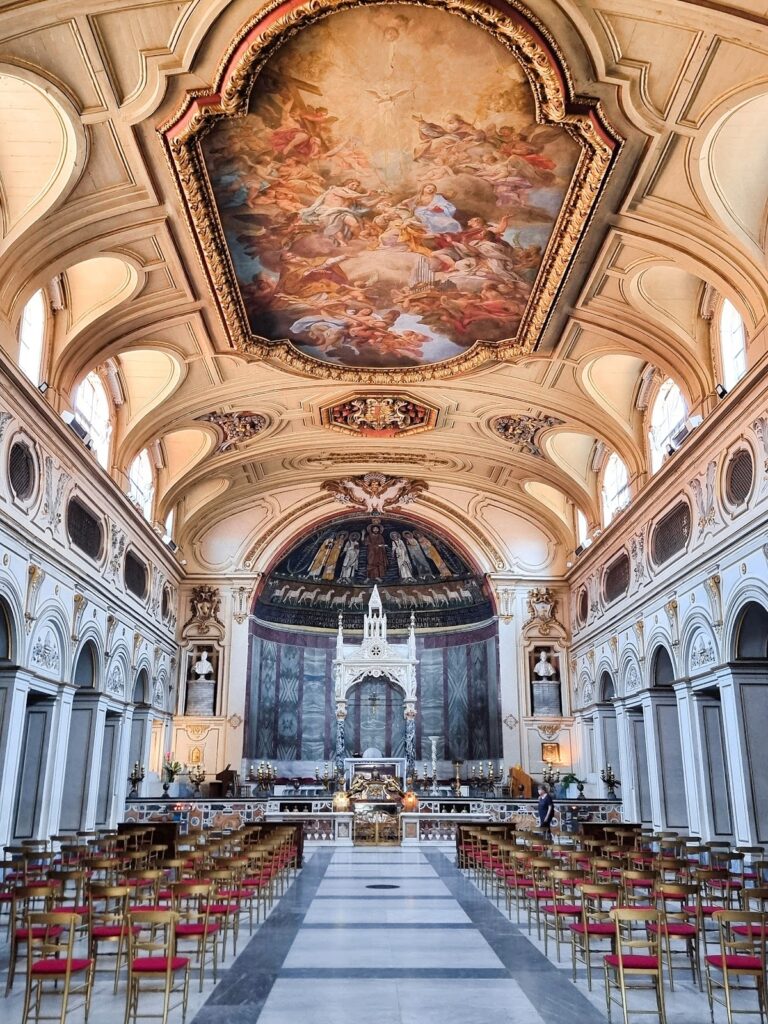
The church is a small single-nave building, compact in scale for a monastic church. Its present interior retains one fresco from the earlier fifteenth-century phase in the presbytery, the area around the main altar reserved for the clergy. The work, Madonna and Child between Saints Francis and Clare, is attributed to Antonio del Massaro, known as Il Pastura. A small Romanesque campanile, or bell tower, stands beside the church.