San Leo Cathedral: A Romanesque-Lombard Cathedral in Italy


Site at a Glance
- Rating
- 4.7
- Popularity
- Low
- Country
- Italy
- Primary era
- Medieval
- Eras represented
- Medieval, Early Modern
- Civilizations
- Unclassified
- Site type
- Religious
- Remains
- Cathedral
On this page12 sections
History
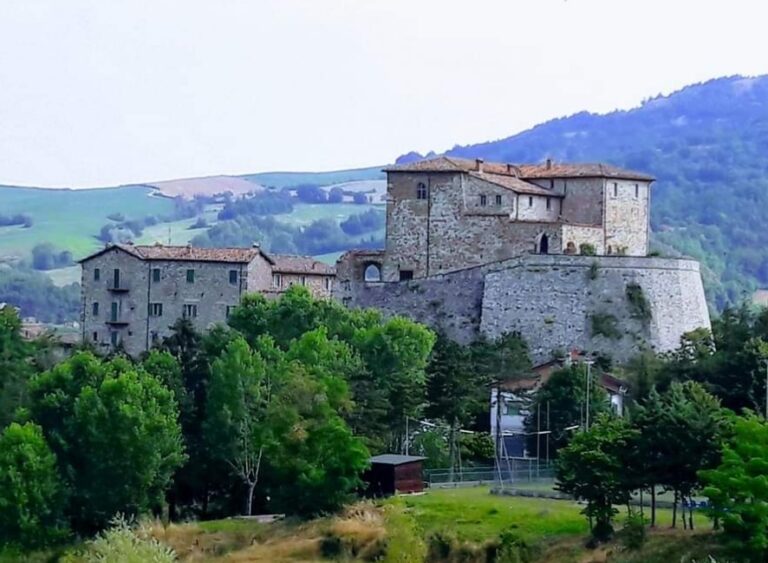
San Leo Cathedral is a Romanesque-Lombard Catholic cathedral in Italy, rebuilt in the twelfth century on a sandstone outcrop with a much older religious history. It is dedicated to Saint Leo, a local Christian hermit, and remains the principal church of the Diocese of San Marino-Montefeltro.
Early cathedral and episcopal quarter
The sandstone outcrop had been used for the worship of deities since prehistoric times. In the seventh century, when San Leo became a civitas, an urban settlement recognized as an important civic center, the site became the seat of the Montefeltro diocese. A cathedral dedicated to Saint Leo was established there, and elements of that early medieval church were incorporated into the present building.
The cathedral later formed the religious center of a distinct complex known as the episcopal quarter. This religious citadel included the bishop’s palace, the canons’ residence, guesthouses, a hospital, the sacristy, and probably a baptistery. The complex was probably fortified and retained its separate identity as a cathedral quarter for several centuries.
Twelfth-century rebuilding
A new cathedral was erected in the twelfth century in the Romanesque-Lombard style, a medieval architectural tradition characterized by heavy masonry, rounded arches, vaults, and solid forms. An inscription dated 1173 survives inside the church and probably records renovation by master builders from Emilia and Lombardy. The building’s pointed arches anticipate the later Gothic style.
Count Montefeltrano of Montefeltro donated the large suspended crucifix in 1205. It had originally been mounted on his carroccio, a ceremonial and military wagon used by medieval Italian cities. The relic of Saint Leo arrived much later, in 1953, when the community of Voghenza donated it to the cathedral. Voghenza had preserved the saint’s remains in a sanctuary since 1016.
Later changes and continued religious use
A renovation following the Council of Trent altered the interior arrangement in the sixteenth century. Two floor levels were replaced by a single level, and the presbytery balustrade and its Urbino-style staircase were added. Traces in the wall indicate that access to the presbytery had previously used two narrower and steeper stairways. Before the renovation, screens and an iconostasis, a partition separating the sanctuary from the main body of the church, divided the presbytery from the congregation. The cathedral continues to serve as an active place of worship dedicated to Saint Leo.
Remains
Rock setting and exterior
The cathedral stands directly on the sandstone rock, without conventional foundations. The rock forms a steep slope beneath the building, and two stairways cut into it lead to the crypt. The exterior walls are made entirely of smoothly dressed sandstone blocks. Their surfaces are ochre outside and iron-gray inside. The building has an asymmetrical arrangement: its entrance occupies a side wall, while the facade faces the steep rocky slope. The portal is crowned by busts of Saints Leo and Valentino, brought from the earlier church. The bust of Saint Leo is described as the oldest surviving representation of the saint. Numerous single- and double-lancet windows have splayed reveals, openings whose sides widen toward one face of the wall.
Church interior
Nave and presbytery
The church follows a Latin-cross plan with three aisles divided by clustered piers and reused columns. These supports carry pointed arches, linking the Romanesque structure with the emerging Gothic style. Marble shafts from Roman columns are incorporated into the interior without a fixed overall order. Four shafts with Corinthian capitals alternate with the piers in the aisles and presbytery, indicating the presence of Roman-period buildings at the site.
Capitals and other sculptural elements show animals from the Christian bestiary, a system of symbolic animal imagery expressing moral and theological ideas. Other carvings include a fish symbolizing Christ, stylized Trees of Life, and male and female figures associated with human activity. Large telamons and caryatids, sculpted male and female figures used as architectural supports, are arranged symmetrically in the center of the nave and in the presbytery. Tombs at the end of the central nave contain members of San Leo’s old noble families.
Suspended crucifix
The large crucifix hangs in the presbytery. The figure of Christ was repainted several times, while the lateral figures are original. The work was first mounted on the donor’s carroccio before being given to the cathedral in 1205.
Crypt
The crypt follows the architectural lines of the church above but preserves more consistently Romanesque forms. It is considered the oldest part of the complex and contains round arches, cross vaults, columns, and cruciform piers. Small windows with double splayed reveals admit light. A fifth-century Roman-type sarcophagus lid occupies a niche at the rear. An altar holds the relic of Saint Leo, linking the crypt’s ancient architectural setting with the cathedral’s dedication.
Earlier sanctuary arrangement
The sixteenth-century interior preserves the effects of a major reorganization. The present presbytery balustrade replaced an earlier arrangement of plutei and other screens, together with an iconostasis. The former altar was smaller and stood beneath a ciborium, a canopy over an altar. Fragments of that ciborium are displayed in the nearby museum of sacred art.
Organ
The pipe organ stands on the floor against the counter-facade, the interior wall opposite the main facade. Built in 1964 by Schuke Orgelbau of Potsdam-Berlin, it was acquired by the cathedral in 2008. Its transmission is entirely mechanical, and it has two 56-note keyboards extending from C1 to G5 and a straight 30-note pedalboard extending from C1 to F3.
Nearby sites