Chiesa di Santa Maria d’Antico: A Romanesque Church in Maiolo, Italy


Site at a Glance
- Rating
- 4.3
- Popularity
- Very Low
- Country
- Italy
- Primary era
- Medieval
- Eras represented
- Medieval, Early Modern
- Civilizations
- Duchy of Urbino, Holy Roman Empire
- Site type
- Religious
- Remains
- Church
On this page10 sections
History
Chiesa di Santa Maria d’Antico is a Catholic church in Italy, located in the hamlet of Antico within the municipality of Maiolo, in the province of Rimini. Built by the medieval Christian community of the Alta Valmarecchia, it preserves Romanesque features from a construction phase no later than the eleventh or twelfth century and is regarded as the most important monumental complex in the Maiolo area. Dedicated to the Blessed Virgin of Graces, the church belongs to the Diocese of San Marino–Montefeltro.
Early worship and the Castle of Antico
Local tradition places a place of worship at Antico as early as the ninth century. The present building, however, is associated with the Romanesque architectural tradition, a medieval style known for strong masonry, rounded arches, and restrained decoration. Its history developed alongside that of the Castle of Antico, whose surrounding territory later became associated with the Oliva counts.
An historically uncertain tradition dates the first imperial feudal grant of the castle, then called Bosco, to 984 and attributes it to Otto III, the Ottonian Holy Roman Emperor. Otto was only about four years old at the time, making the traditional attribution problematic. The grant may instead have involved his regency or another Ottonian ruler.
The Oliva county
The first Oliva family member documented in the archives is Besazzonus miles de Plagnano, recorded during the Hohenstaufen period. Bisaccione II and Ugolino were the first documented Oliva lords of Antico and Piagnano, appearing in records in 1234, while archival research places the origin of the Oliva county around 1230.
The Oliva counts expanded their possessions through the Montefeltro Apennines and maintained connections with the Malatesta, Montefeltro, Gonzaga, and Medici families. Members of the family also served as podestà, civic officials appointed to administer towns, as captains of justice responsible for law and public order, and as governors in major cities of central Italy. In 1371, the Castle of Antico was described as a substantial settlement with thirty taxable households.
The Oliva county ended in 1571 when the family lacked legitimate male heirs. Its territory passed to the Holy See, and in 1574 the castle came under the Government of Piandimeleto in the Legation of Romagna.
Renaissance commissions and the Madonna
During the fifteenth century, the church received important artistic commissions. These included the sculpted relief in the portal lunette, a semicircular field above a doorway, and a glazed terracotta Madonna and Child acquired between 1440 and 1450 through the local confraternity. Glazed terracotta is fired clay covered with a vitreous coating. The details of the statue’s artist, price, and transaction remain uncertain, as does the full reliability of the manuscript tradition associated with Luigi Bartolini.
The Renaissance presbytery is traditionally connected with the patronage of Count Gian Francesco Oliva. Its date remains uncertain, with local attributions ranging from 1484 to 1520. The presbytery’s decoration is related by tradition to the Brunelleschian environment, meaning a Tuscan Renaissance ornamental language rather than a direct attribution to Filippo Brunelleschi or his workshop.
War damage and twentieth-century restoration
During the Second World War, the community concealed the Madonna and Child to protect it from requisition by occupying forces. The statue was dismantled into several pieces and hidden in the tomb beneath the altar, which was reached through a trapdoor. After the war, it was recovered, but its gilding was irreversibly damaged when the sculpture was washed with water and soda.
A major restoration cycle followed. Roof repairs funded by the Ministry of Public Education in 1963 revealed serious instability in the bell tower, and the mayor of Maiolo ordered bell ringing to stop in June 1965. Work from 1965 to 1967 washed the masonry, consolidated the foundations with cement injections, consolidated and partly rebuilt the portal, replaced its architrave, and secured the bell tower. Worship resumed in 1967 after an interruption of approximately four years.
Between 1969 and 1970, the Urbino Superintendency for Monuments, the state office responsible for conserving historic monuments and works of art, restored the fresco of Saint Nicholas and Saint Lucy. The eighteenth-century pipe organ later underwent major restoration in 1993.
Remains
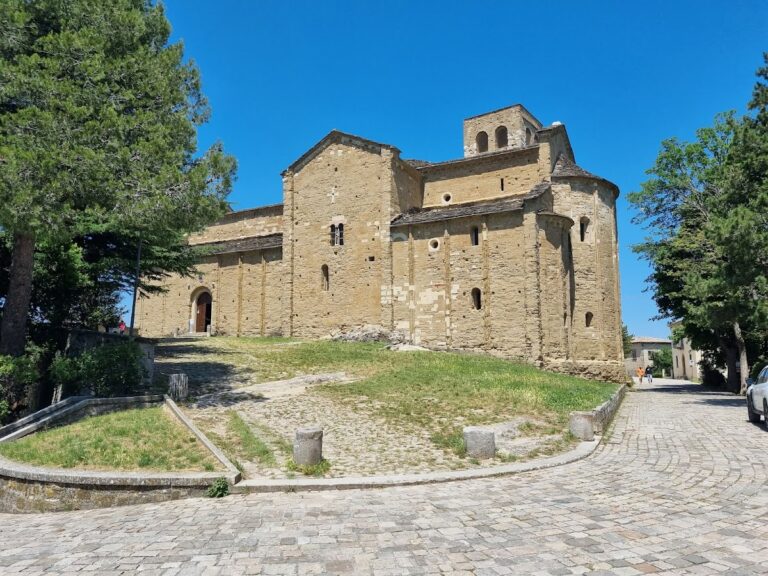
The church is a Romanesque building with Renaissance additions, constructed in local sandstone and arranged on a single-nave plan. Its restrained facade combines a thirteenth-century circular rose window with a Renaissance portal. The bell tower is aligned with the nave and forms part of the building’s surviving composition, while the apse contains the presbytery, the area surrounding the main altar.
Facade and portal
The sandstone facade is organized around the rose window and portal. The thirteenth-century rose window is a circular opening with radiating stone tracery. Beneath it, the Renaissance portal is crowned by a lunette containing a fifteenth-century high-relief image of the Merciful Madonna embracing, an iconography associated with the Virgin of Graces. High relief is sculpture that projects strongly from its background. The portal was consolidated and partly rebuilt between 1965 and 1967, when its architrave was also replaced.
Presbytery and interior decoration
The apse contains the church’s principal architectural feature, the Renaissance presbytery. Its arched decoration includes 128 sandstone rosettes, each bearing a different ornamental motif. Their decorative language is traditionally associated with the Brunelleschian environment and reflects a Renaissance repertory of Tuscan origin.
The interior also preserves devotional votive frescoes, including the depiction of Saint Nicholas and Saint Lucy. That fresco was restored between 1969 and 1970. Above the entrance, a wooden choir loft holds an eighteenth-century pipe organ with 510 pipes. A pipe organ produces sound by sending air through tuned pipes.
Madonna and Child
The church preserves a life-size Madonna and Child made from polychrome glazed terracotta, predominantly white and cobalt blue. The work has been associated at different times with Luca della Robbia, Andrea della Robbia, and the Della Robbia workshop as a whole. Its most cautious attribution is to the Della Robbia workshop. The statue’s gilding retains irreversible damage from the postwar washing carried out after its recovery from concealment beneath the altar.
Bell tower
The bell tower stands in alignment with the nave and underwent substantial structural work during the twentieth century. Its instability was identified after the 1963 roof repairs, and safety measures carried out from 1965 to 1967 secured the tower as part of the wider restoration of the church.