San Daniele in Padua: A Medieval Roman Catholic Church
Site at a Glance
- Rating
- 4.5
- Popularity
- Very Low
- Country
- Italy
- Primary era
- Medieval
- External website
- Open
- Eras represented
- Medieval, Early Modern, Modern
- Civilizations
- Habsburg, Holy Roman Empire, Venetian
- Site type
- Religious
- Remains
- Church
On this page10 sections
History
San Daniele is a medieval Roman Catholic church in Padua, Italy, dedicated to Saint Daniel of Padua and belonging to the Diocese of Padua. The site was used from the Venetic period onward and later became a Christian foundation associated with the Benedictine community of Santa Giustina. The present church preserves elements of its medieval history alongside major seventeenth-, nineteenth-, and twentieth-century alterations.
Before the Medieval Church
The site stood in a strategic position beside important land and river routes and was continuously frequented from the Venetic period. Between the sixth and fifth centuries BC, it contained a pagan place of worship probably associated with Reitia, a major deity of the ancient Venetic people in northeastern Italy. Before the medieval church was built, the location became a Christian oratory.
The Foundation and Cult of Saint Daniel
The church of San Daniele was established from 1076 onward, following the discovery of Saint Daniel’s relics at the Basilica of Santa Giustina. Saint Daniel was venerated as a martyr and, in Padua’s religious tradition, as a deacon of Saint Prosdocimus, regarded as the city’s first bishop. The new church and its adjacent monastery were associated with Benedictine monks connected to Santa Giustina.
Tradition attributes the foundation to Olderico, Bishop of Padua from 1064 to 1080, during the transfer of the relics in 1075 and 1076. According to the legend, the relics became too heavy at this location as the procession moved from Santa Giustina toward the cathedral. Darkness, thunder, and lightning followed, and Olderico vowed to build a church dedicated to the martyr. The procession then continued.
The traditional chronology distinguishes the discovery of the relics on 25 or 26 December 1075, their transfer on 26 December, and their placement on 3 January 1076, which became Saint Daniel’s feast day. An older hagiographic tradition connects the discovery with a blind pilgrim from Tuscany who was instructed in visions to travel to Padua and pray for healing. Olderico identified the body through signs of martyrdom and an inscription on the sarcophagus lid. He first placed it on an altar, claimed it for the cathedral of Santa Maria, and arranged for a church to be built near the city walls. Opposition from part of the population meant that clergy used force to complete the transfer.
A document dated 10 January 1076 records Olderico’s transfer of land at Turreselle, outside Padua and near the city rampart, to Giovanni, abbot of Santa Giustina. A church dedicated to Saint Daniel already stood there, probably the building associated with the procession legend. Soon afterward, the bishop authorized the monks of the urban monastery to hold a market in Saint Daniel’s honor. A donation of 31 March 1076 refers to the cathedral of Santa Maria and Saint Daniel as the place where the saint’s body rested, confirming that the relics had by then been permanently deposited in the cathedral.
Olderico’s promotion of Saint Daniel’s cult formed part of a political and religious strategy intended to strengthen episcopal authority in a troubled urban society. The saint was presented as the bishop’s saint, while the cult connected the cathedral canons with the monks of Santa Giustina and helped Olderico cultivate alliances with prominent citizens and regional lords.
Medieval and Early Modern Changes
In 1123 the church was placed under the protection of Pope Callixtus II together with the Basilica of Santa Giustina. It was mentioned again in documents issued by Pope Eugene III in 1145 and Pope Alexander III in 1164. Medieval chronicles described a small Romanesque building with a T-shaped plan and a small semicircular apse. Romanesque architecture was a medieval style marked by heavy masonry, rounded arches, and compact forms.
A pastoral visitation in 1627 described San Daniele as fairly spacious, with a single nave, five altars, and a vaulted chapel containing the high altar. Entrances opened to the west and east, while a cemetery lay between the two doors. Major alterations followed between 1653 and 1657. The portico was demolished to make way for a new facade, the entrance toward Via Rudena was closed, and a new entrance and a large window were opened toward the rectory. A sacristy was added, and the interior was equipped or embellished with five altars and an organ.
Members of several Padua noble families, including the Dondi dell’Orologio, Oddi, and Emo-Capodilista families, were buried beneath the nave floor. Later changes to the floor buried their tomb slabs and removed their memorials. The identified burial of Angelo Beolco, known as Ruzante, is commemorated by a plaque in the nave. Marco Guazzo and Rolandino of Padua are also reported as buried in the church, while Benedetto Bordone is said by some to have been buried in the churchyard.
Nineteenth- and Twentieth-Century Restoration
The church was extensively remodeled during the nineteenth century. Between 1851 and 1854, it was raised by approximately four metres, the earlier Romanesque ceiling was replaced by a vault, and a choir and additional decoration were introduced. The facade and interior were refurbished in a neoclassical manner, while the architect Francesco Muttoni also gave the church a late-Baroque character. Neoclassical architecture revives forms associated with ancient Greece and Rome, whereas late-Baroque design is associated with elaborate ornament and dramatic spatial effects.
Sebastiano Santi frescoed the interior between 1863 and 1866. Agostino Rinaldi designed the facade attic between 1859 and 1866, and statues by Francesco Rizzi were installed in 1866. The presbytery was enlarged and fitted with a marble floor, balustrade, and steps between the 1920s and 1939. Further restoration continued for the next five years, and the church was consecrated in 1946 by Monsignor C. Agostini. A marble inscription was installed on the left wall of the nave.
Napoleonic suppression in 1810 caused the parish seat to be transferred to the basilica. It was re-established in the San Daniele district on 1 April 1919 after the Benedictines returned to Santa Giustina. In 1948, the monastery housed Benedictine monks exiled from a monastery in the former Yugoslavia. The church remains consecrated. The Romanesque bell tower was consolidated in 1975, while work on the organ continued in stages during the twentieth century and culminated in a restoration in 2015 carried out according to the requirements of the monuments authority.
Remains
Medieval Structure and Site Layout
San Daniele is oriented from east to west and faces Via Umberto I, formerly known as the street of Torricelle. The area in front of the building now serves as the churchyard, while it formerly formed part of a cemetery that extended behind the church between the apses toward the Ponte della Morte. Archaeological investigations have revealed extensive remains predating the seventeenth-century rebuilding.
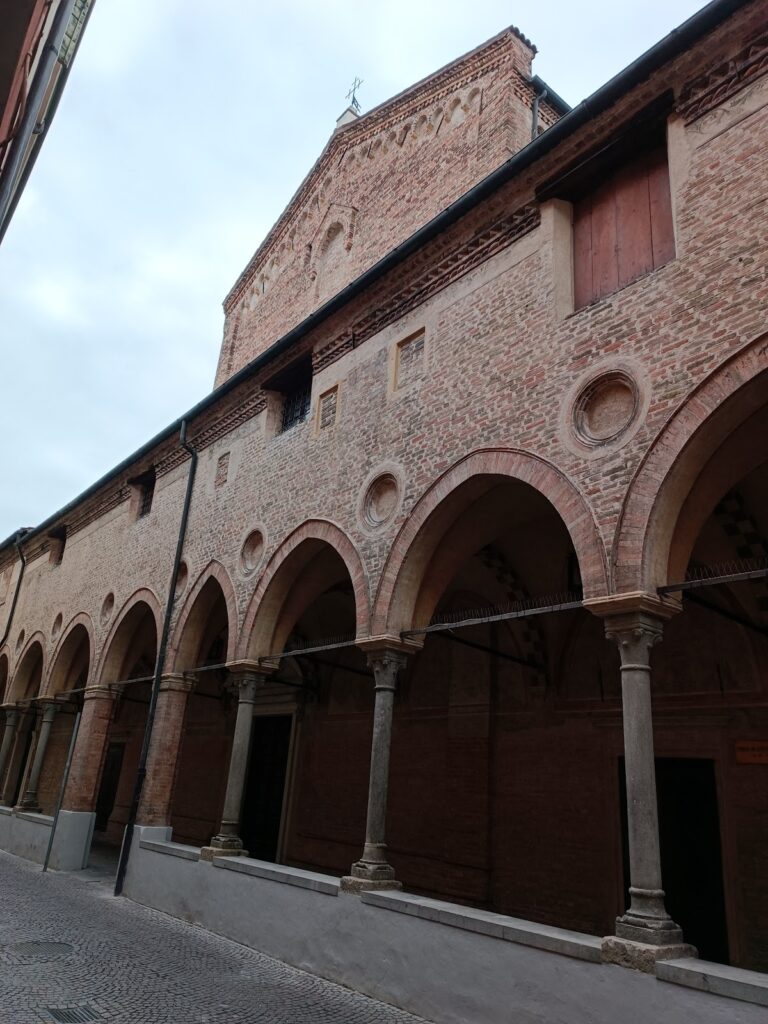
Perimeter walls made from reused Roman bricks survive along the north side of the nave and transept, along the southern perimeter of the transept, and in part of the south nave wall. The transept rests on a foundation of large stones, including four fragments of bases for presses. These surviving structures indicate that the original church had a Latin-cross plan, with a long main arm crossed by a shorter transept. The western corner of the southern transept is concealed by the Baroque bell tower, while its eastern corner remains visible.
A splayed window survives in the northern transept. Its outer frame is formed from shaped Roman bricks and its inner frame from stone. Several damaged arches remain at mid-height on the south side. Their form suggests that the southern nave wall may belong to a different construction phase, pointing to a more complex building sequence than a single campaign.
Facade, Apse, and Bell Tower
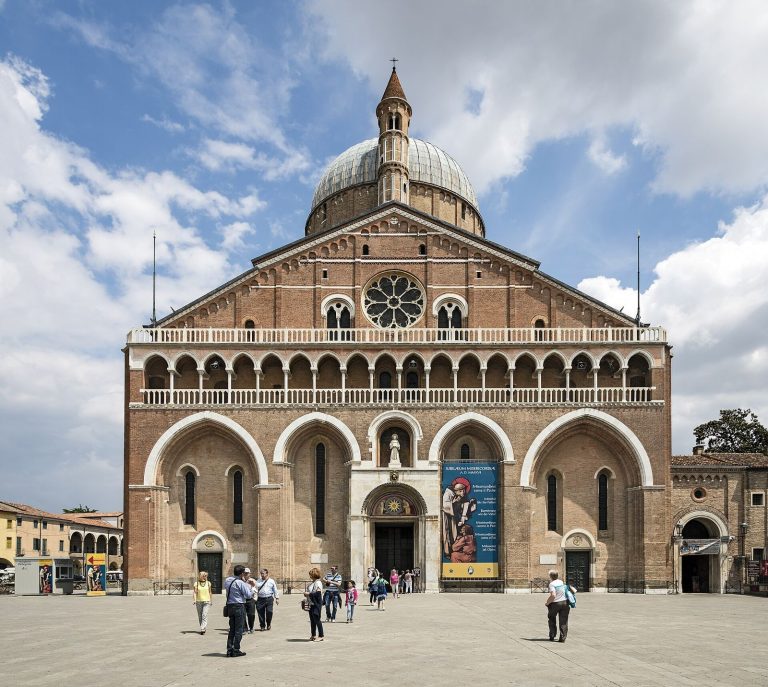
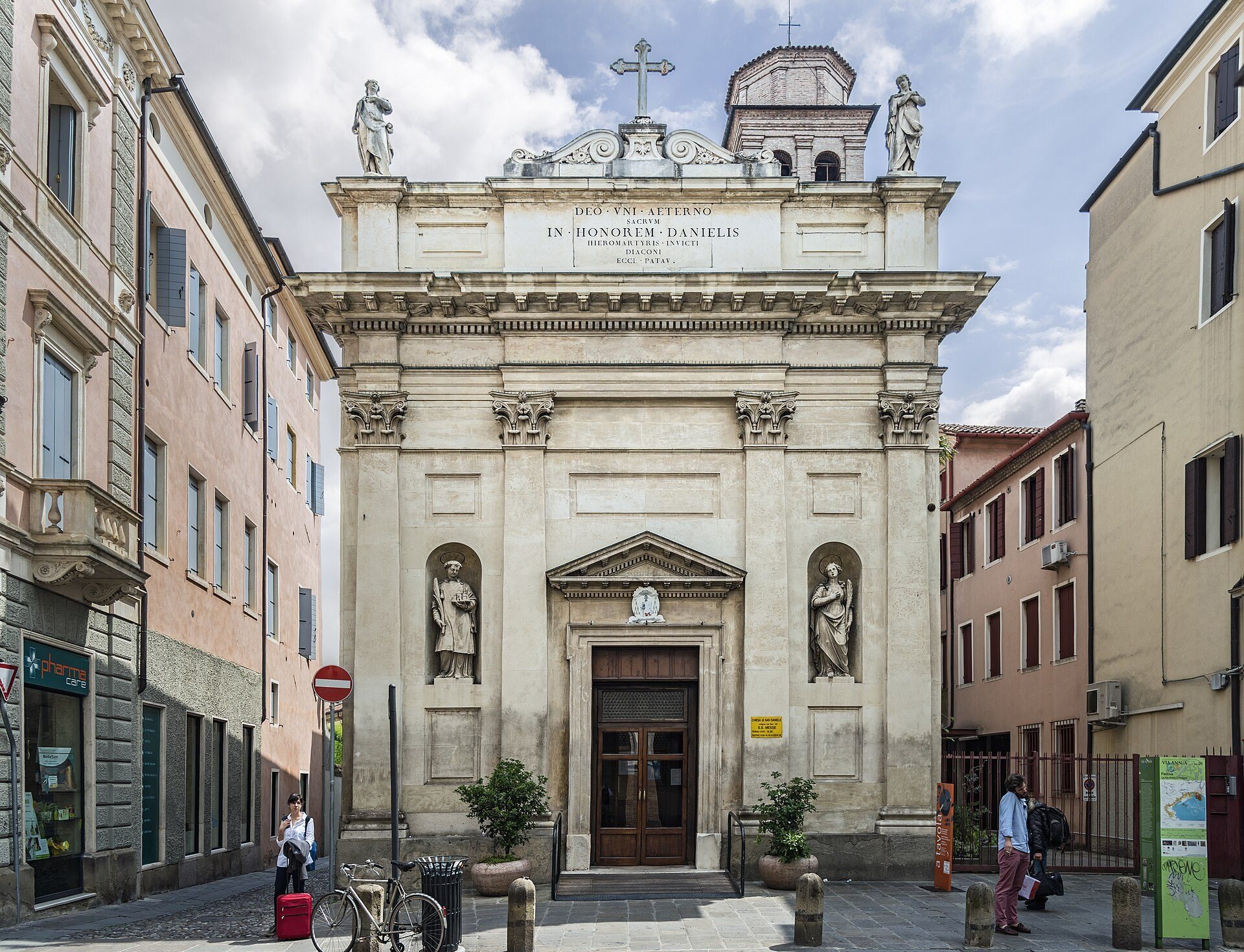
The present facade dates from the seventeenth century and was substantially affected by the raising attributed to Jacopo Sacchetti. Its attic, designed by Agostino Rinaldi between 1859 and 1866, follows a neoclassical style derived from sixteenth-century models. Two Corinthian half-columns divide the attic, and niches contain Francesco Rizzi’s statues of Saint Justina and Saint Daniel the Martyr, installed in 1866. The facade opens directly onto the street and is preceded by the former cemetery area now used as the churchyard.
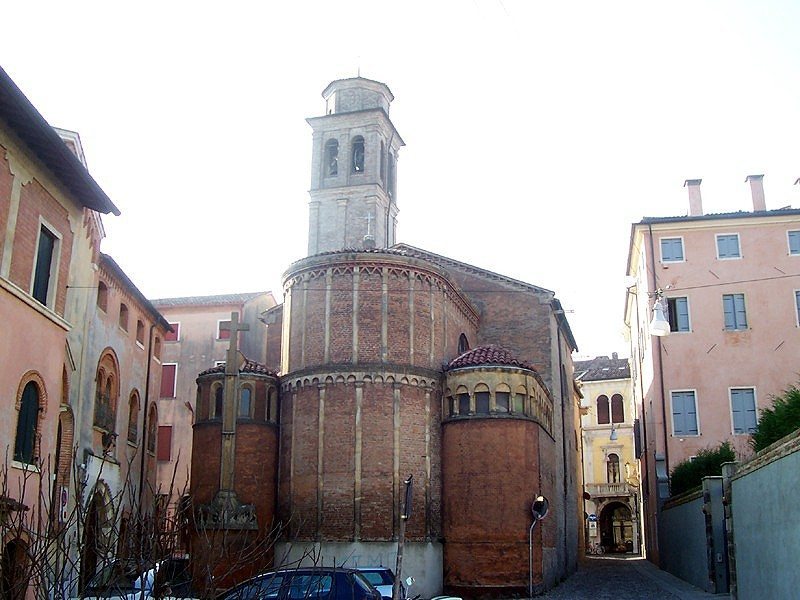
The exterior apse is neo-Romanesque, the result of twentieth-century alterations around the Ponte della Morte, but it retains a circular form partly derived from the earlier Romanesque structure. The bell tower rises on the right side of the church toward the rectory courtyard. Romanesque in origin and decorated with classical pilasters, it preserves a sixteenth-century appearance and contains five bells arranged according to the Veronese system, a traditional method of ringing associated with the Verona area.
Interior Decoration and Presbytery
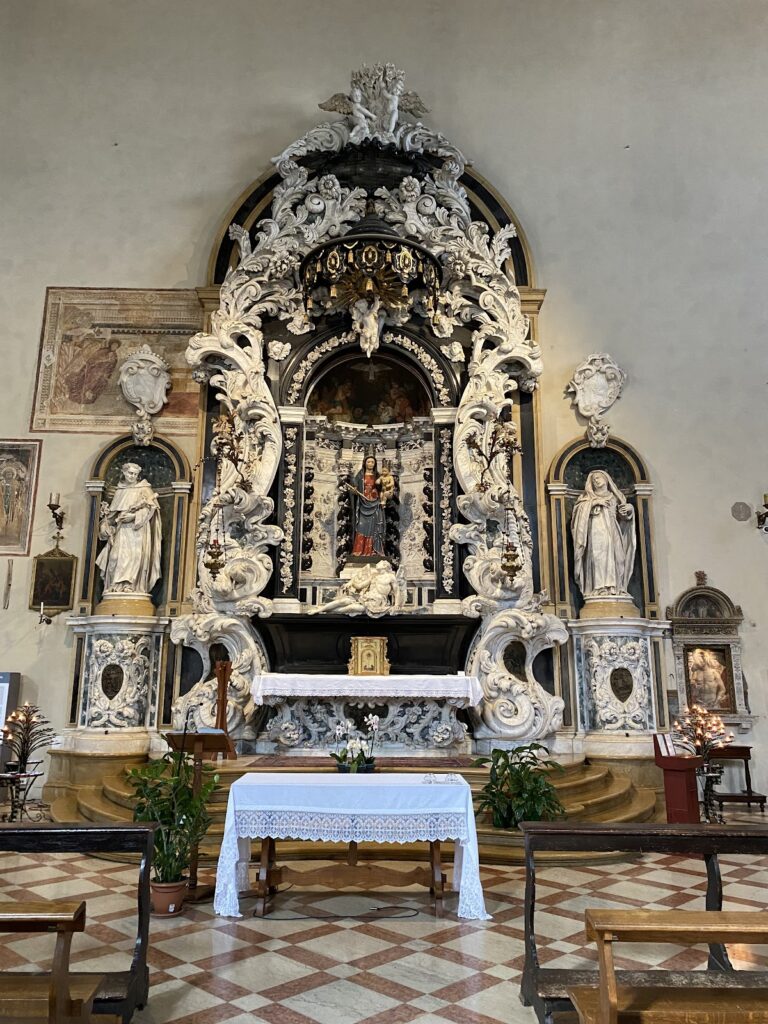
The nave walls carry a lace-like decorative revetment, while Sebastiano Santi’s frescoes cover the walls and ceiling with scenes from the life and martyrdom of Saint Daniel. The presbytery contains paired representations of the four Evangelists with their symbols. Behind the altar, the apse fresco shows Saint Daniel offering a model of Padua to the Virgin. It is flanked by paintings of Saint Prosdocimus and Saint Justina on one side and Saint Benedict and Saint Scholastica on the other.
A long gilded frieze of scrollwork and putti’s heads runs above these paintings and the lunettes containing the Evangelists. Two semicircular stained-glass windows are set in the presbytery walls. Above them, pendentives carry gilded vines and ears of grain, symbols of the Lord’s Supper, while the apsidal dome depicts God seated on a gilded throne with musician angels.
The present presbytery includes a 250-square-metre marble floor with geometric designs, installed during the twentieth-century renovation directed by Professor Renzo Canella. Canella also designed the baptismal font, whose marble basin is decorated at the center with schematic waves and fish. The basin stands within a mosaic-covered triumphal arch, above which two terracotta statues represent the Baptism of Christ in the Jordan.
Paintings and Organ
Two large canvases depicting Saints Peter and Paul were painted by Giovan Battista Langetti in 1675 and transferred from the demolished church of Saint Augustine. Several fifteenth-century panels with sacred subjects are also preserved. Two large canvases by Luca Ferrari showing episodes from Saint Daniel’s life were recorded in the eighteenth century but were later lost. A painting of Saint Charles Borromeo by Giovan Battista Pellizzari was formerly associated with the suppressed School of the Blessed Sacrament and was recorded in the nineteenth century.
The present organ was built in 1894 by Annibale Pugina and his sons. It occupies an older, finely decorated wooden case with three openings divided by ornamented pilasters bearing foliage and musical instruments. The instrument has 1,378 wooden and metal pipes distributed among 25 stops, including five reed stops. A stop is a selectable group of pipes with a particular sound, while a reed stop produces sound through vibrating reeds. The organ is operated by two keyboards and a mechanically transmitted pedalboard, whose keys and pedals connect to the pipe mechanisms through physical linkages.
The organ stands in the choir loft above the main entrance, which has a richly decorated straight parapet with gilded panels. An earlier organ by Gaetano Callido, Opus 53, dated 1769, had one manual and 12 stops and originally stood in the Old Choir of Santa Giustina. It was transferred to San Daniele in 1812 together with the eighteenth-century high altar by Bonazza. The Callido organ was later replaced, and the 1894 Pugina instrument used none of its parts. Earlier restoration took place between 1829 and 1839 and again in 1852 under Angelo Agostini. The Pugina firm substantially altered the arrangement in 1894, followed by work from the Ruffatti firm between 1940 and 1960 and restoration by the Salvato firm in 1990.