San Cassiano: A Baroque Parish Church in Venice
Site at a Glance
- Popularity
- Medium
- Country
- Italy
- Primary era
- Early Modern
- Eras represented
- Medieval, Early Modern, Modern
- Civilizations
- Byzantine, Venetian
- Site type
- Religious
- Remains
- Church
On this page15 sections
History
San Cassiano is a Roman Catholic parish church in Venice, Italy, traditionally founded in 726. Its present interior took shape in a major remodeling completed in 1663, while the church’s history also reflects medieval rebuilding, changing parish institutions, and the work of Venetian artists. The church was first dedicated to Saint Cecilia, traditionally associated with music and regarded as its patron saint.
Foundation and medieval parish
In 926, Venetian families including the Michiel and Mian families rebuilt the church. A severe fire in the early 12th century damaged it along with other churches, and its parish boundaries were more precisely defined afterward. By 1188, San Cassiano held full parish rights under the protection of the Holy See, the central governing authority of the Catholic Church.
Further rebuilding took place in 1205 and 1350. The church received its dedication to Saint Cassian in the 1350 rebuilding. Cassian of Imola was a Christian teacher condemned to death for preaching around 303. Bishop Paolo Foscari of Castello consecrated the church on 25 July 1367.
Renaissance and Baroque transformations
Pietro Bon commissioned an altarpiece from Antonello da Messina, painted in 1475–1476. The work was no longer in the church by the early 17th century, but its composition influenced the Venetian altarpiece format and it helped introduce oil painting to Venice. In 1509, the funeral procession of Catherine Cornaro, former queen of Cyprus and a Venetian noblewoman, departed from San Cassiano. It crossed a floating bridge to Santi Apostoli, where she was buried in the Cornaro family chapel.
A major remodeling began in 1611 and ended in 1663, establishing the church’s present interior appearance. Tintoretto, who had been a parishioner, painted three works for the Confraternity of the Blessed Sacrament, a lay religious association devoted to the Eucharist in Catholic worship. The paintings were restored in 1996. The 18th-century playwright Carlo Gozzi was buried in the church.
Parish in the modern era
Decrees issued in 1805 by the Napoleonic Kingdom of Italy, a state under French rule in northern Italy, reorganized Venetian churches and parishes. Although the number of parishes fell from more than 70 to 40, San Cassiano kept its existing jurisdiction. It was a collegiate church until 1807. Its clergy included four priests until 1555 and three thereafter, along with a deacon and subdeacon. From 1807, a parish priest appointed by the patriarch led the parish.
The entrance portico was demolished during the 19th century after becoming associated with theft, rape, and prostitution. San Cassiano remains a parish of the Roman Catholic Church within the Patriarchate of Venice. It belongs to the San Polo, Santa Croce, and Dorsoduro deanery, an ecclesiastical district grouping parishes.
Remains
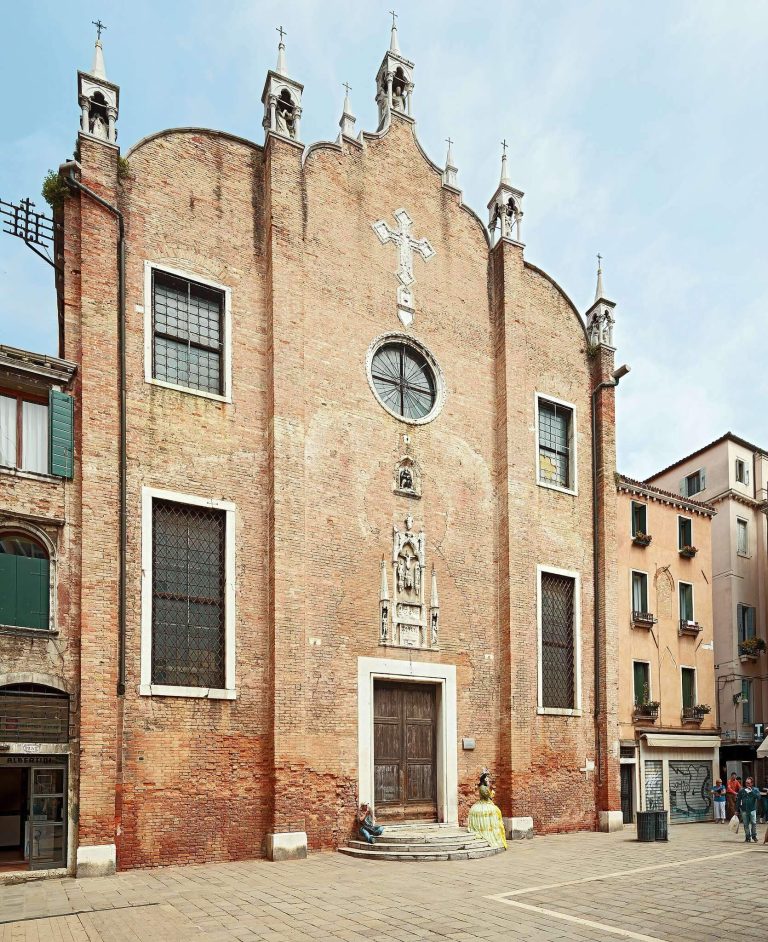
The church has a three-aisled plan and a largely plain exterior, while its interior is richly decorated. It is exposed on three sides, with neighboring buildings against its north side. Its surviving medieval features include the main doorway and a separate bell tower.
Exterior and bell tower
Main facades
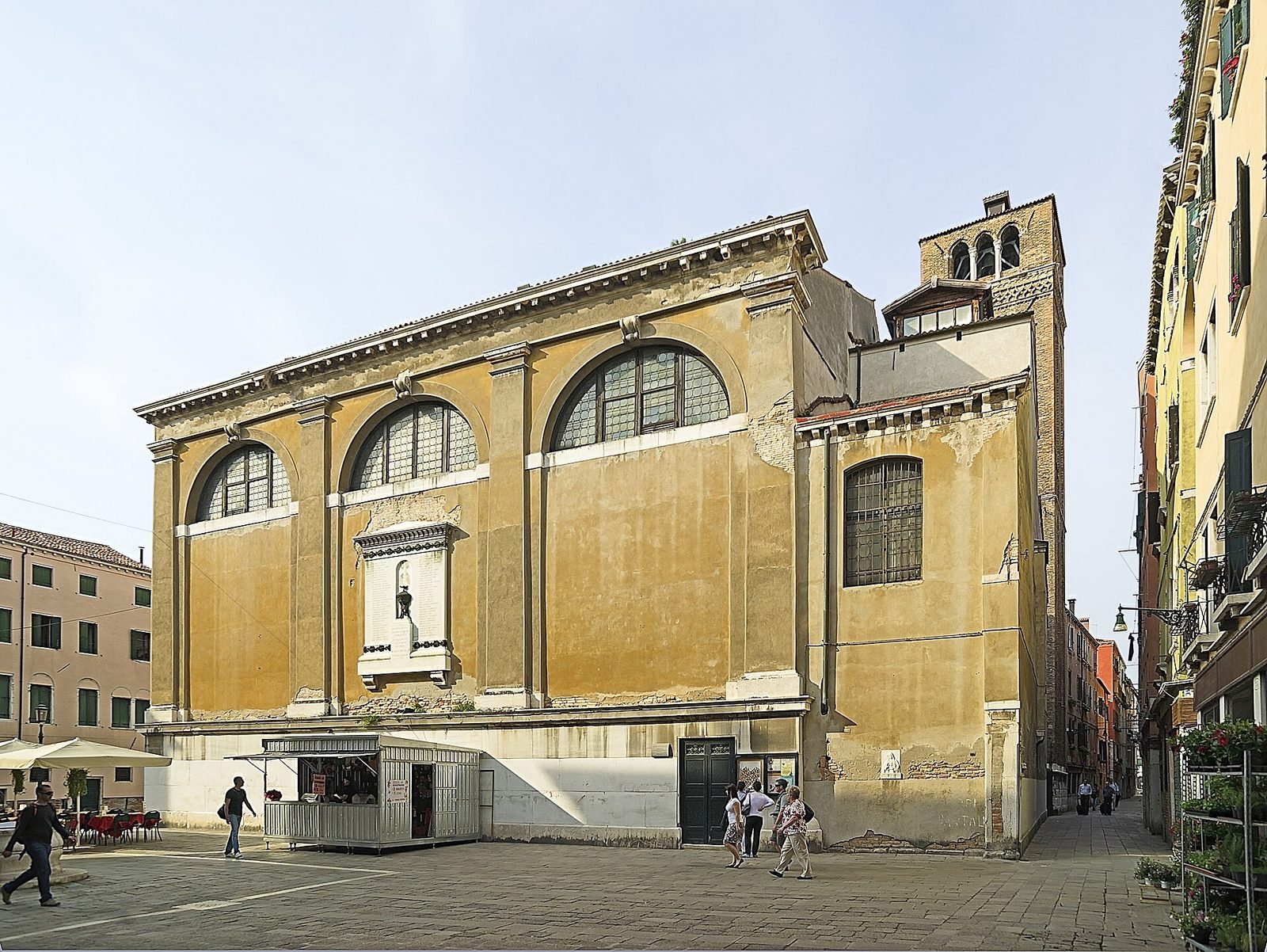
The main facade faces the Rio di San Cassiano and ends in a triangular pediment. Its central lower section rises from a base of stone blocks beneath gray plaster. The doorway retains jambs, the side members of an entrance, from the Byzantine artistic tradition of the Eastern Roman Empire; they may have belonged to an earlier church. The south side, facing Campo San Cassiano, was altered in the 19th century. Four shallow Tuscan-style wall columns divide it into three sections, each with a large semicircular window, while a smaller doorway serves as the main entrance.
Bell tower
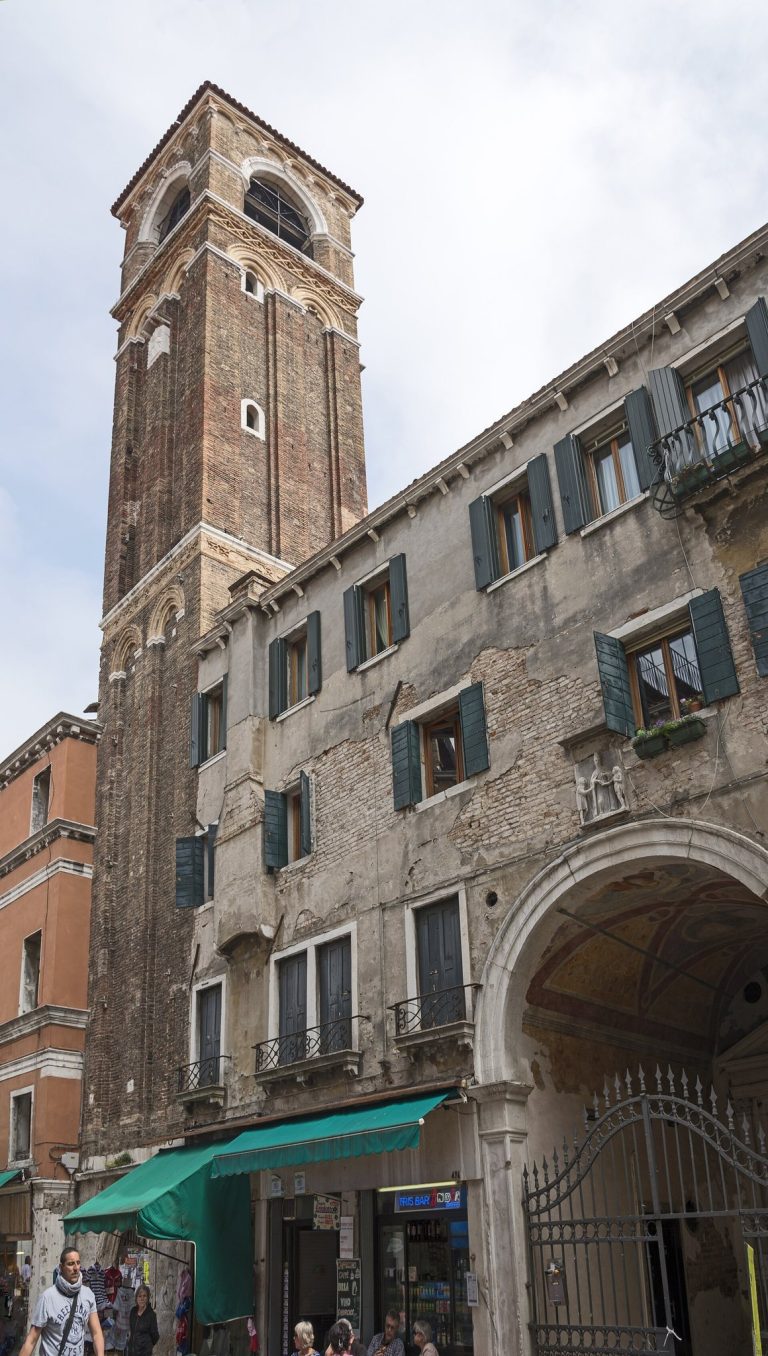
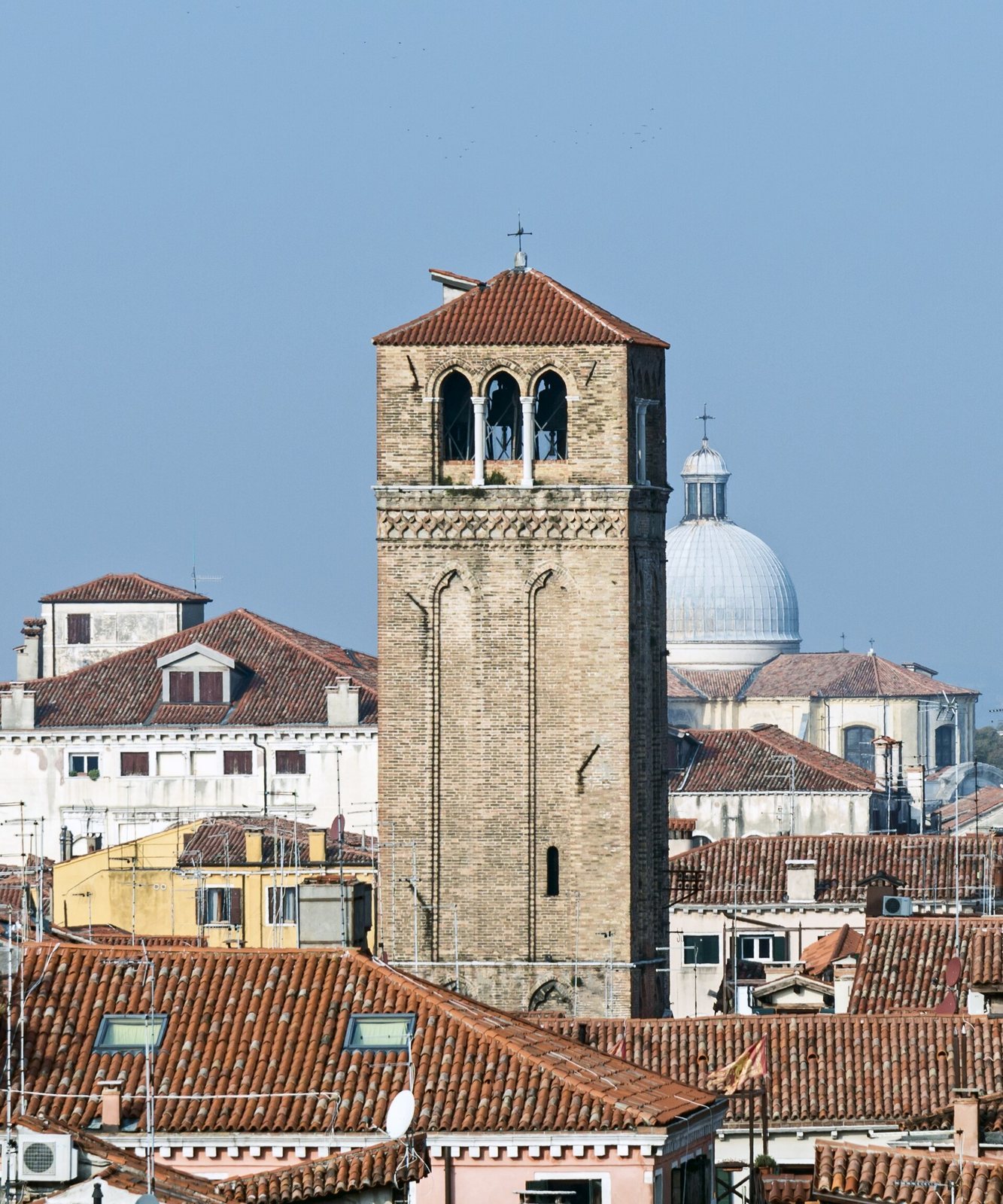
A free-standing Gothic bell tower stands near the north apse chapel. Built in 1295, it received a Gothic upper section for the bells in 1350, with three pointed-arch openings on each side. The tower rises 43 metres. Its robust construction suggests that it may first have served a defensive purpose before the church acquired it. The bells are operated electromechanically.
Interior and furnishings
Plan and decoration
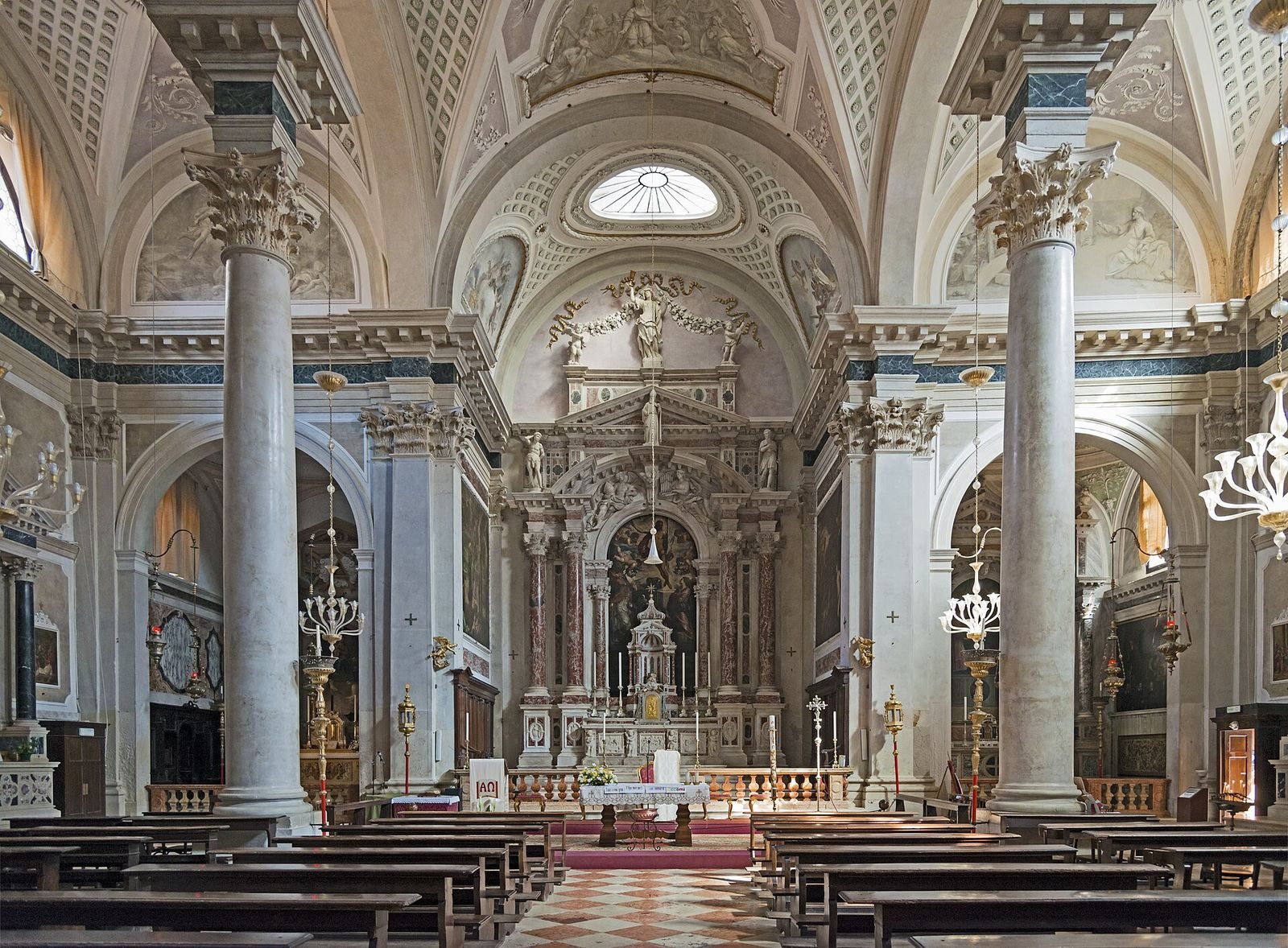
The square-plan interior has three aisles of equal height, divided by four large brick columns faced with marble and arranged in two rows. Their capitals follow the Corinthian style of classical column design. Cross vaults, formed where barrel-shaped ceilings intersect, cover the aisles. The apse chapels end in flat walls. Light-colored finishes and richly decorated, multicolored stucco give the interior its elaborate Baroque character.
Costantino Cedini painted the vaulted ceiling with the Glory of Saint Cecilia and Saint Cassian. His other monochrome paintings depict the martyrdoms of Cecilia and Cassian, the Samaritan woman at the well, and Hagar with the angel and Ishmael. Two semicircular panels above the chapels beside the presbytery, the area around the main altar, depict the Blessed Sacrament. Their painter is unknown and may have been Cedini.
Presbytery and Tintoretto paintings
The high altar includes sculpture and relief work by Heinrich Meyring and Nardo. Three marble reliefs on its decorative front show The Supper at Emmaus, The Last Supper, and Christ in the House of Simon the Pharisee; Tommaso Rues made them.
Tintoretto’s three paintings for the presbytery include The Resurrection, dated 1565, above the altar. It shows Christ between Saint Cassian and Saint Cecilia, the church’s former patroness. The Crucifixion, painted in 1568, hangs to the left, and The Descent into Limbo, also dated 1568, shows Christ freeing Adam and Eve as members of the commissioning confraternity look on from the darkness. The English art critic and writer John Ruskin praised The Crucifixion and drew attention to its unusual perspective.
Chapel of Saint Charles Borromeo
Abbot Carlo del Medico built the chapel beside the sacristy in 1746. Dedicated to Saint Charles Borromeo, a 16th-century cardinal and leading Catholic reformer, it is decorated with multicolored marble, semiprecious stones, and walnut choir stalls. Its artworks include Leandro Bassano’s Prayer in Gethsemane, a Madonna and Child altarpiece, paintings of Saints Charles Borromeo and Philip Neri, and a ceiling painting by Giovanni Battista Pittoni.
Visitation chapel
The chapel dedicated to the Visitation, the Gospel episode in which Mary visits Elizabeth, contains three paintings by Leandro Bassano. The Meeting of Elizabeth and Mary stands above the altar, with the Annunciation to Zechariah on the left and the Birth of John the Baptist on the right. Twelve members of the chapel’s confraternity appear in the paintings. An unidentified artist painted the domed ceiling, possibly Cedini.
Side altars and other paintings
Three side altars stand on each side of the church. One has an altarpiece by Rocco Marconi, a pupil of Giovanni Bellini, showing Saint John the Baptist with Saints Peter, Paul, Mark, and Jerome. The church also contains Antonio Balestra’s painting of the martyrdom of Saint Cassian, depicted as schoolchildren attack him.
Antonello da Messina’s altarpiece
Antonello da Messina’s San Cassiano altarpiece once stood on the church’s first altar on the right. Five fragments were formerly in the collection of Archduke Leopold William in Brussels, and three other fragments are held by the Kunsthistorisches Museum in Vienna.