Tenjinyama Castle (Bizen): A Sengoku-Period Mountain Stronghold


Site at a Glance
- Rating
- 4.2
- Popularity
- Very Low
- Country
- Japan
- Primary era
- Early Modern
- Eras represented
- Early Modern
- Civilizations
- Unclassified
- Site type
- Military
- Remains
- Castle
On this page11 sections
History
Tenjinyama Castle (Bizen) is a mountain castle in Japan, built by the Sengoku-period daimyo Urakami Munekage as his new stronghold, with construction beginning around early 1554. The Sengoku period was an era of prolonged political and military conflict, when regional warlords competed for territory. The castle stood in Tatsuchi, in former Bizen Province, and became the base from which Munekage pursued control over Bizen and later Mimasaka.
The Urakami rivalry
The Urakami family had served during the Muromachi period as deputies to the Akamatsu clan, which governed Harima, Bizen, and Mimasaka. Munekage’s father, Urakami Muramune, surpassed his lord Akamatsu Yoshimura and rose from the position of deputy to become a Sengoku daimyo, or regional warlord. This change helped place the Urakami family among the powers competing for authority in western Japan.
In 1551, Munekage and his elder brother, Urakami Masamune, disagreed over how to respond to Amago Haruhisa’s invasion of Bizen. Masamune sought an accommodation with the invaders and allied with the Amago, while Munekage advocated resistance and formed an alliance with Mori Motonari of Aki. Mori Motonari was a leading warlord of the Chugoku region. Their rivalry divided local warriors and led Munekage to establish Tenjinyama Castle as his own military base.
Supported by Mori forces, Munekage defeated troops aligned with Masamune and consolidated his control over Bizen and later Mimasaka. During this period he also took in Ukita Naoie, who had previously been wandering between patrons. Naoie became Munekage’s principal lieutenant and helped reinforce his regional rule.
Expansion and the fall of the castle
In 1564, Masamune and his son Kiyomune were killed by Akamatsu Masahide at Murotsu Castle during Kiyomune’s wedding. Masamune’s heir succeeded him, but Munekage’s agents assassinated that heir in 1567. The main Murotsu branch of the Urakami family thereby ended, allowing Munekage to absorb its territory.
Munekage allied with Oda Nobunaga in 1573 and received recognition of his control over Bizen, Harima, and Mimasaka. Nobunaga was a major military leader who sought to unify Japan. As Ukita Naoie’s influence within the Urakami family grew, however, he opposed the alliance and joined the Mori clan instead.
In 1574, Naoie rebelled against Munekage while supporting Urakami Hisamatsumaru, a grandson of Urakami Masamune who had been sheltered at Okayama Castle. Naoie attacked Tenjinyama Castle, presenting the campaign as an effort to restore the main line of the Urakami family. Supporters inside Munekage’s household aided the attack, and Munekage abandoned the castle and fled to Harima in 1575.
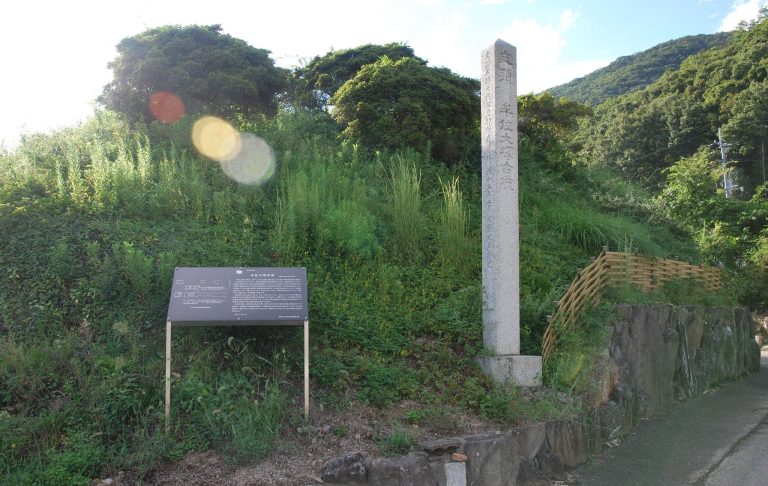
The castle may have remained in use under Ukita control after Munekage’s flight. Surviving stonework and roof-tile fragments have been linked to this later phase, although the extent and timing of Ukita use remain uncertain. The castle’s fall was traditionally dated to 1577 from a Bizen military chronicle. Katsunari Terao’s 1991 study instead argued for 1575 on the basis of primary historical documents, and later studies adopted that earlier date. It is now the widely accepted interpretation. The ruins have been protected as an Okayama Prefectural Historic Site since 1982.
Remains
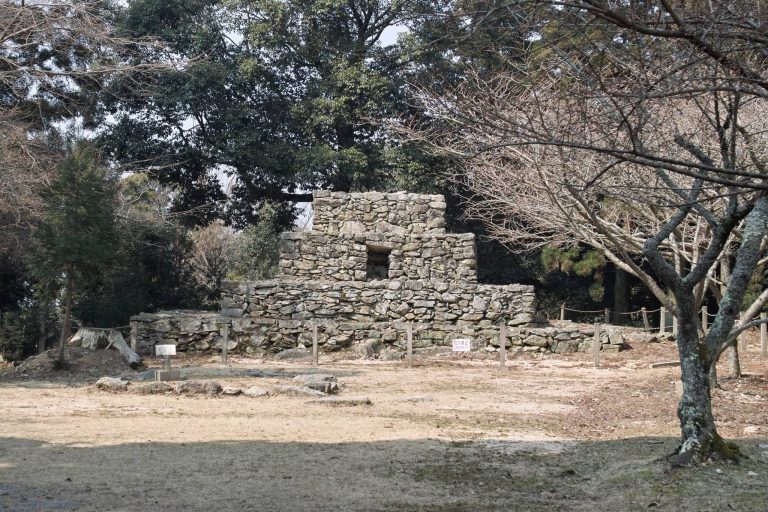
Tenjinyama is an interconnected-ridge mountain castle extending for more than 1 kilometre, from the remains of the Lower Bailey in the northwest to earthworks southeast of Taiko-no-maru. Its steep mountain setting and the Yoshii River along the western side provided natural defensive advantages. The surviving layout consists of ridge-top baileys, earthen ramparts, dry moats, trenches cut across the ridges, stone gates, stone walls, and areas associated with samurai residences.
Western ridge enclosures
Main and upper baileys
The principal fortified enclosure, or main bailey, occupied the summit of Tenjin’s western peak at approximately 390 metres above sea level. The Second and Third Baileys continued northwest along the ridge, linking the summit position with the lower parts of the complex. The Lower Bailey marks the northwestern end of the surviving castle area, while the ridge arrangement connected the principal enclosures into a single defensive system.
Southern baileys and trenches
Southeast of the main bailey lay additional enclosures, including the Horse Bailey and South Bailey. These areas contained deep, V-shaped cut trenches. Such trenches were made directly across the ridge to obstruct movement between sections of the mountain and to control access to the higher castle ground.
Eastern peak and controlled approaches
Taiko-no-maru
Two stone gates led southeast beyond the trenches toward the eastern peak, which rises to approximately 409 metres above sea level. Its summit contained Taiko-no-maru, a high area associated with a taiko drum tower. The drum was used to call and organize troops, giving the enclosure a military communication function within the larger ridge complex.
Tiger’s Mouth and outer earthworks
A northeastern approach reached Taiko-no-maru through a fortified entrance known as the Tiger’s Mouth. The name refers to an entrance controlling access to a castle enclosure. Farther southeast, rougher trenches and additional lines of earthworks survive, extending the defensive organization beyond the principal baileys and gates.
Materials and later evidence
The castle’s defensive structure combined the mountain’s steep slopes with earthen ramparts, dry moats, ridge-cut trenches, and stonework. Stone gates marked important approaches, while stone walls and sites of samurai residences provide evidence of construction beyond the earthworks themselves. The overall arrangement relied on successive enclosures and controlled passages rather than on a single central building.
Stone walls and fragments of roof tiles are associated with the later Ukita period. The tiles have also been compared with examples fired at Himeji in 1580, a connection that has contributed to the possibility that the castle continued in use after Munekage fled. These remains preserve material evidence of a later phase while leaving the precise duration of Ukita control unresolved.