Saints Peter and Paul Church in Gdańsk: A Gothic Parish Church and Marian Sanctuary


Site at a Glance
- Rating
- 4.7
- Popularity
- Low
- Country
- Poland
- Primary era
- Medieval
- External website
- Open
- Eras represented
- Medieval, Early Modern
- Civilizations
- Kingdom of Poland, Teutonic Order
- Site type
- Religious
- Remains
- Church
On this page13 sections
History
Saints Peter and Paul Church in Gdańsk, Poland, is a brick-Gothic church founded in 1397 as a branch of St Mary’s Church. Its construction was completed that year, and it was consecrated in 1456. The church became the historic parish church of Gdańsk’s Old Suburb and later served successive Lutheran, Reformed, Roman Catholic, and Armenian Catholic communities.
Foundation and medieval expansion
A fire completely destroyed the church in 1424. An indulgence letter supported its rebuilding, and the restored building received a new institutional role in a decree of 28 January 1456. The decree divided Gdańsk into six parishes, one of them the parish of Saints Peter and Paul.
The church also developed as a centre of education and craft-based religious patronage. A school was established beside it in 1436 and continued until 1904. Textile workers financed the Chapel of St Thomas in 1458, while ship carpenters from Lastadia, the historic shipbuilding area of Gdańsk, founded the Chapel of St Andrew in 1460. The Chapel of the 11,000 Virgins was consecrated in 1484.
Between 1486 and 1514, the church was enlarged and its walls were raised. A substantial tower was built during the same campaign, and the vaults were completed in 1516. A fire damaged the inside of the tower in 1521.
Reformation and Reformed worship
In 1557, the municipal council transferred the church to the Lutherans, who had become Gdańsk’s dominant confession. Six chapels, dedicated to the Three Kings, St Thomas, the 11,000 Virgins, St George, St Anne, and the Virgin Mary, were demolished in 1579.
The first Calvinist services in Polish were held in 1589. Calvinism is the Reformed Protestant tradition associated with John Calvin, and the church became the principal church of Gdańsk’s Reformed Evangelicals from 1590 to 1945. Worship was conducted in Polish, English, French, and German, although German and Dutch predominated. In 1590, Calvinists removed the statue of the Virgin Mary from the high altar, and from 1622 the building was adapted for Calvinist worship.
Wojcich Niclassus became the church’s first permanent Polish preacher in 1626. The post was abolished in 1707, but Polish services continued intermittently until the end of the eighteenth century. From 1688, the church was also available for French-language Calvinist services for Huguenots, French Protestants who faced religious persecution in France. The French Reformed parish was dissolved in 1823.
Gerard Benning, a prominent Gdańsk bell founder, cast the church bell known as TUBA DEI in 1642. Conservation work took place between 1656 and 1682, and a large organ was built in 1769.
Sieges, military use, and nineteenth-century repairs
The church suffered damage during the wars that reached Gdańsk. During the Russian siege of 1734, a shell fell inside the building. French bombardment severely damaged it during the siege of 1807. From 1807 to 1817, the church was used as a store for hay and straw. Russian and Prussian forces bombarded it again during the siege of 1813.
Between 1817 and 1821, the roofs were comprehensively repaired. The small turret over the chancel and the bell turret over the main nave were removed, together with the former interior furnishing except for the organ. From 1820, the Gdańsk military garrison shared the church for 25 years.
The most extensive nineteenth-century repairs took place between 1890 and 1900 and included removing the exterior plaster. These interventions formed part of the building’s long process of repair after military damage and changing uses.
War damage and post-war transfer
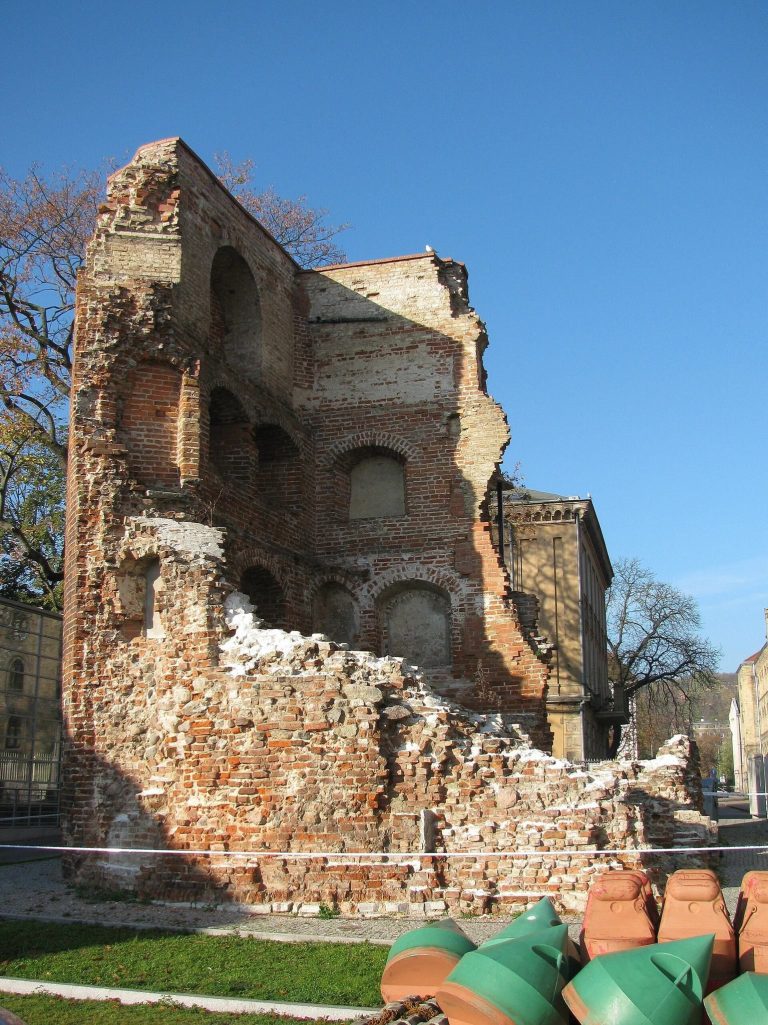
During the Red Army assault on Gdańsk in 1945, bombing and fire caused extensive destruction. Roof structures over the chancel, the south aisle, and part of the central nave collapsed. Most of the vaults fell, and three piers between the nave and aisles were destroyed.
In summer 1945, the entrance openings were bricked up. Resurrectionist priests, members of a Catholic religious order, adapted the sacristy into a Roman Catholic chapel without an established legal basis or title. The Evangelical Reformed Church recovered its legal rights to the building in 1947, but reconstruction was delayed because Catholics were already using it.
In 1949, the authorities of the Polish People’s Republic, Poland’s communist state from 1947 to 1989, took the church from the Calvinists, citing the slow pace of rebuilding. On 20 March 1958, the building was transferred to the Gdańsk Curia, the administrative authority of the Catholic archdiocese in the city, despite protests from the Reformed Evangelicals.
One nave was rebuilt in 1958 and 1959, and a chapel was installed in the former sacristy for the image of Our Lady of Grace from Stanisławów, now Ivano-Frankivsk. The church was transferred to Roman and Armenian Catholics and later served the Armenian Catholic community of Gdańsk and northern Poland.
Reconstruction and Catholic sanctuary
Planned reconstruction began in 1976. The tower was rebuilt in 1977. Between 1978 and 1982, rubble was cleared and three piers with their arches were reconstructed. A new roof structure and tiled roof followed in 1982 to 1984. In 1984, the small roof turret and the attic parapet of the eastern façade were reconstructed. Further work included rebuilding the windows and redesigning the baptistery chapel in 1985, rebuilding the chancel’s inner walls in 1986, and providing new decoration for the north aisle in 1987.
An Armenian chapel functioned at the church until 1992. An Armenian Catholic personal parish operated there from 1999 to 2009 under a decree of Primate Józef Glemp. In 2009, Archbishop Kazimierz Nycz established an Armenian Catholic parish at the church again and appointed Cezary Annusewicz as its parish priest. The Armenian Catholic Church is an Eastern Catholic church that follows the Armenian liturgical tradition while recognizing the authority of the pope.
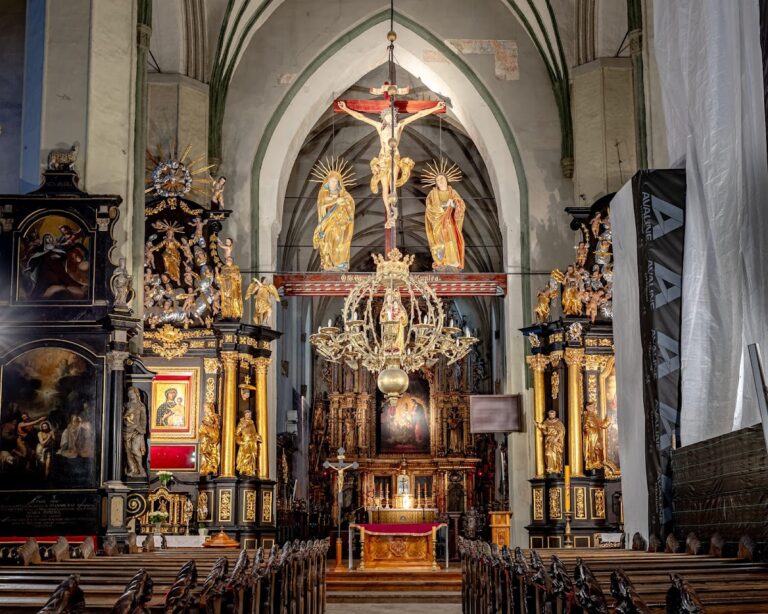
In August 2006, Archbishop Tadeusz Gocłowski solemnly consecrated the side altar of St Clement Mary Hofbauer, an eighteenth- and nineteenth-century Redemptorist priest and canonized Catholic saint. He consecrated the high altar in September of the same year. In 2007, the image of Our Lady of Grace was ceremonially moved from the side chapel to the high altar, and the church became a Marian sanctuary in the Archdiocese of Gdańsk. A Marian sanctuary is a church designated as a special centre of devotion to the Virgin Mary.
A khachkar, a carved Armenian stone cross monument, was unveiled at the church in 2009. It was presented by the Piunik Armenian foundation as a sign of friendship between Armenians and Poles.
On 2 June 2019, an electrical short circuit caused a fire in the roof over the sacristy and chancel. About 200 square metres of roof structure burned, while the church furnishings were not damaged. The consequences of the fire were being removed until autumn 2020. The church is a protected immovable monument entered in the register of monuments, and it functions as a Roman Catholic parish church and sanctuary of Our Lady of Grace, with an Armenian Catholic parish also established there.
Remains
Building and reconstructed fabric
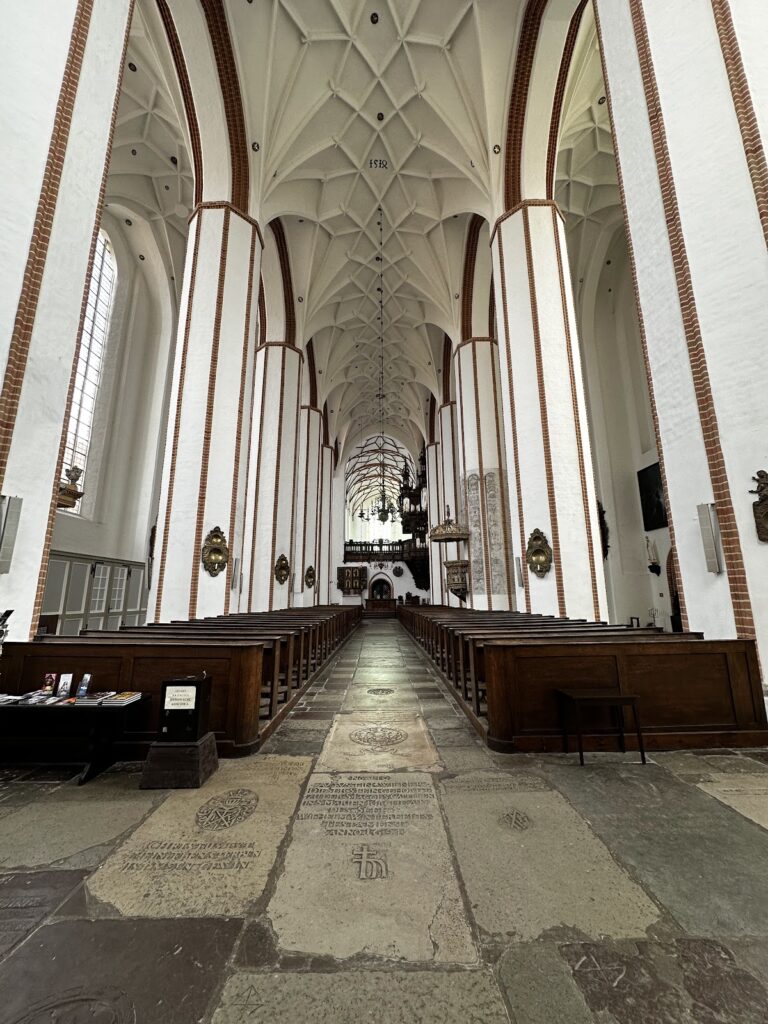
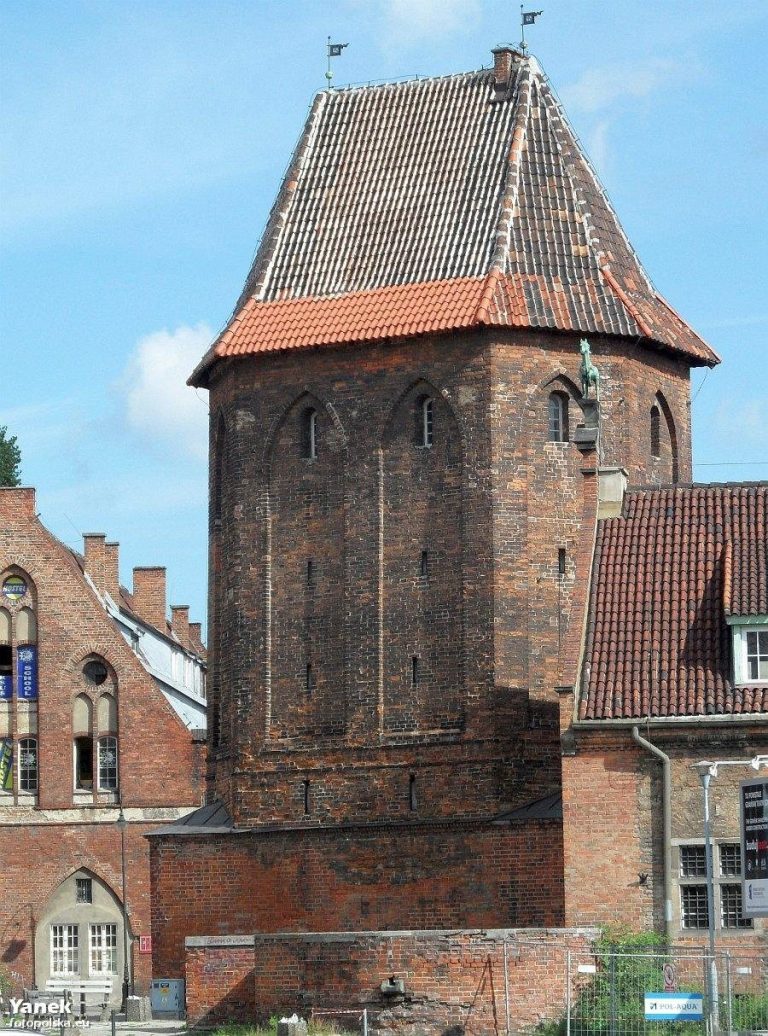
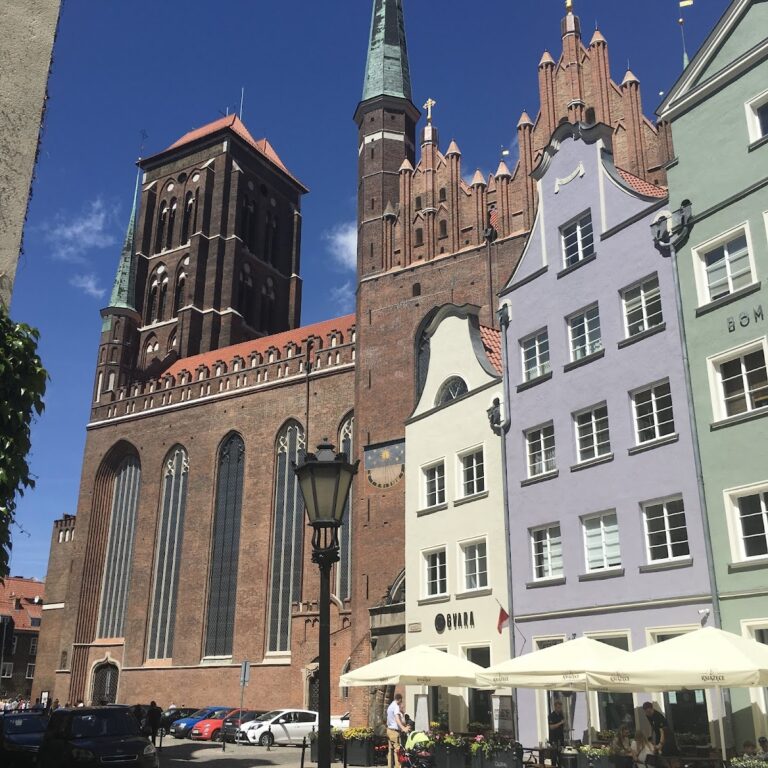
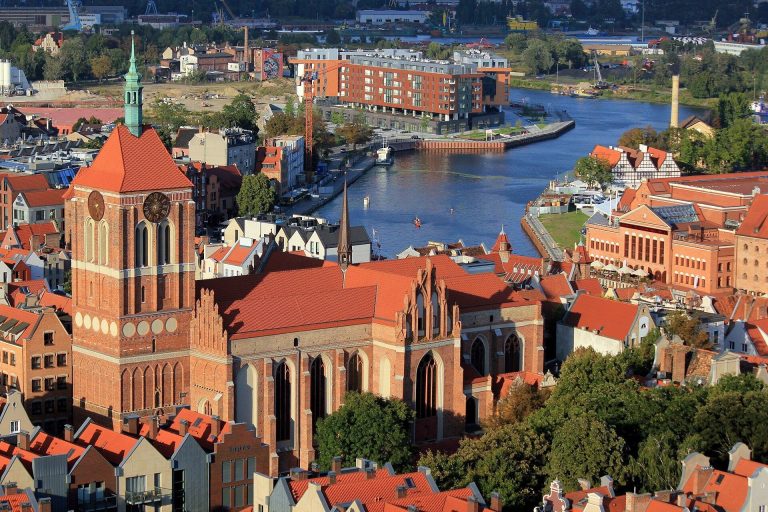
Saints Peter and Paul Church is one of the largest Gothic churches in Gdańsk. Built in brick in the brick-Gothic style, it measures 62 metres in length including the tower buttresses and 26 metres in width. Its tower rises 41 metres, and the building has a usable floor area of 1,392 square metres.
The present fabric reflects the medieval enlargement of 1486 to 1514, when the walls were raised and the substantial tower was built. The vaults were completed in 1516. The surviving structure also incorporates extensive post-war reconstruction, including the rebuilt tower, three piers and their arches, the roof, the small roof turret, the eastern façade’s attic parapet, the windows, the chancel’s inner walls, and interior decoration.
Interior furnishings and memorials
Uphagen Chapel
The 1774 Uphagen Chapel is a surviving interior associated with the church’s Calvinist period. It contains an antique-form epitaph and a Rococo wooden casing. Piotr Uphagen, an eighteenth-century Gdańsk patrician, is also commemorated by his 1774 tombstone.
Baptismal and liturgical features
Medieval stone baptismal fonts survive inside the church, including a Gothic font at the end of the north aisle that dates from the fifteenth century. Other surviving elements include a Rococo fireplace, seventeenth-century chandeliers, a seventeenth-century Renaissance choir stall in the north aisle, and Baroque woodcarving.
The church was rebuilt after 1958 in a form adapted to Roman Catholic worship, including changes to its layout. The Baroque high altar in the chancel belongs to this later interior arrangement and is not original to the church’s historic furnishing. A music gallery in the south aisle was planned for reconstruction using some authentic woodwork.
Image of Our Lady of Grace
The image of Our Lady of Grace measures 56 by 70 centimetres. It was made at the turn of the seventeenth and eighteenth centuries as a replica of the image of Our Lady of Częstochowa, although Mary’s face does not show the scars depicted on the Częstochowa image.
The image formerly belonged to the Armenian church of Stanisławów, now Ivano-Frankivsk. After the Second World War, Kazimierz Filipiak transported it to Gdańsk together with votive offerings and many church furnishings. Its first recorded mention dates to 1742, and it was crowned with papal crowns on 30 May 1937. Papal coronation is the formal crowning of a venerated religious image with crowns authorized or approved by the pope.
Chapels and later physical changes
The church’s medieval interior included chapels dedicated to the Three Kings, St Thomas, the 11,000 Virgins, St George, St Anne, and the Virgin Mary. These chapels were demolished in 1579. The Chapel of St Thomas had been financed by textile workers, while the Chapel of St Andrew had been founded by ship carpenters from Lastadia.
The building’s physical history includes repeated damage from fire and bombardment, followed by reconstruction in stages. The 1945 destruction altered the roofs, vaults, and supports, while the 2019 fire affected approximately 200 square metres of roof structure over the sacristy and chancel. The furnishings escaped damage in that later fire.