Saint Valentine Hermitage: A Mountain Retreat Above Gargnano


Site at a Glance
- Rating
- 4.7
- Popularity
- Low
- Country
- Italy
- Primary era
- Early Modern
- External website
- Open
- Eras represented
- Early Modern
- Civilizations
- Venetian
- Site type
- Religious
- Remains
- Chapel
On this page10 sections
History
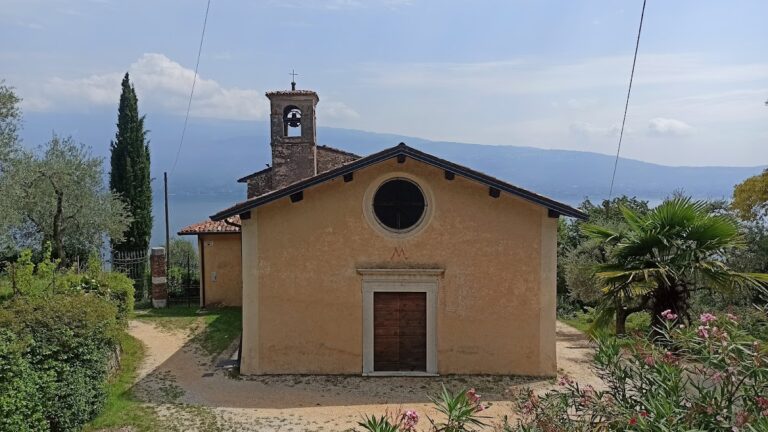
Saint Valentine hermitage is a former hermitage and Roman Catholic filial church above Gargnano in Italy. A filial church is a subsidiary church linked to a larger parish or ecclesiastical institution, and this one belongs to the Diocese of Brescia and follows the Roman rite. Dedicated to Valentine of Terni, a Christian martyr traditionally associated with the Italian town of Terni, the chapel was begun around 1650 after a plague epidemic had struck Gargnano.
The plague vow and foundation
In 1630, when Gargnano had about 3,000 inhabitants, the epidemic killed approximately 400 people. Some residents sought refuge in the mountains and vowed to build a chapel if they survived. The survivors fulfilled that promise between 1650 and 1700, creating the chapel and adjoining living quarters that became the Saint Valentine hermitage.
Hermits in the seventeenth and eighteenth centuries
From the seventeenth through the nineteenth centuries, the chapel and its attached rooms provided a place of retreat and religious devotion for various hermits. A hermit is recorded at the site in 1684. Around the middle of the eighteenth century, Giovanni Marchetti was associated with the hermitage.
Geremia Paladini and the nineteenth century
Geremia Paladini arrived in 1849 from the area near Verona. He had fled military conscription, probably after deserting service under Austrian rule, and remained at the hermitage for sixteen years, until his death in 1865. Local people knew him as “el romet de San Valentì.” During the nineteenth century, the complex also received minor renovations.
Decline and restoration
The hermitage later fell into decline. In 1970, engineer Alberto Cita initiated its restoration with the assistance of Emilio Baruffaldi and Mario Montenovi. The complex reopened on 14 February 1971 during a religious celebration presided over by Don Franco Della Torre.
Remains
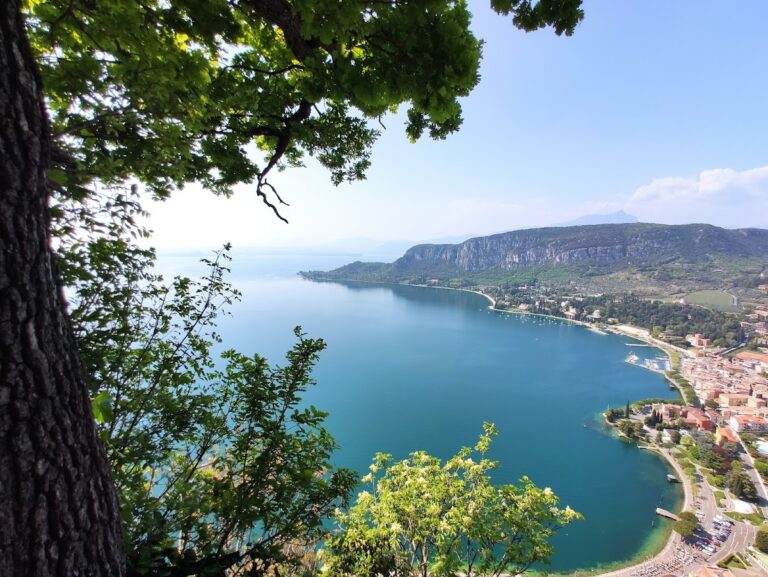
The hermitage stands at an elevation of 772 metres on the slopes of Cima Comer, above Gargnano in the Sasso area on the western shore of Lake Garda. Built against an overhanging rock, the complex uses the rock as the rear wall of both the chapel and the residential spaces. Its compact arrangement includes the chapel, a sacristy, two rooms, a storage room, and a natural cistern.
Approach and outer spaces
A cypress-lined path leads to the whitewashed complex. The wooden entrance door is partly concealed by vegetation and is operated by a stone attached to a rope that passes over a pulley. Beyond the entrance, a terrace is enclosed by cypress trees.
Chapel
The chapel has a simple plastered masonry facade. On the left side, between the chapel entrance and the rest of the hermitage, a sail belfry rises as a wall-like bell structure with openings rather than as a separate tower. A circular window, or rosette, is set above the entrance. Inside, the small single-naved space is covered by a barrel vault and has a raised presbytery, the area around the main altar traditionally reserved for clergy. The main altar is simply built in masonry.
Living quarters and cistern
The residential spaces adjoining the chapel comprise two rooms and a storage room. A natural cistern is enclosed by a wooden door and was formerly supplied by a spring. Together, these spaces preserve the practical arrangement that supported the hermits’ retreat beside the chapel.
Altarpiece and devotional images
The nineteenth-century altarpiece depicts the Madonna and Child with Saint Valentine and Geremia Paladini. Paladini made the painting in 1859 and included a self-portrait at the feet of the Madonna, where he appears in a tunic, carrying a staff and begging, alongside Saint Valentine. A sketch of his portrait hangs beside the chapel entrance.
Before the 1970 restoration, the main altar was made of carved wood and stood with matching wooden candlesticks. Small ex-voto pictures were fixed to the walls. An ex voto is an image or object offered to fulfill a vow or express gratitude for an answered prayer, a fitting form of devotion for a chapel founded after the plague survivors’ mountain vow.