Rocca di Garda: A Historic Fortress above Lake Garda


Site at a Glance
- Rating
- 4.7
- Popularity
- Low
- Country
- Italy
- Primary era
- Classical
- External website
- Open
- Eras represented
- Classical
- Civilizations
- Unclassified
- Site type
- Military
- Remains
- Castle
On this page6 sections
History
Rocca di Garda is a historic fortified ridge in Italy, south of the town of Garda, where a fortress developed during the fifth century. The site contains evidence of human settlement from the Bronze Age, followed by military, religious, and funerary remains from the Roman and medieval periods.
Origins and the fifth-century fortress
Three fifth-century coins, including a gold tremissis, a small late Roman or early medieval coin worth about one-third of a solidus, issued under the Byzantine emperor Zeno, point to the foundation of the castle during that century. A circular silver Gothic fibula decorated with eagle heads provides further evidence of the early fortress. Lombard pottery shows that activity continued under the Lombards, a Germanic people who ruled a kingdom in Italy from the sixth to the eighth century.
The fortress quickly became a strategically important stronghold. Its name gave rise to Garda, derived from the Old Germanic terms Warda or Warte, meaning “guard” or “fortress.” The name first applied to the locality and later replaced the older Latin name Benacus for the entire lake. The earliest document using Garda is dated 712, during the reign of Liutprand, the Lombard king who ruled from 712 to 744.
Political importance and destruction
Rocca di Garda entered the political history of tenth-century Italy when Berengar II, king of Italy, reportedly imprisoned Adelaide of Burgundy there between 19 April and 26 August 951. Adelaide, the widow of Lothair II, later married Otto I, the German king and Holy Roman Emperor.
Between 960 and 965, the Arab geographer Ibrāhīm al-Turtuši visited the fortress during a journey through western and central Europe. He described Rocca di Garda as imposing and extremely well fortified. In 1193, Henry VI, Holy Roman Emperor and king of Germany and Italy, transferred the stronghold to the city of Verona for 700 silver marks.
At the beginning of the thirteenth century, the fortress was demolished by its own defenders for reasons that remain unknown, probably during the reign of Otto IV, Henry VI’s successor as Holy Roman Emperor. Today, the Rocca lies within Site of Community Importance IT3210007, a protected European ecological designation covering habitats and species in the Monte Baldo, Val dei Mulini, Senge di Marciaga, and Rocca di Garda area.
Remains
Ridge and fortress traces
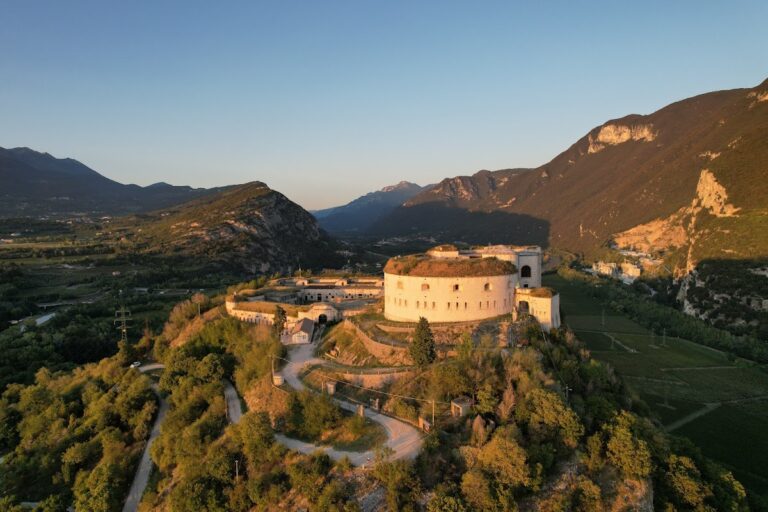
Rocca di Garda occupies a mountain ridge approximately 283 metres above sea level. It rises steeply above Lake Garda, south of the town of Garda, and marks the boundary between the municipalities of Garda and Bardolino. The ridge is a southern offshoot of Monte Baldo, shaped by Quaternary glacial erosion, particularly during the Würm glaciation, the last major Alpine glacial period of the late Pleistocene.
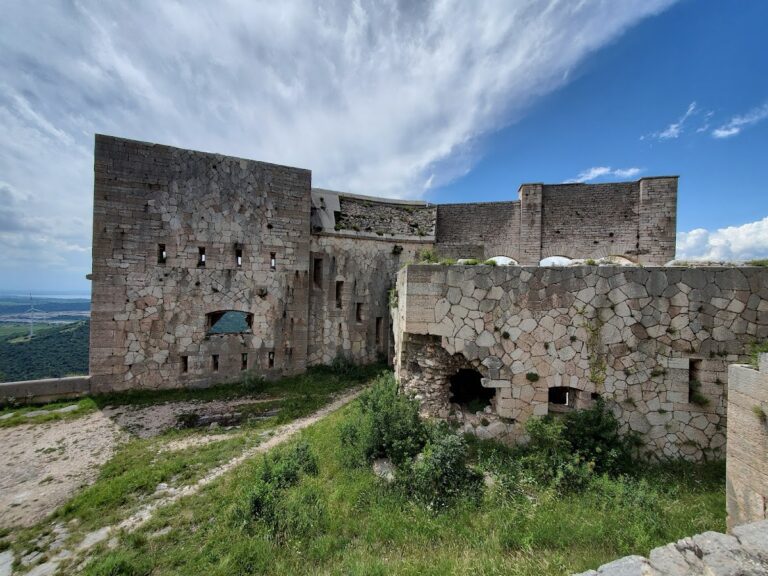
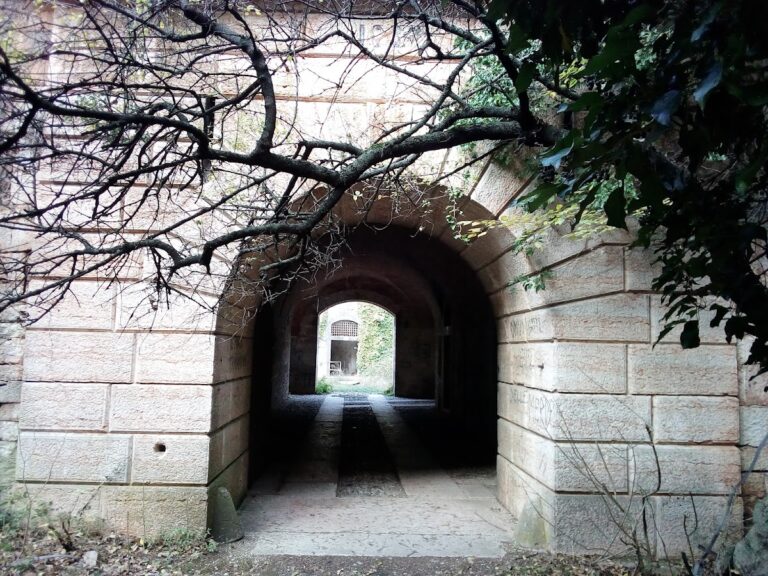
The summit fortress survives only in sparse masonry traces. Archaeological finds provide much of the evidence for its early history: the three fifth-century coins, Zeno’s gold tremissis, the silver Gothic fibula with eagle-head decoration, and Lombard pottery. Together, these remains connect the fragmentary masonry with the fortress’s fifth-century foundation and its continued use in the following centuries.
Vegetation and wildlife
The ridge has Mediterranean vegetation typical of the Lake Garda basin. Downy oak, cypresses, European hop-hornbeam, manna ash, holm oak, laurel, terebinth, mock privet, viburnum, smoke tree, and broom grow among the landscape, while olive groves and vineyards occur near the lake. Dry, nutrient-poor pastures support red fescue, erect brome, and Stipa austroitalica. Several orchid species grow on loose soil with a thin grass cover.
The recorded mammals include Etruscan shrew, wild rabbit, fox, stone marten, badger, weasel, polecat, European hedgehog, common shrew, European mole, brown hare, red squirrel, edible dormouse, hazel dormouse, bank vole, European water vole, subterranean vole, Fatio’s vole, Savi’s pine vole, and striped field mouse.
Amphibians include smooth newt, fire salamander, yellow-bellied toad, common toad, green toad, European tree frog, edible frog, and common frog. Reptiles include the western green lizard, wall lizard, viviparous lizard, slow worm, western whip snake, Aesculapian snake, barred grass snake, smooth snake, asp viper, and adder.
Mature and young coppice woodland supports breeding tawny owl, Eurasian wryneck, Eurasian hoopoe, great spotted woodpecker, European green woodpecker, several tit species, Eurasian nuthatch, Eurasian golden oriole, red-backed shrike, woodchat shrike, Eurasian jay, common chaffinch, and cirl bunting. Low shrubs, meadows, dry-stone walls, and cultivated areas provide breeding habitat for woodlark, Eurasian skylark, tawny pipit, nightingale, common redstart, barred warbler, common chiffchaff, common whitethroat, spotted flycatcher, European goldfinch, European greenfinch, common linnet, ortolan bunting, corn bunting, and northern wheatear.
Nearby sites