Saint Simeon Stylites Church on Povarskaya Street: A Russian Orthodox Church in Moscow
Site at a Glance
- Popularity
- High
- Country
- Russia
- Primary era
- Early Modern
- Eras represented
- Early Modern, Modern
- Civilizations
- Russian
- Site type
- Religious
- Remains
- Church
On this page7 sections
History
Saint Simeon Stylites Church on Povarskaya Street is a Russian Orthodox church in Moscow, Russia. Its stone building was constructed in 1676–1679 in the richly decorated Russian ornamental style, under Tsar Fyodor Alexeyevich, who ruled Russia from 1676 to 1682. A wooden church had stood on the site by 1625, though its first dedication is uncertain.
Wooden predecessor and stone church
The earlier church may have been dedicated either to the Presentation of the Virgin Mary in the Temple, a Christian feast commemorating Mary’s presentation at the Temple in Jerusalem, or to Simeon Stylites, a Christian ascetic remembered for living atop a pillar. One tradition links the dedication to the day of Boris Godunov’s coronation, which fell on Simeon’s feast. Another proposes that Godunov commissioned a church to mark his wedding. Neither explanation establishes the original dedication.
The stone church’s main altar was dedicated to the Presentation of the Virgin Mary in the Temple. Its two side altars honored Simeon Stylites and Nicholas the Wonderworker; the altar dedicated to Nicholas was rededicated to Dmitry of Rostov in 1759.
Parish life and notable associations
The church became a popular wedding venue among Moscow’s intelligentsia. Sergey Aksakov and Olga Zaplatina married there in 1816, followed by Konstantin Pobedonostsev and Elizabeth Engelhardt in 1866. In December 1918, Elena Nurenberg married her first husband there; she later became the wife of writer Mikhail Bulgakov. A persistent legend also places the secret 1801 wedding of Count Nikolai Sheremetev and actress Praskovya Zhemchugova at the church. A marriage-register entry instead locates their wedding at St Nicholas Church by the Old Stone Bridge, so the ceremony at Povarskaya Street is unconfirmed.
Actor Pavel Mochalov lived in a wooden house on the church grounds from 1819 until the middle of the 1820s. Writer Nikolai Gogol belonged to the parish in the final years of his life, when he lived at the Tolstoy house on Nikitsky Boulevard. In February 1852, the church’s priest and longtime rector, Father Alexy Sokolov, administered communion to Gogol at home.
Closure, preservation, and return to worship
The church closed after the 1917 Revolution. By 1930 it faced demolition, and the bells, enclosure, and some exterior decoration were destroyed. Plans to remove the church accompanied construction of Kalinin Avenue and nearby high-rise buildings. Preservation advocate Lev Antropov intervened, while architectural historian G. V. Alferova and restoration specialist P. D. Baranovsky secured an order for state protection. The church received federal-level cultural heritage status on 30 August 1960.
A major restoration took place in 1966–1968. In 1968 the building was assigned to the All-Russian Society for Nature Protection, which used it to exhibit small animals and birds; this use destroyed the remaining original interior decoration. Painting and folk-art exhibitions followed during the 1990s. Crosses returned to the cupolas in 1990 after crosses installed during the restoration had been removed by order of senior officials. The church was returned to the Orthodox Church in 1992, redecorated with frescoes, and restored to liturgical use. It remains active as part of the Moscow Diocese’s Central Deanery, an administrative grouping of parishes within the diocese.
Remains
Plan and exterior
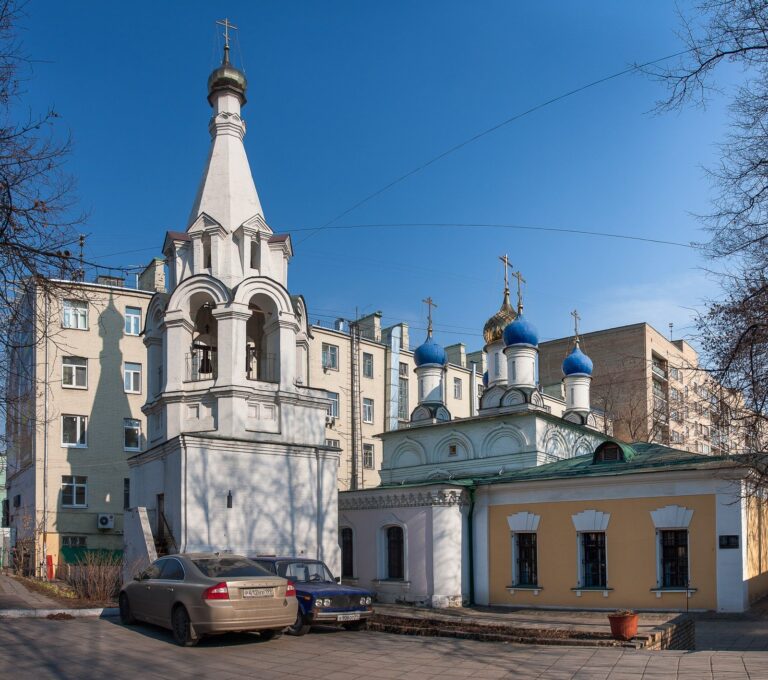
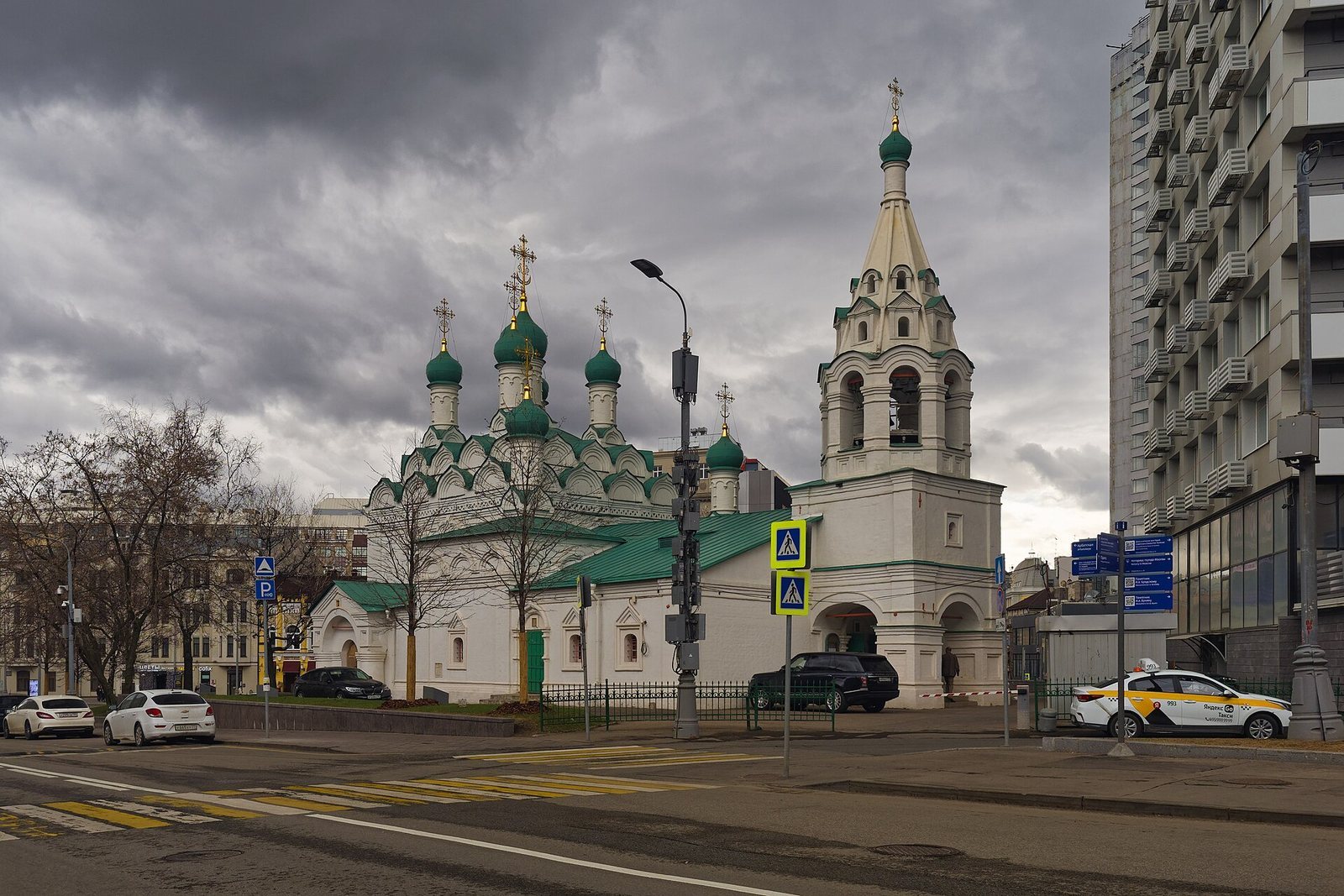
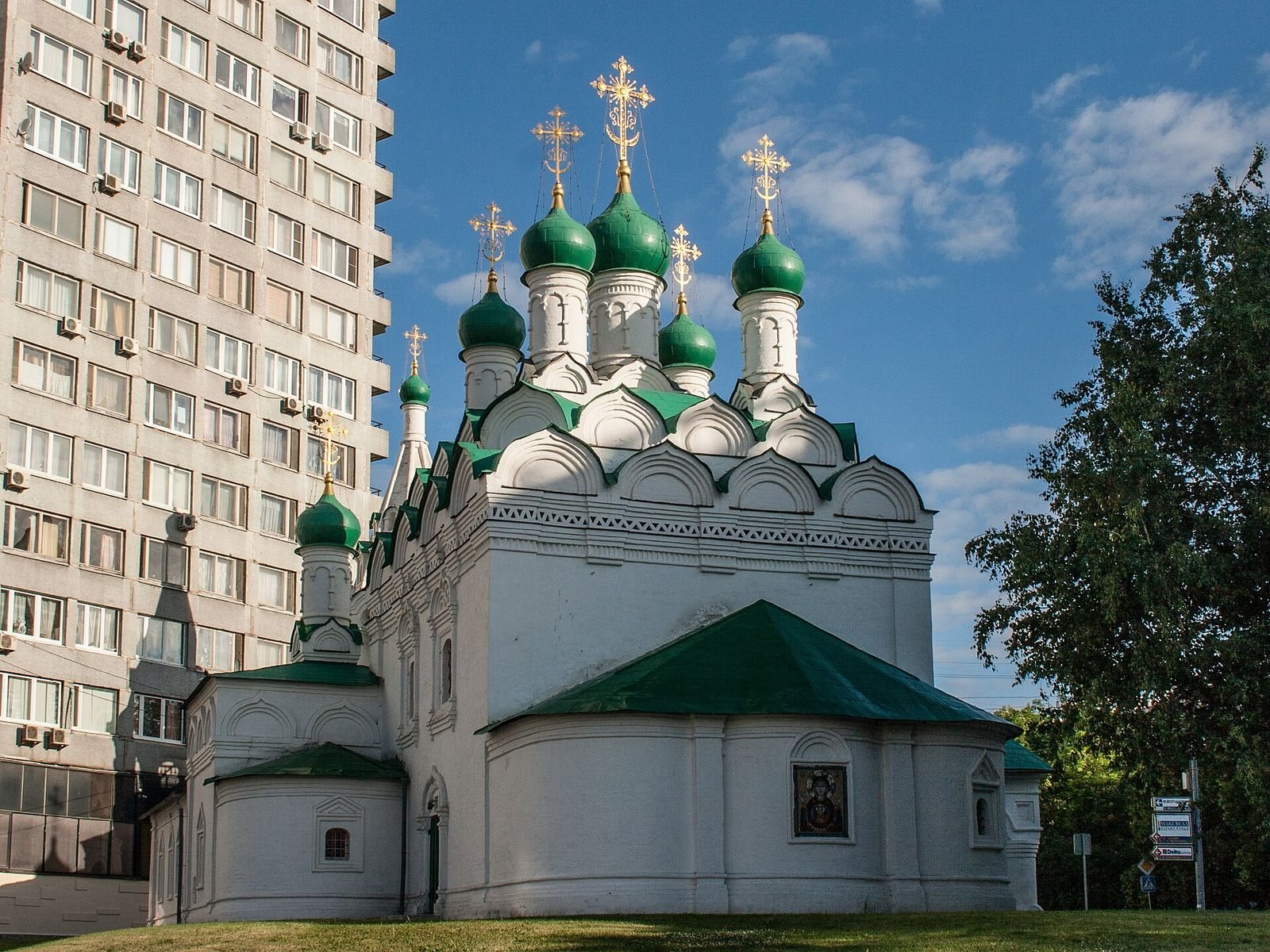
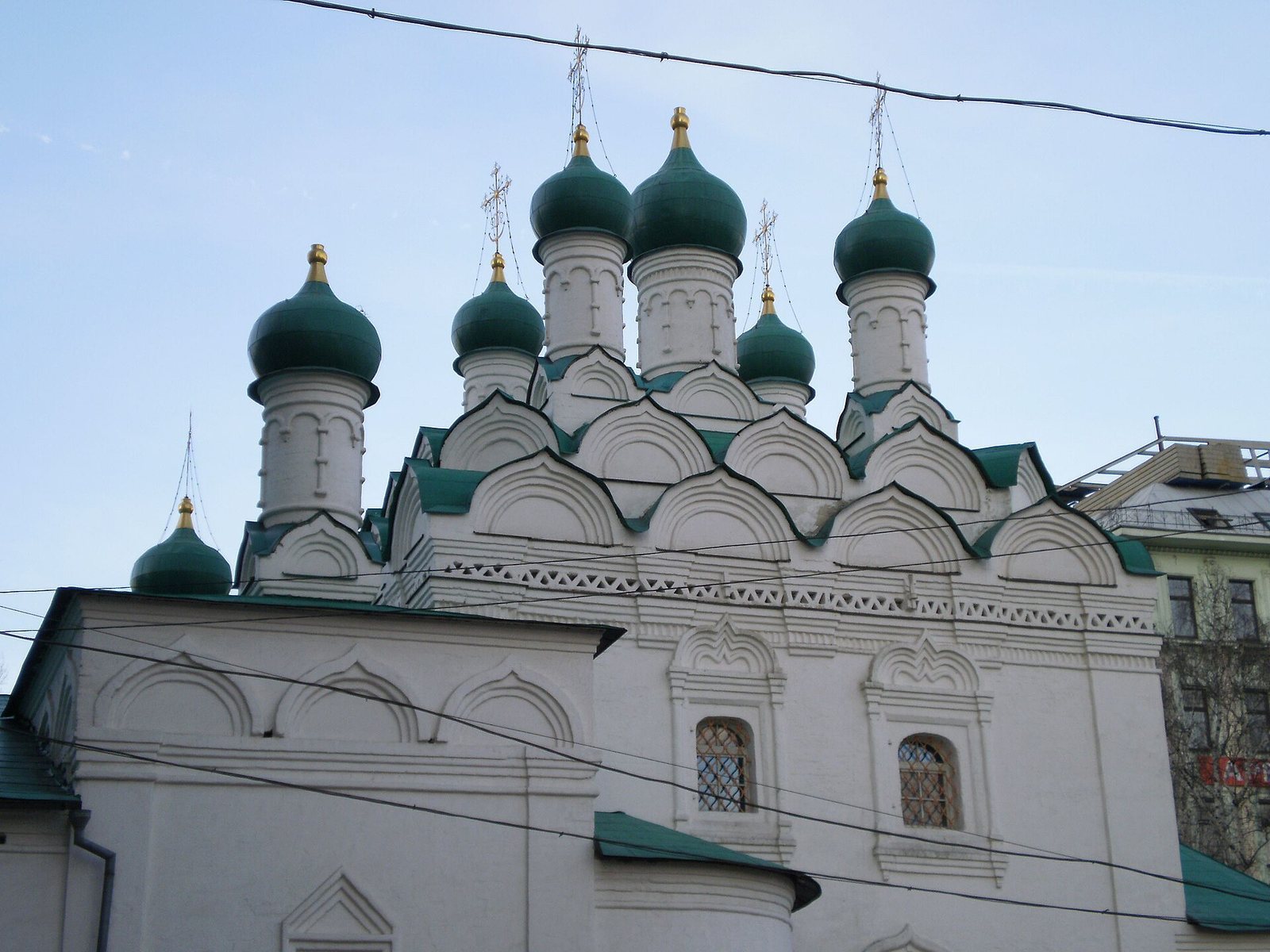
The church has a single nave, five cupolas, one bell tower, a refectory, and one iconostasis, the screen of icons separating the sanctuary from the main body of an Eastern Orthodox church. Its three altars include the main altar and two side chapels. Each side chapel has its own apse, a rounded recess at a church’s end, and a cupola, or small dome. Rows of kokoshniks, ornamental arches used in Russian architecture, and a frieze decorate the exterior. White-stone tomb slabs from the 17th and 18th centuries remain set into the walls.
Restoration and interior
The 1966–1968 restoration reinstated the original roof form and main volume, the refectory’s vaulted ceilings, two tiers of kokoshniks, and the original shapes and decorative surrounds of the windows and doors. Later alterations were removed, and the surrounding ground was excavated to its 17th-century level and paved. The church’s icon of Simeon Stylites survived and was kept by parishioners. Frescoes were added to the interior in 1992.