Saint Petka of the Saddlemakers Church: A Medieval Orthodox Church in Sofia


Site at a Glance
- Rating
- 4.6
- Popularity
- Medium
- Country
- Bulgaria
- Primary era
- Medieval
- Eras represented
- Classical, Medieval, Modern
- Civilizations
- Roman
- Site type
- Religious
- Remains
- Church
On this page11 sections
History
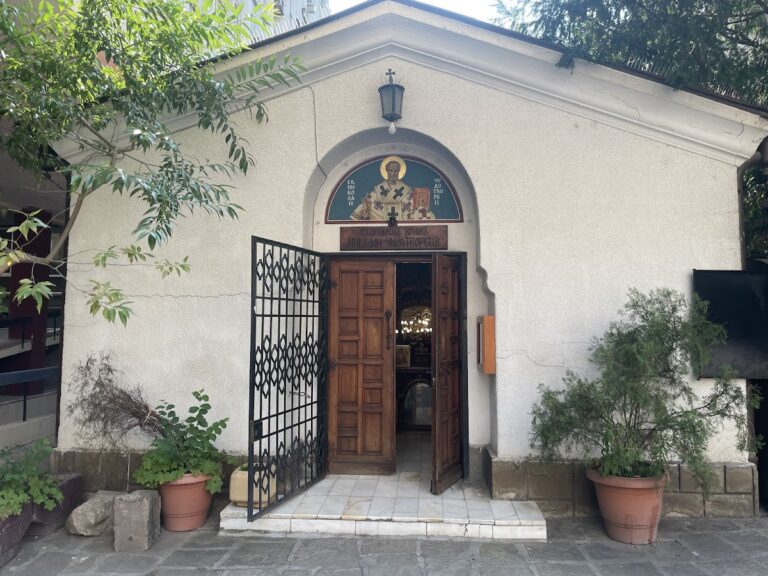
Saint Petka of the Saddlemakers Church is a medieval Eastern Orthodox church in Sofia, Bulgaria, generally dated to the late fourteenth or early fifteenth century. Dedicated to Saint Petka, also known as Paraskeva of Iconium, it is affiliated with the Bulgarian Orthodox Church. The saint was traditionally associated with the patronage of saddlemakers, while the church’s name refers to the medieval saddlemakers’ guild that lived in the surrounding quarter, worshipped there, maintained the building, and was associated with its foundation.
Medieval origins and earlier foundations
The church was built over an earlier Roman or late-antique religious and funerary structure. An eleventh-century foundation has also been proposed, but this dating is considered very unlikely. The surviving medieval building therefore belongs to a later phase of Sofia’s long religious history. The description “of the Saddlemakers” derives from the Ottoman Turkish word semerci, meaning saddlemaker.
Saint Petka of the Saddlemakers was mentioned in the travel account of Stephan Gerlach in 1578. At a later stage, newer construction enclosed the church, although it apparently remained accessible. After the Second World War, the building was uncovered, but it remained buried up to the level of the roof until 1969.
Protection, restoration, and religious use
The church received national cultural-monument status in 1955, initially in recognition of its archaeological value. Artistic value was added to the designation in 1973, followed by architectural, constructional, and historical value in 1988. Its fresco decoration underwent scientific examination in 1956, and minor restoration followed in 1959. Major restoration and exposure works began in 1978 under Nikola Mushanov, Zlatka Kirova, and Lubomir Delchev.
Between 1983 and 1993 the church functioned as a museum site. It returned to active religious use by the Bulgarian Orthodox Church in 1993.
The Vasil Levski burial tradition
A longstanding hypothesis holds that Vasil Levski, the nineteenth-century Bulgarian revolutionary and national hero also known by the monastic name Hierodeacon Ignatius, was buried in the altar area. The idea drew on interpretations of the 1956 archaeological excavations and on press accounts from 1937 that repeated stories about a possible reburial.
The remains identified as skeleton No. 95 were sent for examination but were later lost or destroyed. Commissions in the 1980s found no proof that they belonged to Levski. A marble plaque installed at the church during the 1990s stated that he was buried there according to popular memory, but it later disappeared. On 18 February 2012, a new plaque was ceremonially unveiled east of the apse. Its inscription states that, according to popular memory and some scientific data, Bulgarian patriots buried Levski there in 1873.
Remains
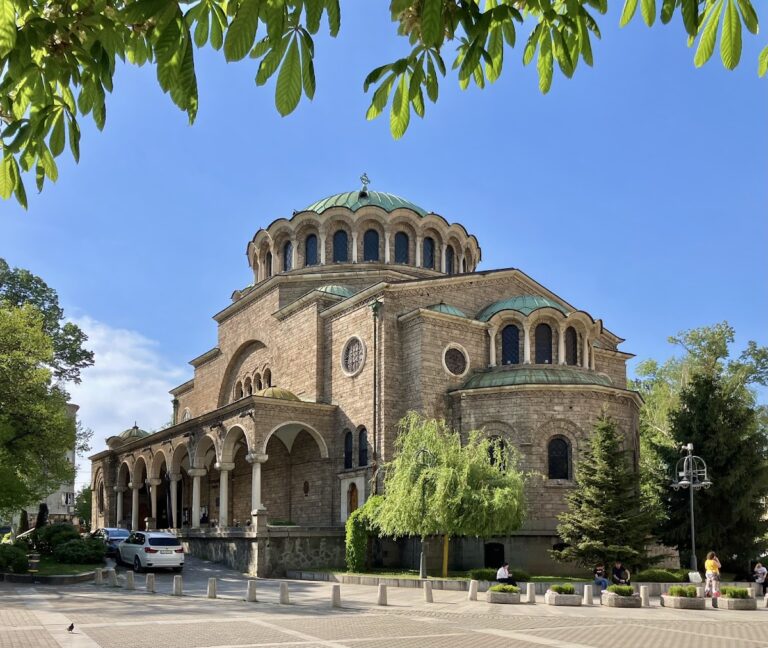
Saint Petka of the Saddlemakers is a small, single-naved church partially dug into the ground, probably from the time of its original construction. It stands in central Sofia in the underpass near Independence Square and the entrance to Serdika metro station, beneath or within the semi-submerged TZUM shopping complex, between the Central Universal Store and the Sheraton Hotel. The Cathedral of Saint Nedelya is nearby.
The church building
Structure and construction
The building has one apse, a semi-cylindrical vault, and a tiled gabled roof. Its walls are approximately one metre thick and consist of alternating courses of stone and brick. Some stones were reused from nearby ancient buildings, alongside river stones of different colours. Two arcades are built into each of the inner walls on the northern and southern sides. They support the ceiling and add structure to the interior. A western vestibule formerly stood at the west end, but it has not survived.
Earlier Roman remains
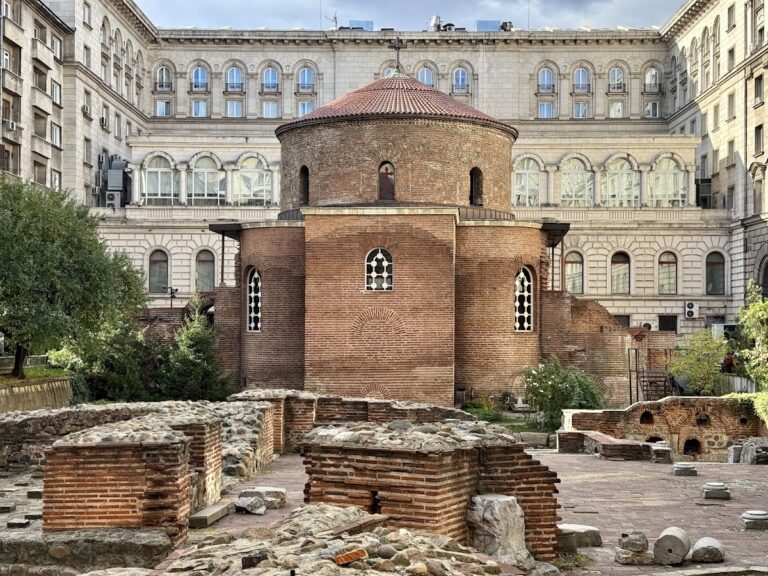
A crypt or Roman tomb lies beneath the church and is associated with an earlier structure dating to the fourth century, or more broadly to the third and fourth centuries. That earlier building was decorated with mosaics. Its exposed remains are displayed beside the church, placing the medieval structure within a site that also preserves evidence of Sofia’s Roman and late-antique past.
Frescoes and furnishings
Wall paintings
Numerous fragments of wall paintings survive inside the church. They probably belong to several periods extending from the fourteenth century to the early twentieth century, while the final frescoes were made in 1922. The earliest paintings are regarded as the most valuable. Their subjects are arranged in zones, with prophets in the ceiling area, hierarchs in the altar and apse, scenes from the life of Jesus Christ in the upper wall zones, and saints and martyrs in the lower zones.
Among the notable paintings is a monk in the western half of the eastern arcade on the south wall, probably Saint Ivan of Rila. The north wall contains a scene of the Exaltation of the True Cross, an unusual subject in Bulgaria. The style of some paintings connects them with fresco painters associated with Cretan ateliers on Mount Athos. Several sixteenth-century frescoes were painted by Pimen of Sofia, a prominent Sofia-based painter of religious frescoes.
Iconostasis and Gospel
The iconostasis, the decorated screen separating the sanctuary from the main body of an Eastern Orthodox church, was carved by members of the Filipov family of woodcarvers from the Debar region. Some icons were made by another Debar master, Alexo Vasilev.
A Gospel from the church has gold-bound covers made by the goldsmith Matei Zlatar. A donor inscription dated 1581 records that a woman named Kera and her daughter Marija gave it to the church. The Gospel is now catalogued as No. 23 in the collection of the Holy Synod of the Bulgarian Orthodox Church.
Nearby sites