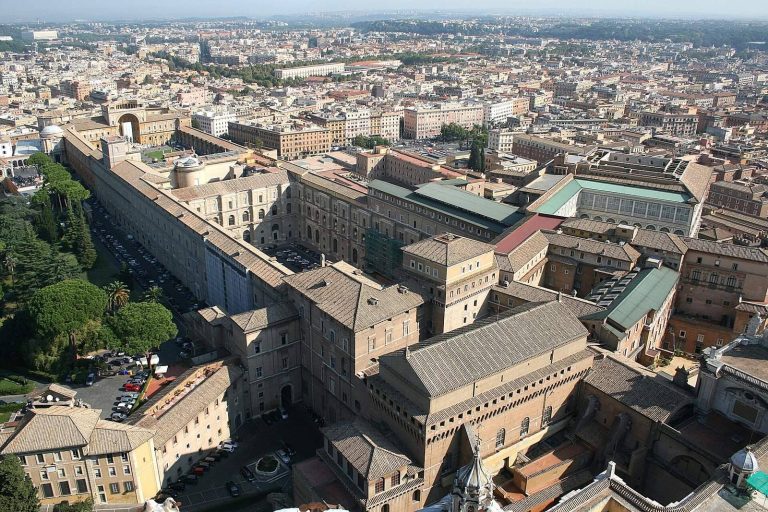
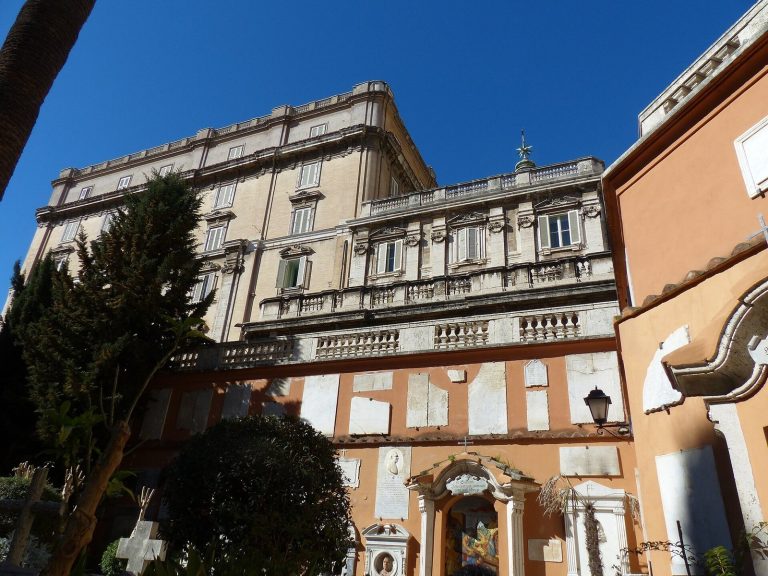
Saint Peter’s Tomb: A Venerated Burial Site Beneath St. Peter’s Basilica
Site at a Glance
- Popularity
- Very High
- Country
- Vatican City
- Primary era
- Classical
- Eras represented
- Classical, Early Modern
- Civilizations
- Papal States, Roman
- Site type
- Religious
- Remains
- Tomb
On this page14 sections
History
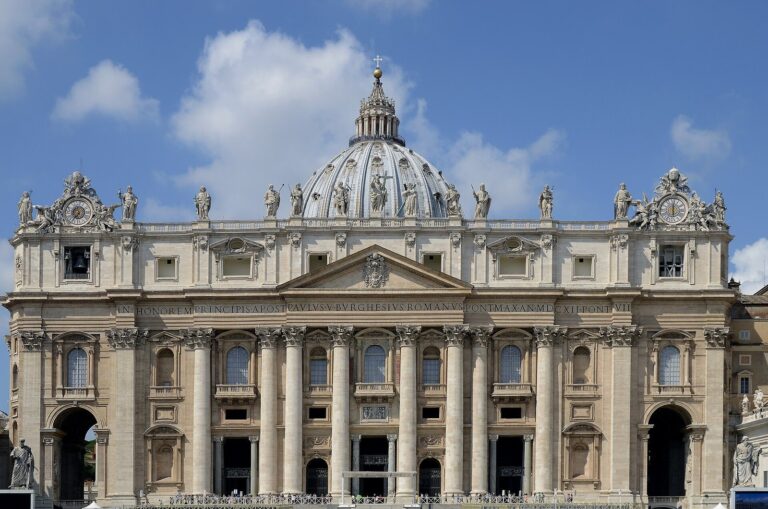
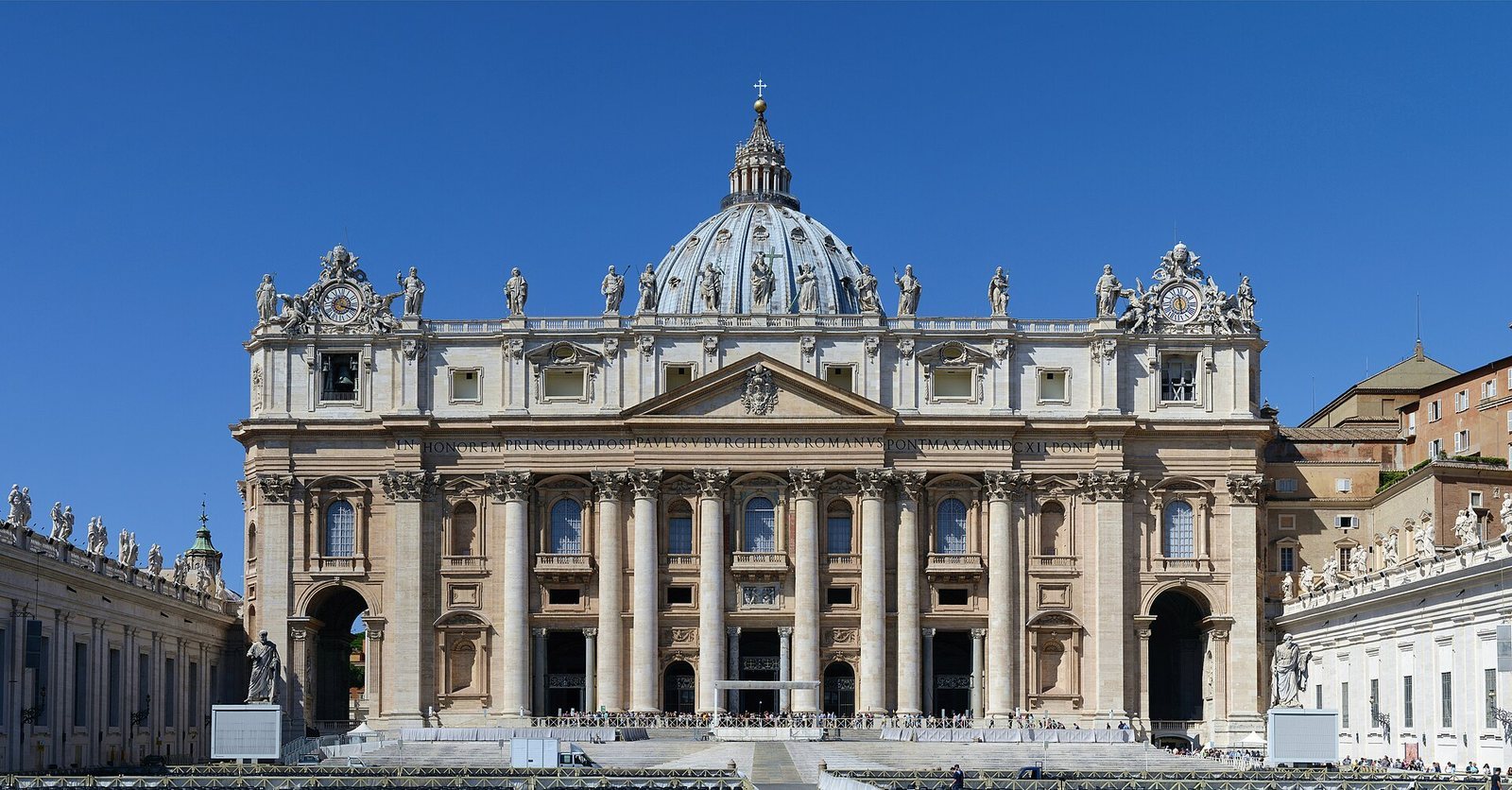
Saint Peter’s tomb is a burial place venerated by Christians beneath St. Peter’s Basilica in Vatican City, associated with a memorial built around AD 160 to 180 and a basilica erected over it in the first half of the fourth century. Christian tradition identifies the grave with the apostle Peter, but whether he was buried there and whether recovered bones are his remain disputed.
Early Christian traditions
The First Letter of Clement, written around AD 90 to 100, recalls Peter’s suffering and death. Later Christian traditions place his martyrdom in Rome under Nero, often dating it to about AD 64 to 67. Tertullian connected Peter’s death with Nero’s persecution of Christians. Eusebius, writing later, attributed to the earlier theologian Origen the story that Peter was crucified upside down. The Roman historian Tacitus described the punishment of Christians after the Great Fire of Rome in AD 64.
By the middle of the second century, Dionysius of Corinth wrote that Peter and Paul had preached in Italy and died there. In the early third century, the Christian writer Caius referred to memorials, or “trophies,” of the apostles at the Vatican and on the Ostian Way. The term’s meaning is uncertain. Eusebius later took it to refer to their burial places. Christians also made pilgrimages to the apostles’ tombs during periods of persecution.
A tradition in the Book of Popes credits Anacletus, an early bishop of Rome, with establishing a burial monument over Peter’s grave. In AD 363, the emperor Julian referred to secret worship at the tomb. Some scholars have proposed that Peter’s and Paul’s remains were moved to the Catacombs of St. Sebastian in AD 258 to protect them from desecration, then returned to their original graves around AD 260, after the persecution under Valerian ended.
Constantine’s basilica and later traditions
In the first half of the fourth century, Constantine I sponsored a basilica over the site Christians revered as Peter’s grave. Its altar was placed above the tomb, and the earlier memorial chamber was retained as a chapel. The Book of Popes attributes rich decoration to Constantine. The tomb’s treasures were later believed to have been taken during the sack of Rome by Muslim forces in AD 846.
A tradition places the skulls of Peter and Paul together at the Lateran from at least the ninth century. Urban V is credited with moving the relics in 1367 from the Lateran’s Sancta Sanctorum chapel to the Lateran Basilica, where tradition places them above the main altar. Later tradition also associates the graves of early bishops of Rome, including Linus, Anacletus, Evaristus, Telesphorus, Hyginus, Pius I, Anicetus, and Victor I, with Peter’s tomb. Anicetus’s remains were later transferred to the Catacomb of Callixtus. A broken slab found in 1615 has been proposed as an inscription naming Linus, though its reading is uncertain and may instead refer to Aquilinus or Anullinus.
Excavation and debate over the relics
Excavation beneath St. Peter’s began in 1939, following Pope Pius XI’s wish to be buried near Peter’s tomb, and continued under Pope Pius XII into 1949 and 1950. Overseen by Vatican monsignor Ludwig Kaas, the work exposed a cemetery beneath the basilica, with second- and third-century mausoleums and a central memorial area. In 1951, the first excavation team announced that it had found Peter’s tomb. Its interpretation drew criticism over excavation methods and records. Further investigations from 1953 to 1958 and in 1965 added evidence without settling the grave’s identity.
In 1942, Kaas removed bones from a niche near the memorial and kept them separately from the excavation team. After his death in 1952, archaeologist Margherita Guarducci found them. Anthropologist Venerando Correnti reported in 1963 that they belonged to a robust man aged about 60 to 70 and were probably from the first century. Guarducci argued that they were Peter’s; archaeologist Antonio Ferrua disagreed. Pius XII had said in 1950 that the bones could not be identified as Peter’s with absolute certainty.
On 26 June 1968, Pope Paul VI announced that Peter’s relics had been identified convincingly, while the evidence remained circumstantial. Nine bone fragments were placed in a reliquary for the papal residence, and the other remains were returned to the site. Nine fragments were displayed publicly in 2013. In 2019, Pope Francis gave a reliquary containing nine fragments to Ecumenical Patriarch Bartholomew through a representative, as a gesture toward Catholic-Orthodox unity.
Remains
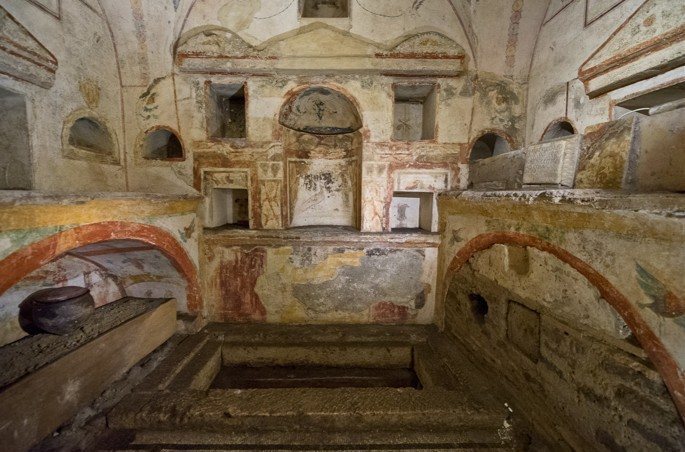
The burial complex lies on the slope of Vatican Hill, near the western end of the Vatican Necropolis. Its funerary buildings occupied two parallel rows running west to east. The cemetery’s main area took shape in the second century and was used from the first century into the early fourth century. It contained both Christian and non-Christian burials; parts of the complex were demolished and filled when the ground was prepared for Constantine’s basilica.
The cemetery and memorial
The central memorial and grave
A small memorial structure was built in a funerary courtyard around AD 160 to 180. It consisted of a columned monument with a canopy and a small niche in a wall. The structure is often linked with the “trophies” mentioned by Caius, although that identification is uncertain. Beneath the monument, excavators found a simple earth grave dating to the late first century. The arrangement of Christian graves close around it was interpreted by some excavators as evidence that the spot was revered by about AD 150.
In the burial tradition, Peter’s grave was a vault beside the Via Cornelia, reached by steps from the road, with a stone sarcophagus at its center. The Book of Popes describes a small chamber above the grave, large enough for three or four people to kneel and pray.
Other graves and the wall niche
A separate grave at the foot of the small shrine-like aedicula contained remains attributed to four people and several farm animals. A niche on the north side of the Graffiti Wall held the bones that were removed in 1942. The marble-lined cavity measured 77 centimeters long, 29 centimeters wide, and 315 centimeters high. The Graffiti Wall meets the Red Wall to the right of the aedicula.
A damaged Greek inscription on the Graffiti Wall has been transliterated as Pet(ros) eni. It has been interpreted as “Peter is here” or “Peter rests in peace.” Guarducci treated it as evidence for Peter’s relics, an interpretation that did not gain broad scholarly acceptance.
The altar and surviving basilica features
Burials beneath the altar and the Confession
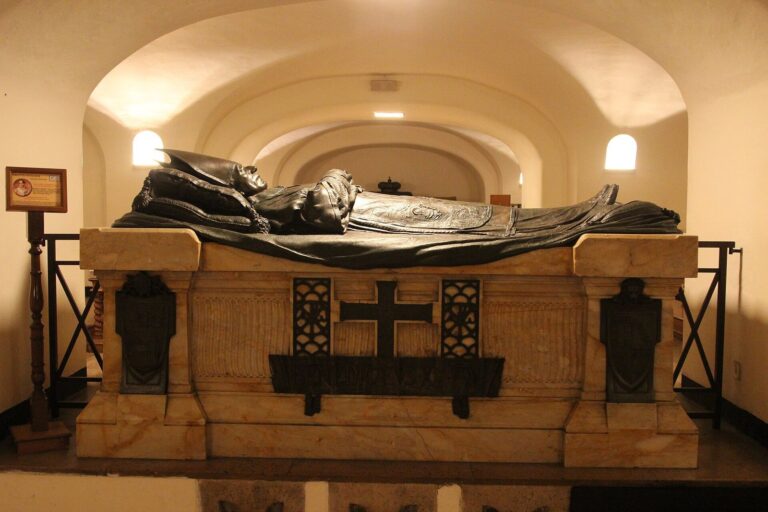
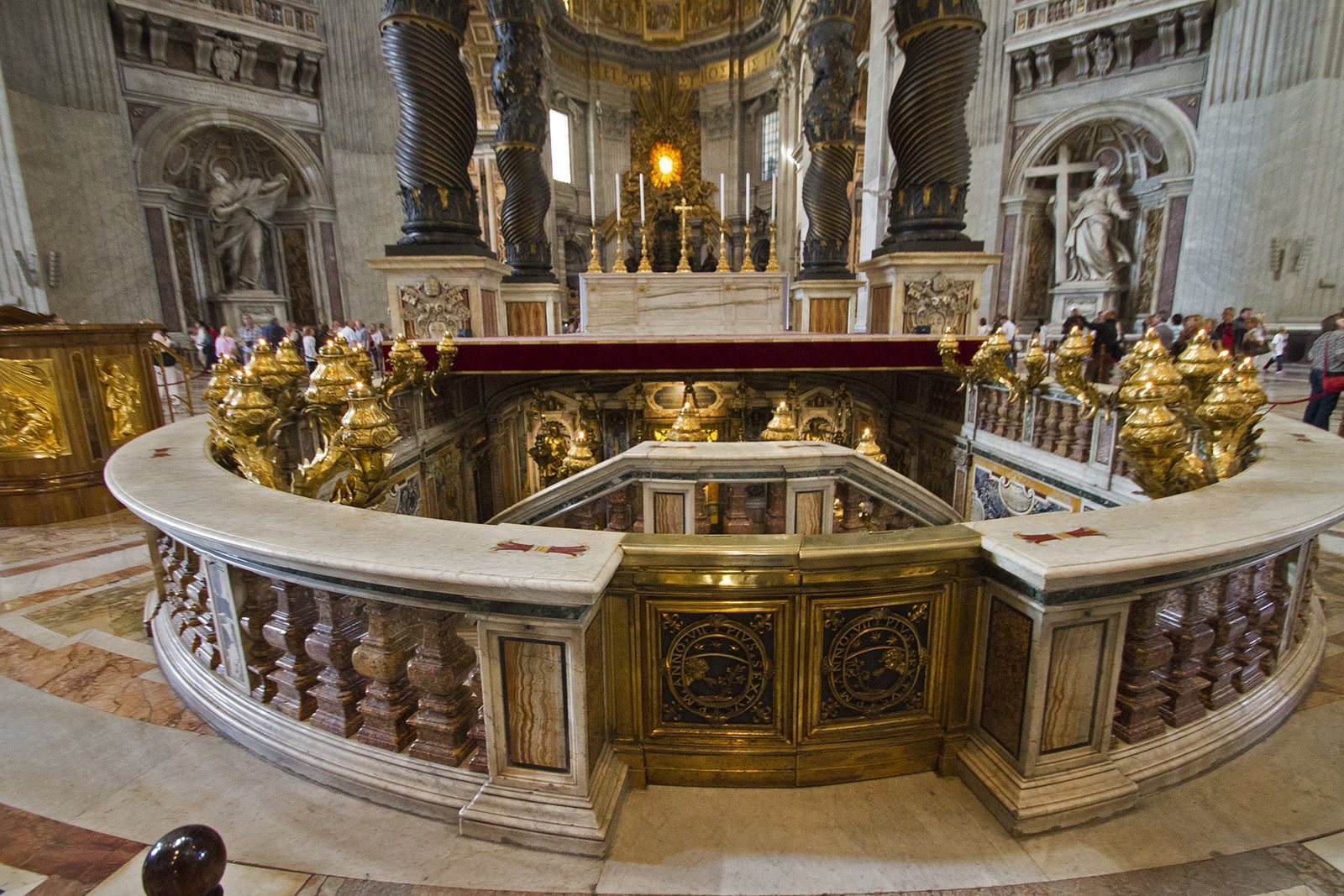
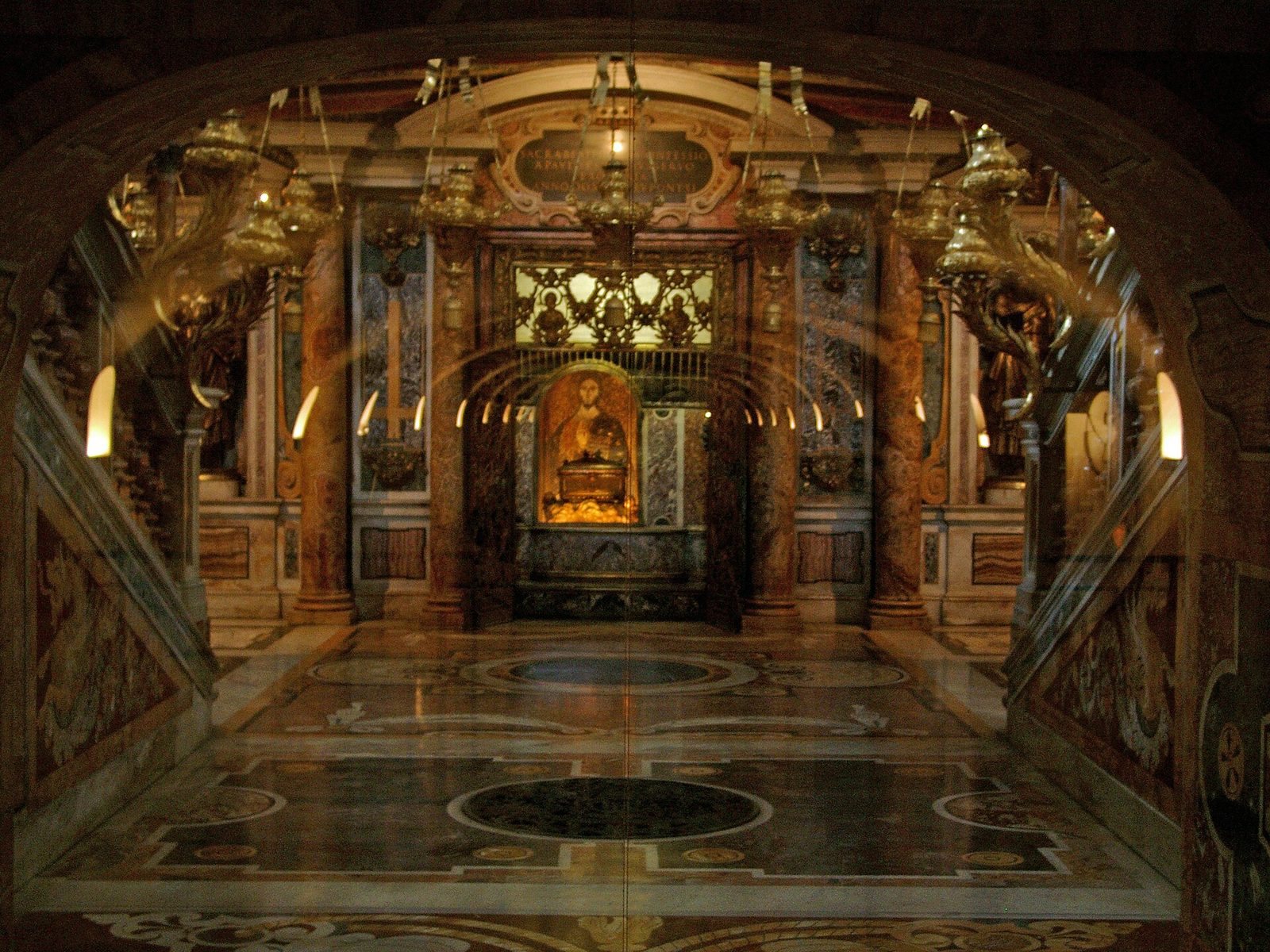
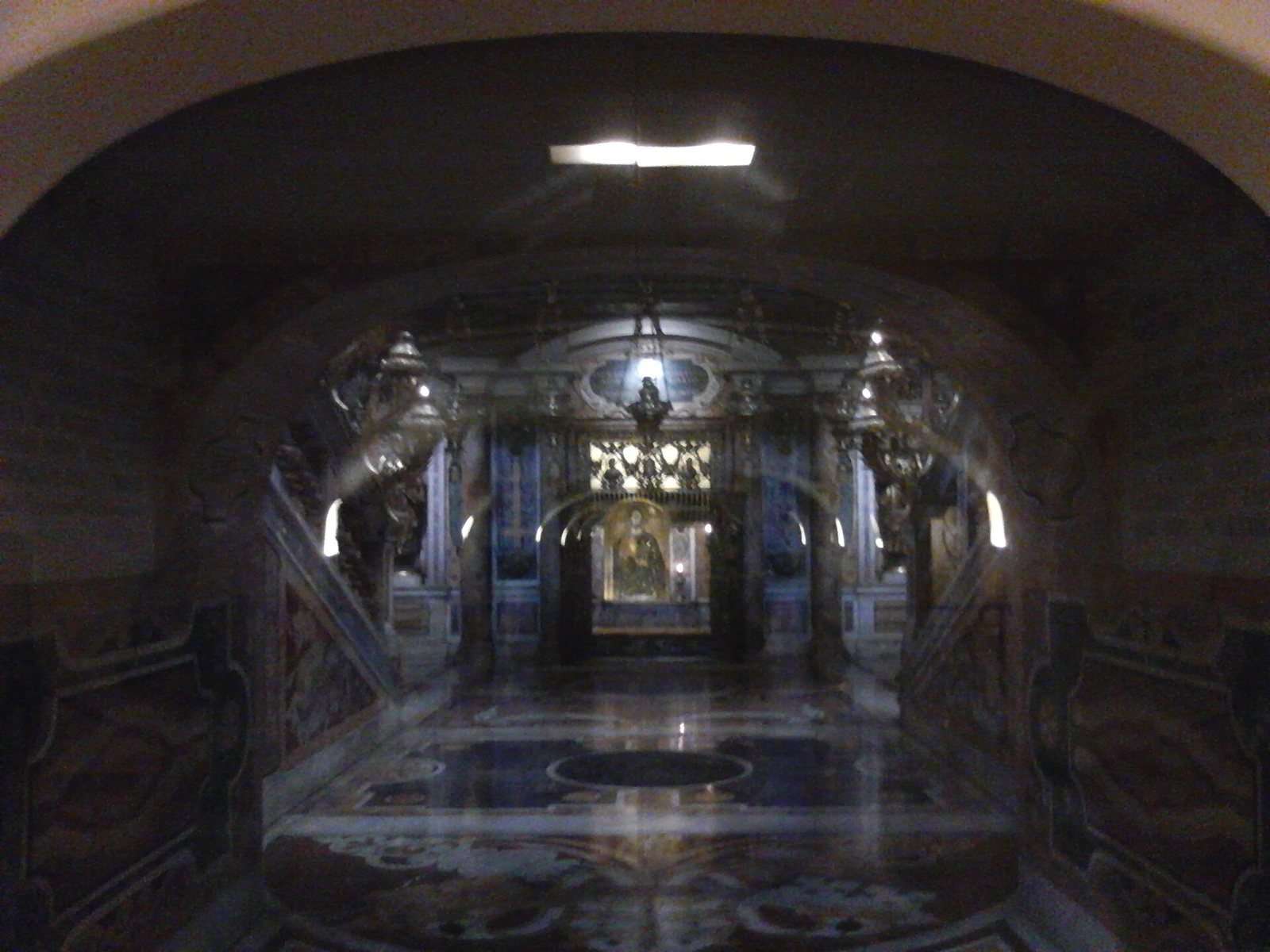
Shallow graves lie directly below the present high altar. One contained a tile dated to the reign of Vespasian, AD 69 to 79, and later graves were arranged around the central area. A small wall monument beneath the altar dates to about AD 160. The Constantinian basilica placed its altar above the venerated grave and memorial. Its raised altar stood over the earlier memorial chamber, which became the Chapel of the Confession, a shrine space associated with Peter’s burial. The later basilica preserves this vertical arrangement. The ancient monument is concealed behind the Christ mosaic in a niche of the Confession, beneath the papal altar.
Damaged mausoleums and mosaics
Construction of the present basilica, which replaced the old one from 1507, and later work on Bernini’s altar canopy damaged much of the vaulting in the semi-subterranean burial chambers. Bernini’s canopy above Peter’s tomb was made between 1624 and 1633. One affected building is the second-century Tomb of the Julii, which has mosaics depicting Jesus as the sun riding in a chariot, Jonah, a fisherman who may represent Peter, and Jesus as the Good Shepherd. The mosaics were revealed in the sixteenth century and are regarded as among the earliest Christian images.
Relics and reported furnishings
Bone fragments
Most of the recovered bone fragments are kept in 19 transparent cases set within a marble recess in the aedicula. The collection has been described as 134 fragments representing nearly half a skeleton.
Reported tomb furnishings
The Book of Popes describes a bronze casing around the sarcophagus, said to measure five feet, about 1.5 meters, on each side. It also describes a gold cross weighing about 150 pounds, or 68 kilograms, above the tomb. According to the account, the cross bore an inscription naming Constantine Augustus and Helena Augusta and comparing the place to a royal dwelling.