Saint Nicholas Church in Kraków: A Roman Catholic Parish Church


Site at a Glance
- Rating
- 4.7
- Popularity
- Low
- Country
- Poland
- Primary era
- Early Modern
- External website
- Open
- Eras represented
- Medieval, Early Modern, Modern
- Civilizations
- Kingdom of Poland, Polish–Lithuanian Commonwealth
- Site type
- Religious
- Remains
- Church
On this page11 sections
History
Saint Nicholas Church in Kraków is a Roman Catholic parish church in Poland, first established as a Romanesque church in the Kraków settlement of Wesoła during the eleventh century or the first half of the twelfth century. It stood on the trade route leading from Kraków toward Rus and later became an important church for the surrounding community.
Medieval foundations and institutional changes
The church initially belonged to the Benedictines of Tyniec, members of the Order of Saint Benedict, a major Western Christian monastic order. Their ownership was confirmed by a papal bull issued by Gregory IX in 1229. From the fourteenth century, Saint Nicholas also served as the parish church and principal church of Wesoła.
In 1467, the Benedictines transferred the church to the Kraków Academy, the institution later known as Jagiellonian University. The original Romanesque building was subsequently replaced by a Gothic church during the fourteenth or fifteenth century.
Destruction and Baroque rebuilding
Swedish forces looted and burned the church in 1655 during the Swedish invasion of Poland. Reconstruction followed in the Baroque style between 1677 and 1684. Bishop Mikołaj Oborski solemnly consecrated the rebuilt church in 1682.
Modern alterations and religious role
Major changes were introduced at the beginning of the twentieth century under the direction of the architect Aleksander Biborski. The church also preserves links with notable events in modern Polish history. Emilia Kaczorowska, the mother of Karol Wojtyła, who later became Pope John Paul II, was baptized here on 13 April 1884. Feliks Dzierżyński and Zofia Muszkat were married in the church on 10 November 1910.
War damage was repaired in January 1945 by a Red Army unit. Saint Nicholas remains a parish church dedicated to Saint Nicholas and is also a sanctuary of Blessed Hanna Chrzanowska, a Polish nurse associated with community-based nursing and venerated in the Catholic Church. The church lies on the Lesser Poland Way of Saint James, a pilgrimage route connecting Sandomierz and Tyniec.
Remains
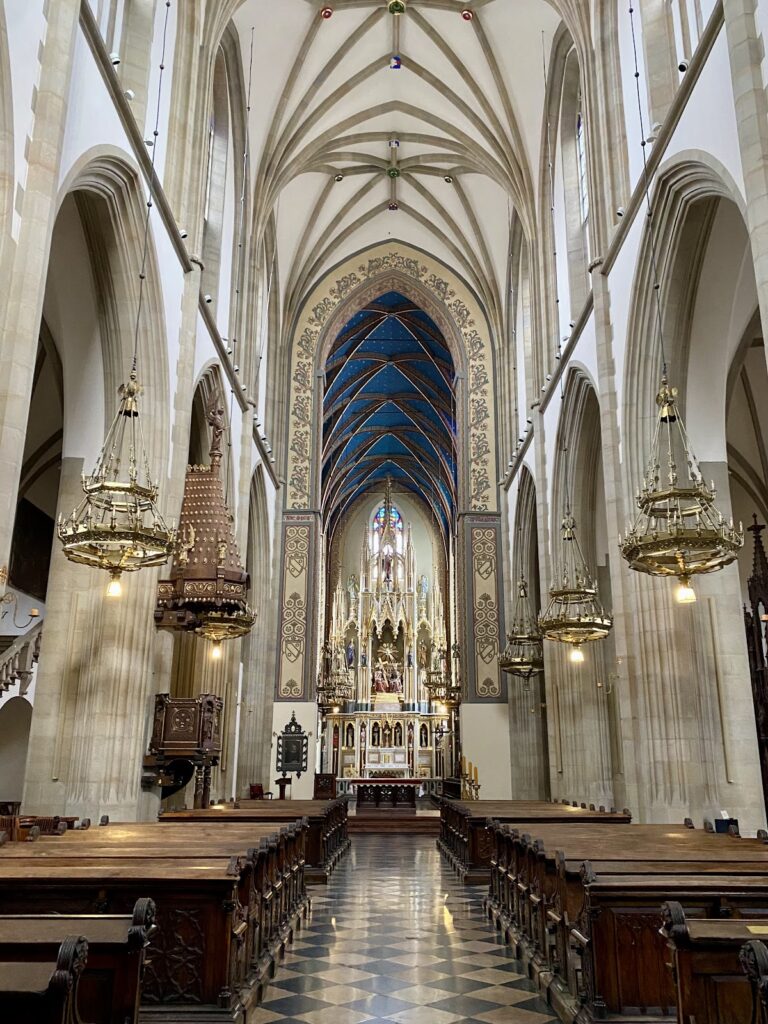
The present brick church combines Gothic and Baroque elements. Its plan has three naves, while the building is marked externally by a single tower. Three altars form part of the interior arrangement, which also incorporates medieval, Renaissance, Baroque, and modern features.
Main church building
Façade and medieval fabric
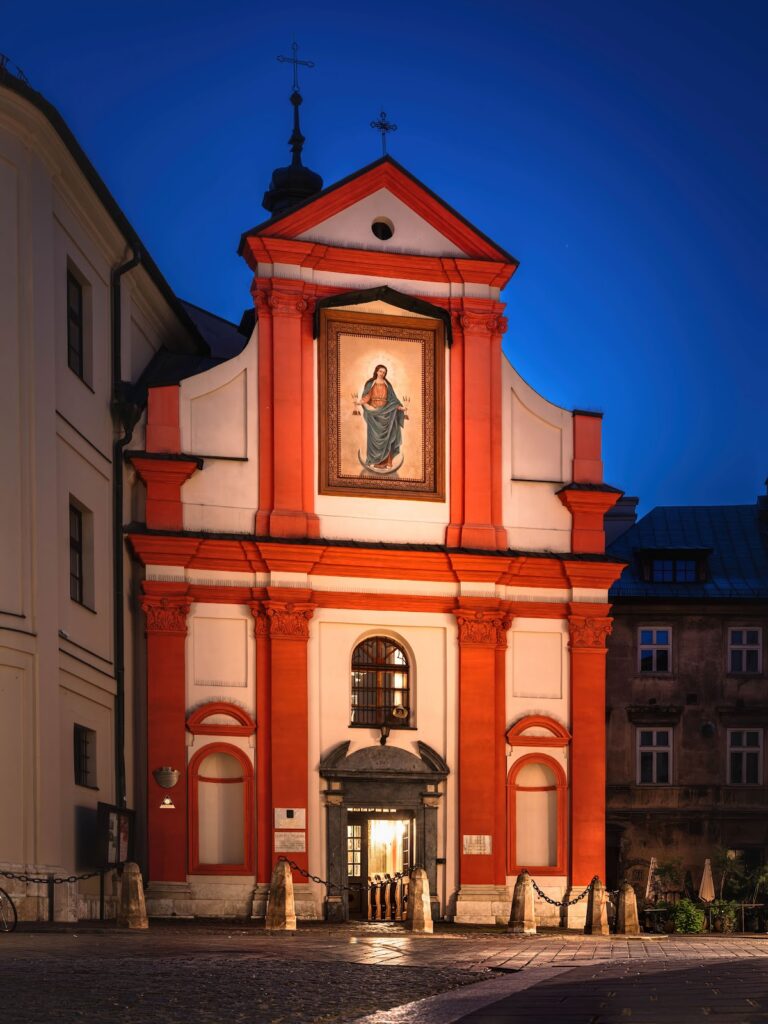
The western façade is a restrained Baroque composition. Niches in its lower storey contain statues of Saint Peter and Saint Paul. Fragments of the walls of the Gothic chancel survive within the later building, preserving physical evidence of the church’s medieval phase.
Interior furnishings and artworks
Most of the interior furnishings date from the second half of the eighteenth century. The church organ has 15 stops, two manuals, and a pedal division. On the south side, the second side aisle added at the beginning of the twentieth century accompanies a sacristy with vestibules attached to the south side of the chancel.
The right-hand aisle contains the shrine of Blessed Hanna Chrzanowska, comprising a reliquary and a pentaptych, an artwork made of five hinged panels. Relics of Chrzanowska are preserved in the church. Another pentaptych, a late Gothic work from the fifteenth century depicting the Coronation of the Virgin, was brought here at the beginning of the nineteenth century from the closed Church of Saint Gertrude.
Other furnishings include an Early Renaissance painting of the Madonna with Saints Adalbert and Stanislaus, a bronze baptismal font dated 1536, and choir stalls bearing the coat of arms of Jagiellonian University.
Monuments beside the church
Lantern of the dead
A fourteenth-century stone lantern of the dead stands beside the church. It consists of a pedestal, a six-sided shaft with small arcades, and a pyramidal roof topped by a cross. The lantern originally stood in the courtyard of Saint Valentine’s Hospital in Kleparz and was installed beside Saint Nicholas Church in 1871.
Armenian commemorative stone
A khachkar, a cross-bearing stone monument characteristic of Armenian religious and commemorative art, stands beside the church. It commemorates Armenian victims of twentieth-century wars and massacres.