Saint John Church, Ganja: A Church of Albanian and Armenian Traditions
Site at a Glance
- Rating
- 5
- Popularity
- Very Low
- Country
- Azerbaijan
- Primary era
- Early Modern
- Eras represented
- Early Modern
- Civilizations
- Caucasian Albania, Safavid
- Site type
- Religious
- Remains
- Church
On this page8 sections
History
Foundation and changing identity
Saint John Church is a historic Christian church in Ganja, Azerbaijan. It was built in 1633, although 1618 is also given as a possible construction date. The building is among Ganja’s oldest surviving structures and was the city’s oldest and principal church of the Albanian Christian tradition, rooted in ancient Caucasian Albania in the eastern Caucasus.
The church retained an Albanian identity into the nineteenth century, when Armenians restored it. It belongs to the Armenian Apostolic Church, an ancient Christian church rooted in Armenian Christianity, and its Azerbaijan Diocese, a regional administrative jurisdiction. After its restoration, the church served as one of Ganja’s four Armenian churches: three were in the city and one was in a cemetery.
Nineteenth-century use and rebuilding
An 1849 record lists the church alongside Saint George, the Holy Mother of God, a title for Mary, and Saint Sarkis, a saint venerated in Armenian tradition. Ganja was recorded as having four city churches in 1870 and six in 1885. The church itself was reconstructed in 1860.
Hovannes Yengibariants, the earliest priest associated with the church by name, died in 1862. Qaregin Ter-Qriqoryan Tumanyants became chief priest on 15 November 1898. From 1908 he served with Qriqor Babakevxyants, who died that year, and later with Daniel Ter-Danielyants, Mkrtç Ter-Hovsepyan, and Shmavon Boriyants.
Repair plans submitted to city authorities in 1899 were delayed by the Armenian-Turkish War. An architect prepared a design and estimate for a major reconstruction in 1903. Work began in 1910 and was completed that year, led by Hovsep bey Melik-Beyleryan, Simeon Afanasyan, Mixail Lazaryan, Akop Lisikyan, Martiros Nabatyan, and Simeon Babakevxiyan.
Conflict and later uses
During fighting in 1920, five shells struck the church. It remained active until 1990. Following the Karabakh conflict, mass pogroms against Armenians and their expulsion, the building was looted. A decision was then made to use it as a music club; it now serves as the Chamber Hall of the Ganja State Philharmonic. The church is listed in Azerbaijan’s national register of historical monuments as a site of national importance, under entry 187.
Remains
Plan and additions
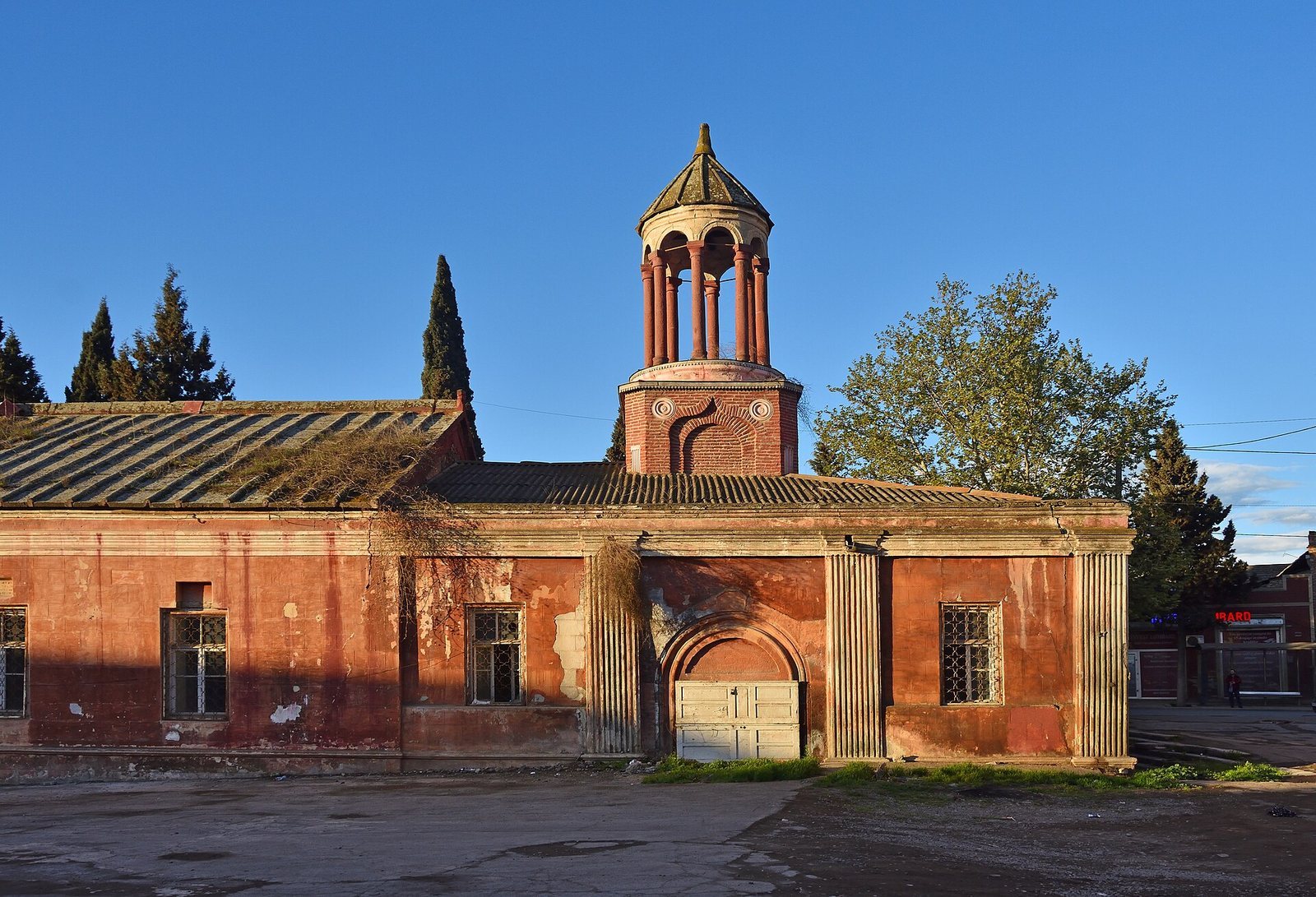
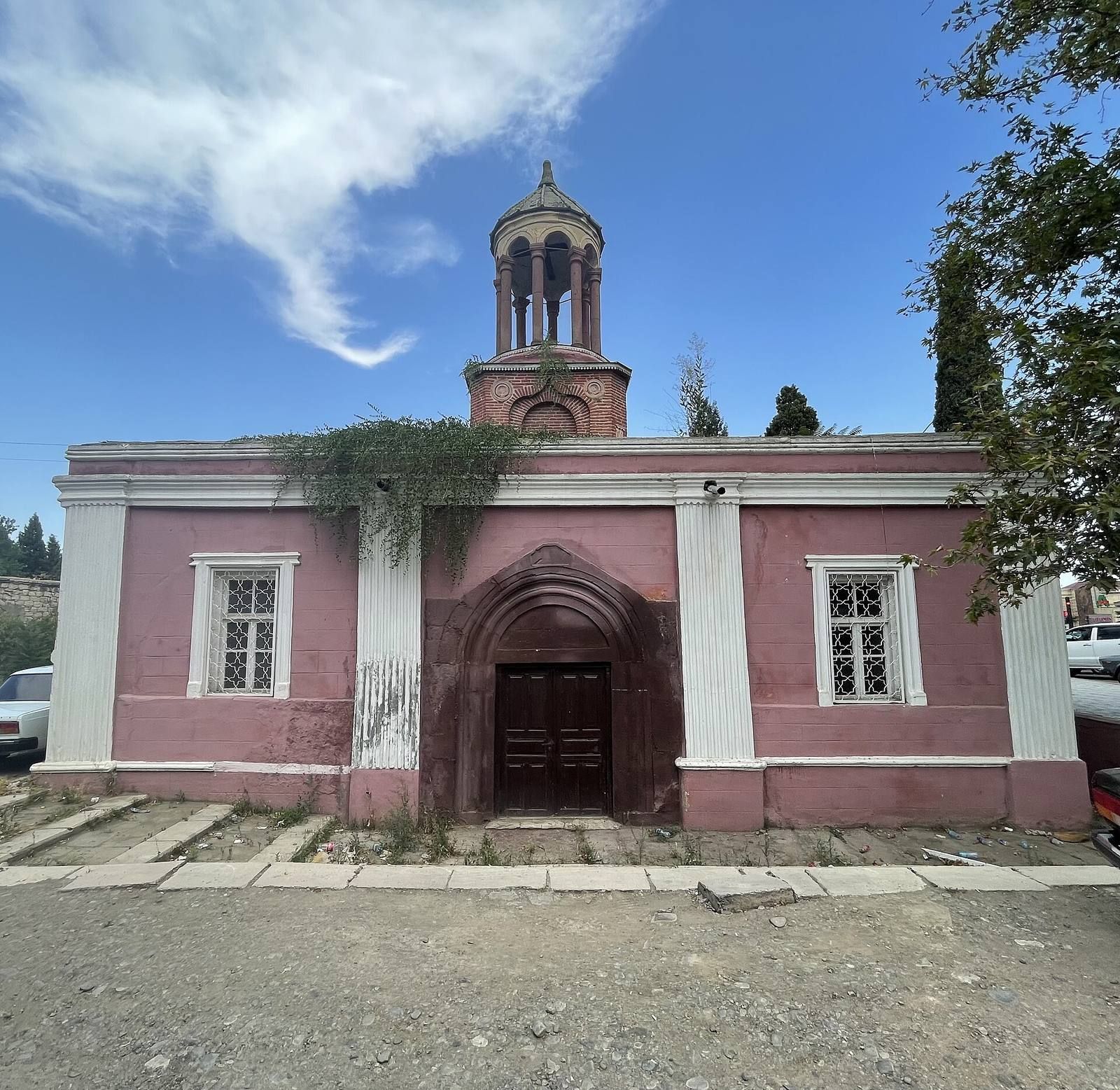
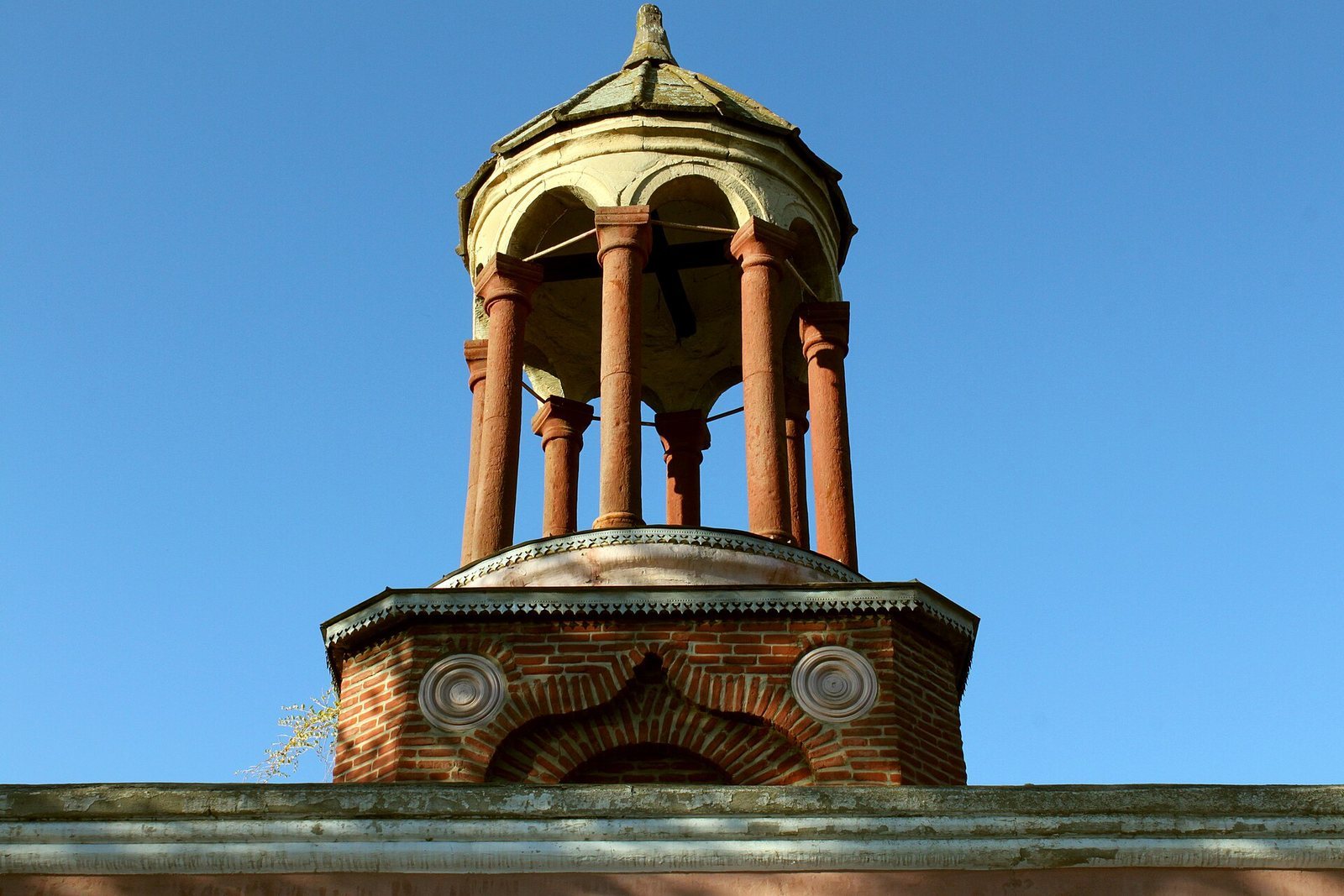
The church stands in Ganja’s historic Kilsəkənd quarter, on the right bank of the Ganja River. It is a three-aisled basilica, a church with a central aisle and two side aisles. A semicircular vaulted ceiling lies beneath a double-pitched roof, and the vault’s arches rest on three pairs of columns. Entrances pierce the south and west walls, while a two-storey vestry stands on the east side. A gavit, an Armenian church entrance hall, along with a vestibule and bell tower, was added later.
Inscriptions and burials
An inscription associated with a solar feature gives the church’s construction date and identifies its builder. A nineteenth-century inscription was placed on the vestibule façade, and another on the south façade concerned construction or repair of the roof. Burials from the eighteenth and nineteenth centuries were made in the vestibule, inside the church, and in the courtyard. Those buried there included Avag, a learned cleric known as a vardapet; Arzuman, a military officer with the rank of sotnik; and Mejlum, a local noble or ruler known as a melik.
Damage and present condition
The 1920 shelling destroyed the dome and two walls. Armenian inscriptions on the interior and exterior were later erased, and the cross was removed, apparently to conceal the church’s Armenian origins. The building is in satisfactory condition.