Ganja Fortress: An Ottoman and Safavid Stronghold in Azerbaijan


Site at a Glance
- Rating
- 4.6
- Popularity
- Very Low
- Country
- Azerbaijan
- Primary era
- Early Modern
- Eras represented
- Early Modern
- Civilizations
- Ottoman, Safavid
- Site type
- Military
- Remains
- Fortified Town
On this page9 sections
History
Ganja Fortress is a sixteenth-century Ottoman military monument in Ganja, Azerbaijan. Ottoman forces under Farhad Pasha captured Ganja from the Safavids on 1 September 1588, during the wars between these rival Islamic empires.
Ottoman Foundation
On 3 September 1588, acting on the orders of Sultan Murad III, Farhad Pasha ordered a new fortress to be built 7–8 kilometres from the old city. Construction was completed about forty days later. The stronghold housed troops responsible for controlling the earlier Ganja fortress.
Safavid Expansion
Shah Abbas I, the Safavid ruler who consolidated Safavid power and campaigned against the Ottoman Empire, captured Ganja in 1606 during the Ottoman–Safavid War of 1603–1618. He destroyed the walls of the old city fortress, moved the city center to the new fortress, and ordered restoration and strengthening works. Under Shah Abbas and later Javad Khan, ruler of the Ganja Khanate, the fortress was expanded and fortified. The Palace of the Ganja Khans became the center of the inner fortress.
Capital of the Ganja Khanate
By the end of the eighteenth century, Ganja Fortress had become the capital of a new khanate, a state ruled by a khan. Ganja was also one of the region’s major trading centers. The city remained involved in the Russo-Iranian War during the late eighteenth and early nineteenth centuries. After a short period of Russian military rule in 1796, the Ganja khan strengthened the city’s defenses.
Russian Capture and Urban Transformation
After a siege and more than a month of warfare, the Russian Empire captured Ganja Fortress in 1804. Pavel Tsitsianov, commander of the Russian imperial army, ordered a one-ruble fine for anyone who used the name “Ganja.” The khan’s palace was immediately looted and destroyed.
In 1868, after Ganja became a regional center of the Caucasus, architect Ignati Kshishtalovic prepared a new urban master plan. Alexander II approved it in 1873. The fortress walls were then demolished as European-style neighborhoods were built. Historical maps and plans, engravings, and photographs have consequently been important for understanding the fortress. The remaining wall was renovated in 2007.
Remains
Fortress Layout
The fortress stood on level ground on the left bank of the Ganja River, about 7–8 kilometres from the old city. Its irregular polygonal plan is represented as an irregular hexagon on a plan from 1797. In the sixteenth century, the fortified settlement divided Ganja into four areas: the outer city, Shahristan, Ichgala, and Naringala. The last two names referred to inner fortified areas. Some neighborhoods, large gardens, and houses remained beyond the principal walls and were protected by brick walls.
Walls and Defensive Works
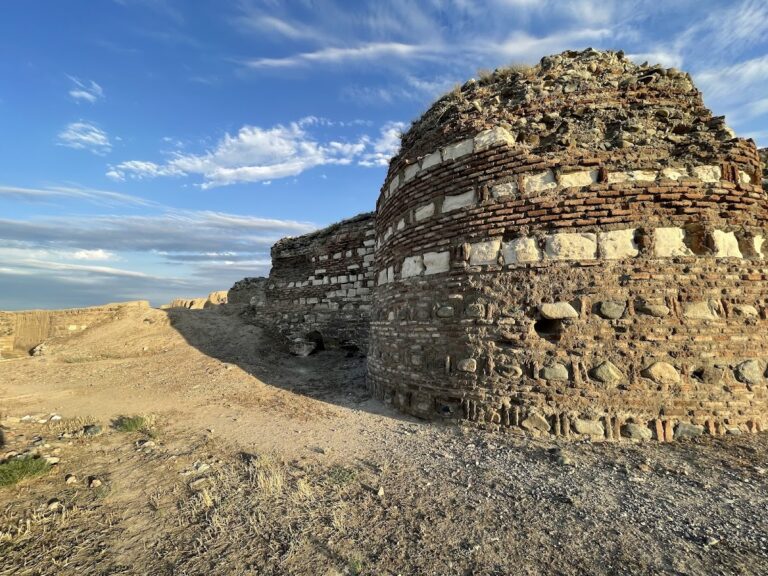
Descriptions give different measurements for the fortress. One records a length of 2.3 kilometres, walls 6 metres high, and a thickness of 1.8 metres. Another gives a total length of 13.7 kilometres and a height of 12 metres. The walls used clay mud, cobblestones, and baked red brick, materials associated with traditional Ganja architecture. The south-western, north-western, and north-eastern walls were especially strong.
The defenses included two-storey towers, defensive towers, embrasures, and watchtowers. The principal walls stood approximately 70–80 metres apart, while the external towers were relatively widely spaced. The inner walls of the main fortifications are described as having six bases. Thirty defensive towers stood along the walls at intervals of about 200–500 metres. Embrasures and watchtowers occupied elevated positions from which defenders could attack assailants, including by pouring boiling oil and lubricant onto them.
Inner Fortress and Surviving Wall
The Palace of the Ganja Khans formed the core of the inner fortress until its destruction after the Russian capture in 1804. Surviving sections of the fortress wall can be seen near Khan’s Garden, the city’s oldest park, and near the city entrance along the Ganja River. Only a very small portion of the fortress survives, identified as the Shiralibey Tower.