Old Ganja: Archaeological Remains of a Medieval City
Site at a Glance
- Popularity
- Medium
- Country
- Azerbaijan
- Primary era
- Medieval
- Eras represented
- Medieval, Early Modern
- Civilizations
- Abbasid, Ottoman
- Site type
- Settlement
- Remains
- City
On this page24 sections
History
Old Ganja is the archaeological site of a medieval city in Azerbaijan, on both banks of the Gəncəçay about 6–7 km northeast of modern Ganja. It developed over an earlier settlement and became a regional center of trade, craft production and cultural life. Its precise foundation date remains uncertain.
Origins and regional growth
Different traditions place Ganja’s foundation in different years. One dates it to 659–660, while another gives 859 and credits Muhammad ibn Khalid ibn Yazid ibn Mazyad, a governor under the Abbasid caliphate. An Armenian chronicle attributes the building of Ganjak to Patgos, son of Xazr; one manuscript dates that event to 846–847. Archaeological evidence indicates that people had settled there before the city took shape. The name Ganja has been connected with the Middle Persian word ganza, meaning treasure. One interpretation links the name’s use from the seventh century to the city’s wealth. The proposal that the settlement was first called Arran and later Ganja remains a hypothesis.
Ganja grew along the Silk Road, a network of trade routes linking East Asia with western Asia and lands farther west. Its surrounding deposits of iron, copper, silver and alum provided materials for production. The city became a center for commerce and crafts, and its silk cloth found valued markets in neighboring regions and the Middle East.
Shaddadid and Seljuk rule
By the middle of the tenth century, Ganja was the capital of the Shaddadids, a ruling dynasty in the Caucasus, after a period under Salari rule. In 969–970, the brothers Fadl and Lashkari, with local support, drove out the governor Ali al-Tazi. Lashkari was declared emir, a title for a ruler or commander. His brother Marzuban succeeded him in 978, but Fadl later removed Marzuban and took power in 985. Fadl ruled the region for about 47 years and had also taken Barda and Beylagan by 993.
The city’s defenses were reinforced during this period. The Seljuk emir Qutulmish, whose dynasty ruled extensive territories across western and central Asia, besieged Ganja for a year and a half in 1046–1047. Lashkari II turned back the attack and ordered further strengthening of the fortifications.
In 1053, Abul-Aswar Shavur took control of Ganja. He ordered additional work on the fortress, the restoration of the ruler’s palace and the building of the great city mosque. He also commissioned the Ganja Gates from the master Ibrahim Osmanoglu. Shavur died in 1067 and was buried in the city’s main mosque. Seljuk sultan Alp Arslan later came to demand tribute. In 1075, the last Shaddadid ruler of Ganja, Fadl III, was displaced. Seljuk sultan Malik Shah assigned the region to Sav-Tegin as a revenue grant, then later entrusted the city’s government to his son Qiyas al-Din Muhammad Tapar.
Earthquake and Eldiguzid rule
Ganja faced attacks by Georgian forces during the twelfth century and was for a time a Georgian vassal. On 30 September 1139, a powerful earthquake devastated the city. The collapse of Mount Kəpəz created Göygöl and other landslide lakes: Maralgöl, Ceyrangöl, Ördəkgöl, Zəligöl, Ağgöl, Qaragöl and Şamlıqgöl. Georgian king Demetre I then attacked the damaged city and carried away its famous gates. Ganja later recovered and prospered, although it is uncertain whether the rebuilt city occupied the same site.
Under the Azerbaijan Atabegs, a medieval ruling dynasty also known as the Eldiguzids, Ganja became the residence of the ruler of Arran. In the twelfth and thirteenth centuries it served as a major capital, and at times the second capital, of the Eldiguzid state. Trade and manufacturing supported its prosperity. The poets Nizami Ganjavi and Mahsati Ganjavi, and the historian Kirakos of Ganja, were active in this period.
Conquests and recovery
Khwarazmshah Jalal al-Din captured Ganja in 1225 and ruled it until his death in 1231. Abuses by his supporters, including the forced conversion of Christians, led to an uprising under an artisan named Bandar. The rebels defeated the garrison, but their revolt was crushed. Thirty leaders were executed and Bandar was killed. Mongol forces captured Ganja in 1235 after a siege, using siege engines to break through its walls. Recovery was slow.
From the thirteenth through the fifteenth centuries, the city passed successively under the Ilkhanids, a Mongol ruling house in Iran, and the Turkoman dynasties of the Qara Qoyunlu and Aq Qoyunlu. Timur, also known as Tamerlane, held Ganja in the late fourteenth and early fifteenth centuries. Under the Safavids, who ruled Iran from the early sixteenth century into the eighteenth, Ganja became the political and administrative center of the Karabakh province. Shah Tahmasp I appointed Shahverdi Sultan of the Qajar tribe as its first provincial governor; the Ziyadoglu family descended from him and governed Ganja under Safavid rule.
Ottoman conquest and the move to new Ganja
In 1588, during the wars between the Ottoman and Safavid empires, Ottoman forces led by Farhad Pasha captured Ganja and built new fortifications. Shah Abbas I retook the city in 1606 and ordered it to be moved. The transfer appears to have taken place in stages, with the ruler accelerating a migration already underway rather than relocating the whole population at once. The new city was established about 7 km southwest, at the site of the Ottoman fortress. A date of 8 May 1616 is associated with its foundation. Old Ganja was abandoned during the late sixteenth or seventeenth century, though the timing and completeness of the move are uncertain.
Memorial history and archaeological research
Nizami Ganjavi’s grave was opened in 1922. His remains were taken to Ganja and later returned to their original burial place. A temporary monument was erected over the grave in 1932, followed by a new monument in 1947.
Archaeological work began with partial excavations by E. R. Khadarin in 1935–1937, undertaken mainly to gather objects for the local museum. Iskhak Jafarzade led excavations in 1938–1940 that provided a substantial study of the city’s archaeology and architecture, including its defenses. In 1981–1982, Jabbar Khalilov excavated deposits dating from the ninth to the seventeenth centuries and recovered numerous works of art. Old Ganja is protected as an archaeological monument of world significance, and the area has reserve status.
Remains
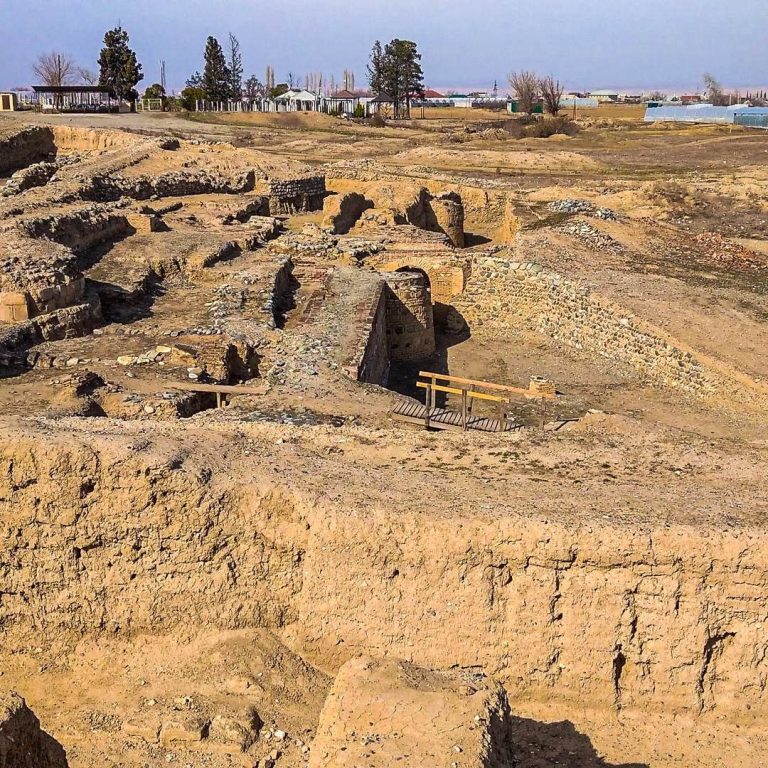
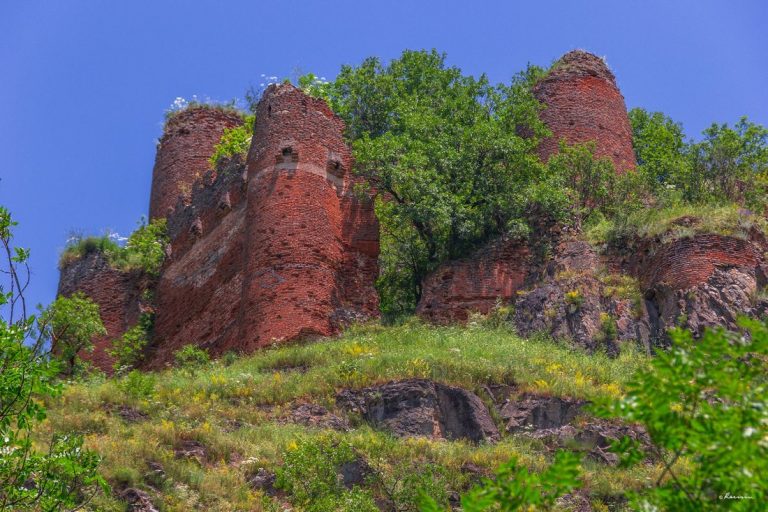
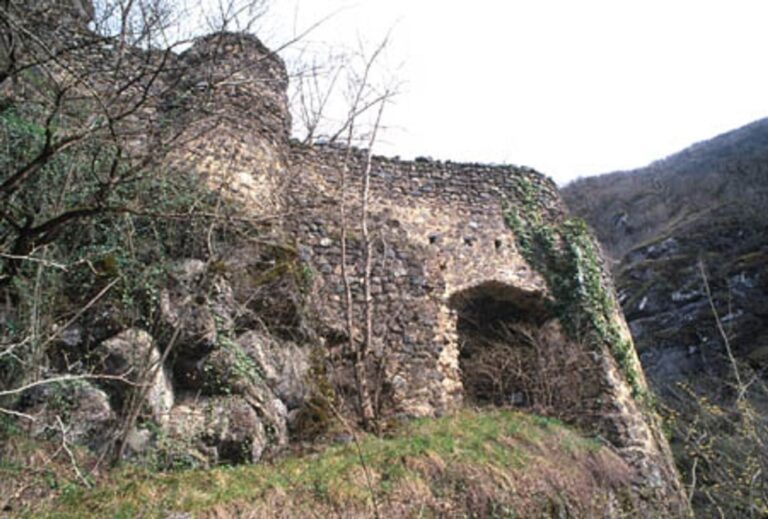
Old Ganja occupied both banks of the Gəncəçay, with its two sections roughly equal in area. The city and its surrounding settlements covered about 12–16 km², amid suburbs, villages and cemeteries. Walls, towers and moats enclosed the urban sections. Surviving features include ruined defenses, partly preserved riverside walls, bridge remains and archaeological evidence for houses, water supply and craft production.
Urban layout and defenses
City layout
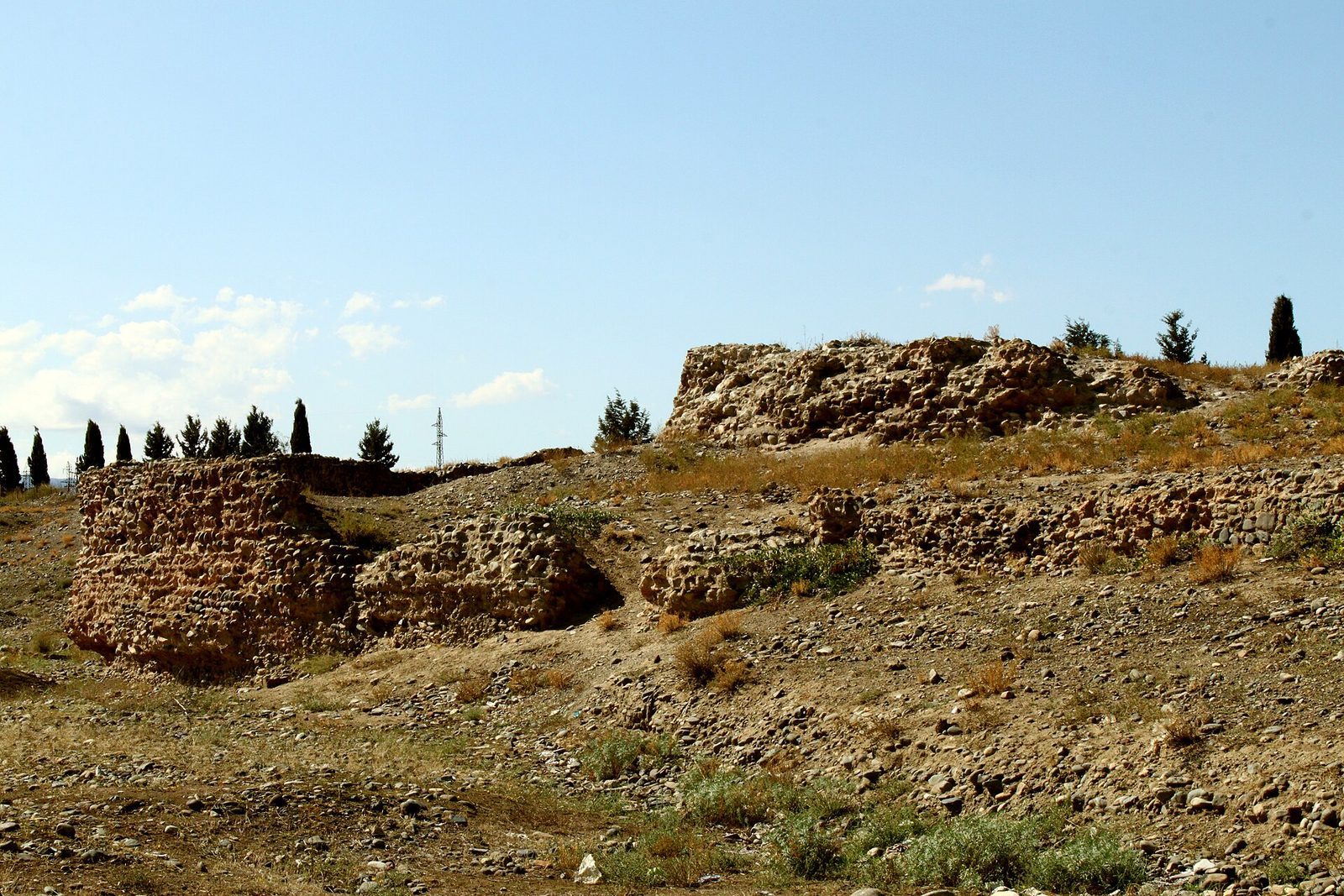
The defensive boundary followed an irregular polygon around the two parts of the city. On the river’s right bank, three successive wall lines show how the built-up area expanded. The innermost enclosure may have served as a citadel, a fortified inner stronghold. The surviving remains include wall and tower ruins and moats that have filled in over time.
Walls and towers
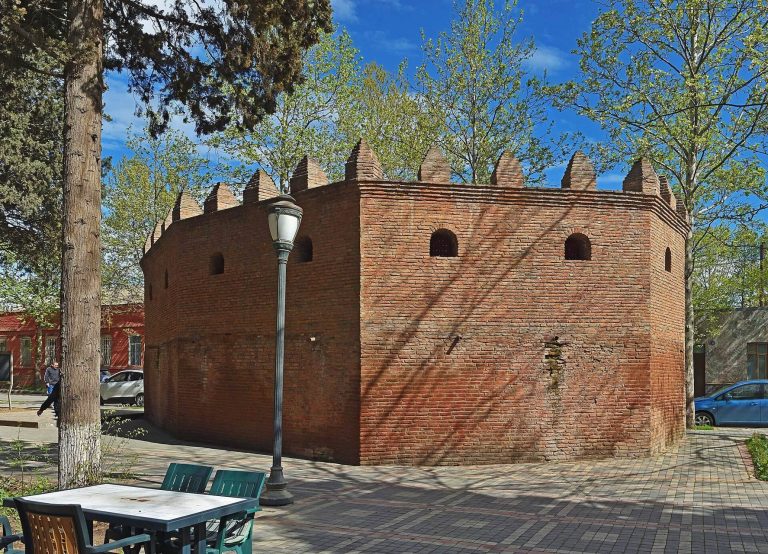
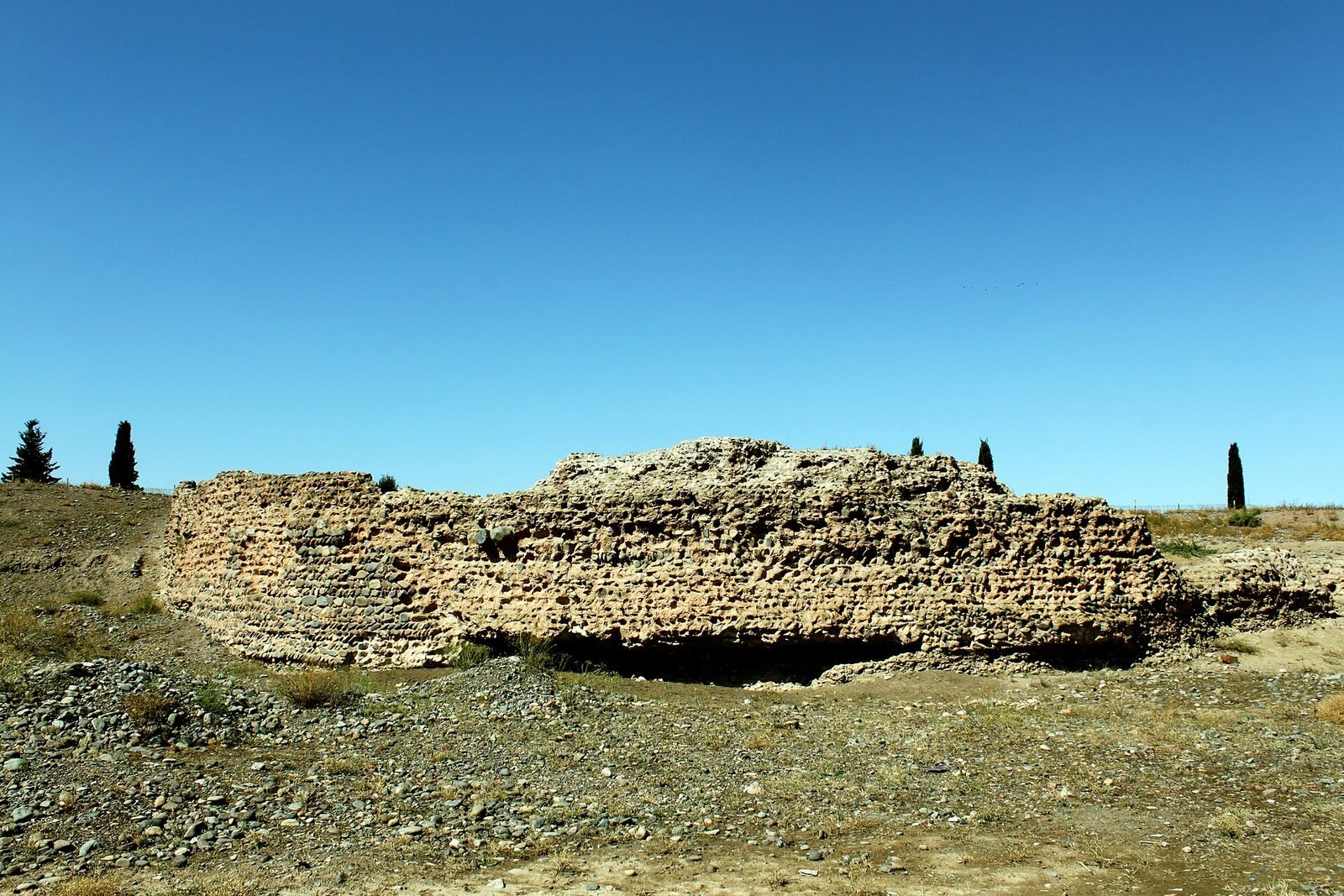
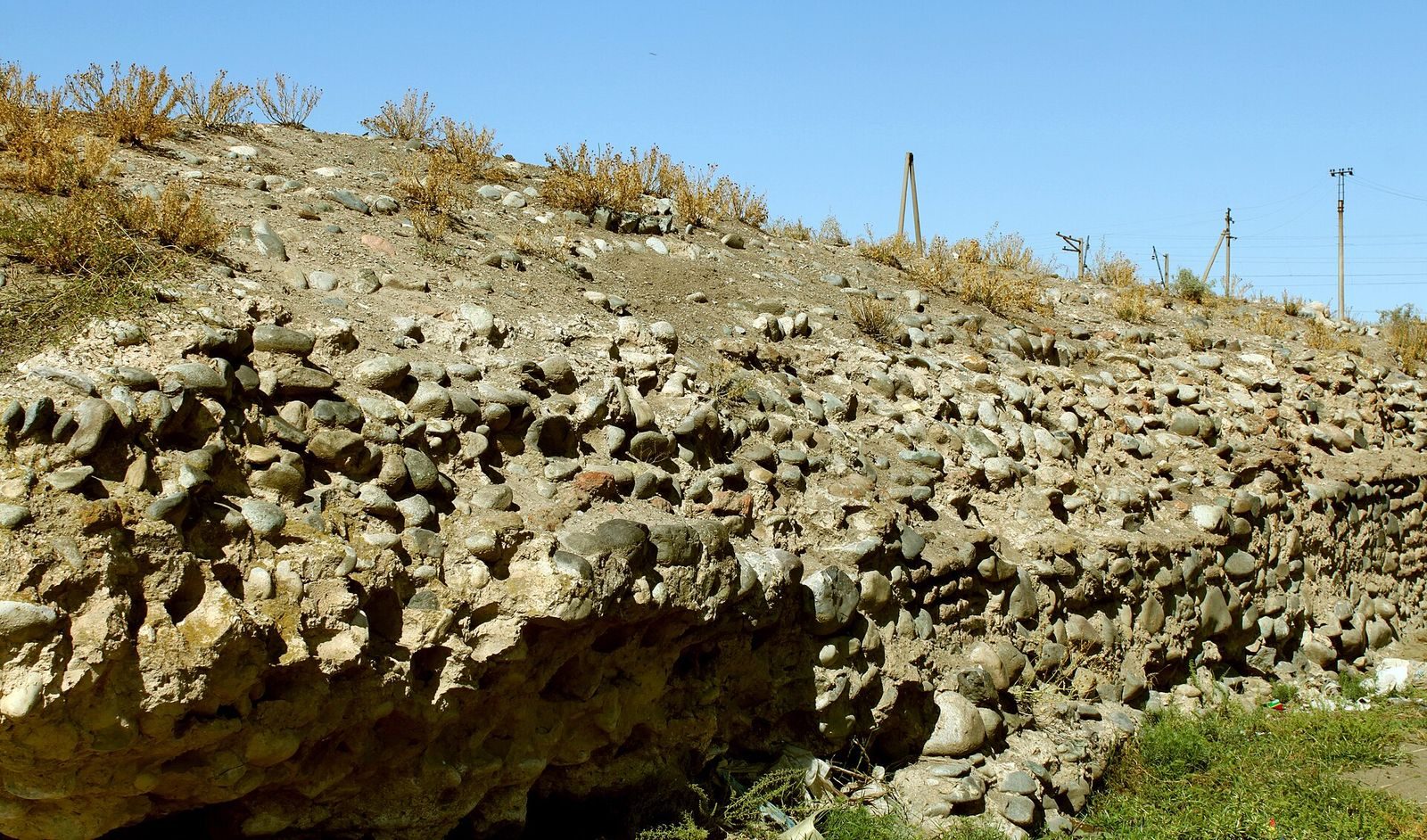
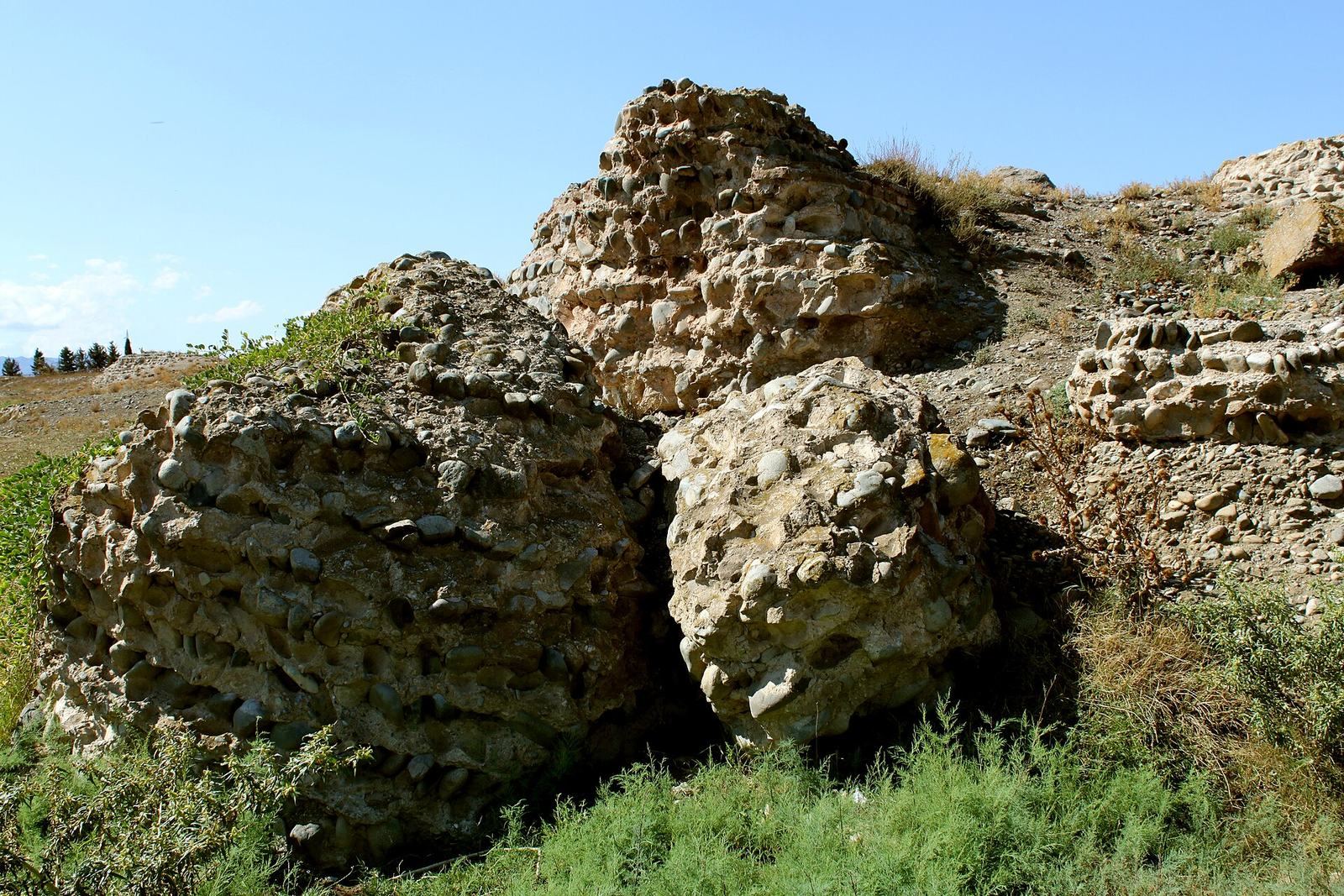
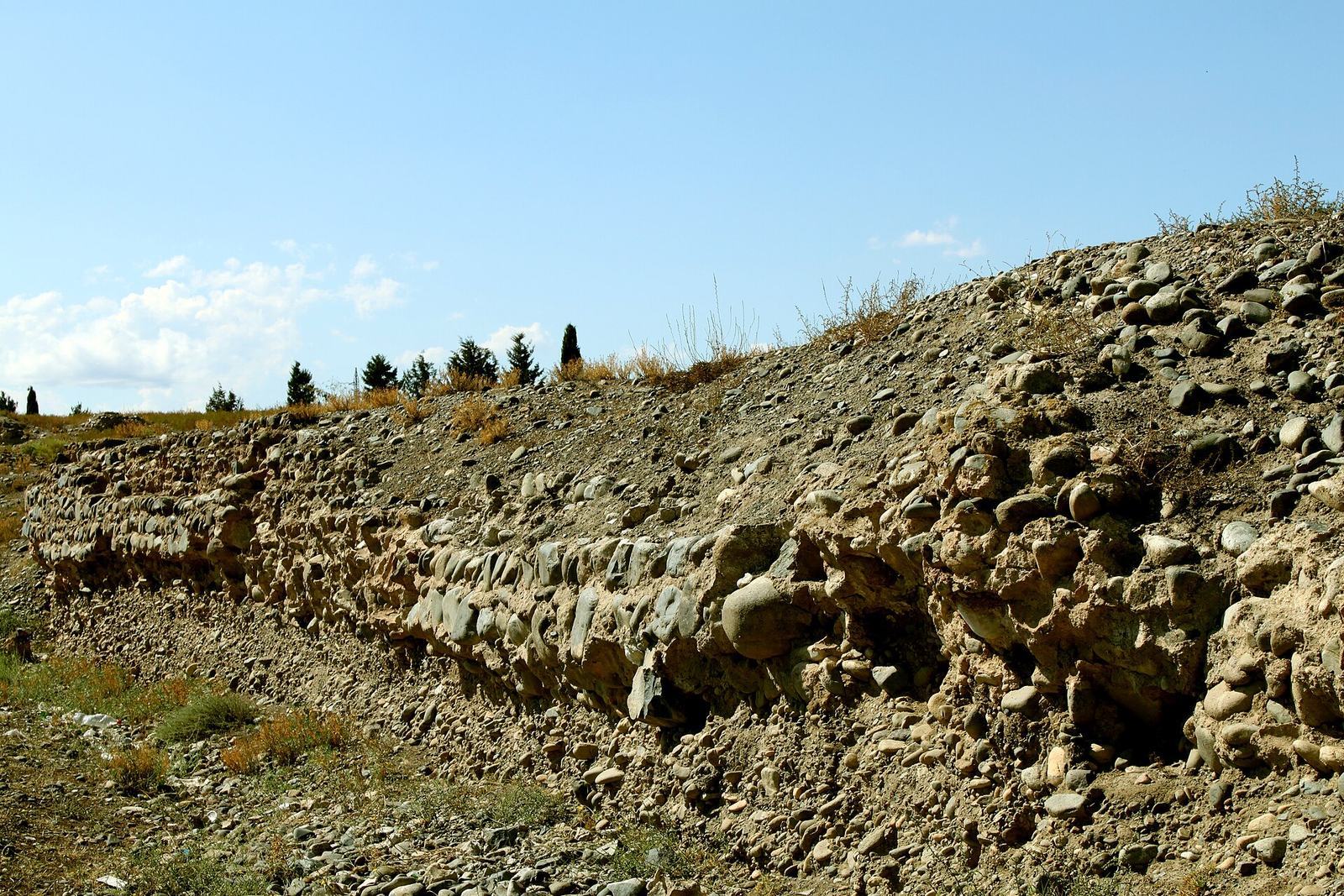
The fortifications were built in successive phases as the city grew. Their cores were generally made of unfired brick and rammed earth, faced externally with stone and brick. Some sections were built entirely of brick and stone. In places, the walls reached 3–6 m in thickness. Strong lime mortar, ranging from gray to ochre-yellow, bound the masonry. Builders used patterns including herringbone brickwork and alternating courses of river cobbles and brick.
In one technique, large cobbles were set within frames of bricks placed on edge, joining the facing securely to the wall or tower core. Sections built this way have retained their facing better than those made with cobbles alone. Other masonry combines large, dressed red and white stones with patterned square-brick work between them. Materials included river cobbles and stone from the foothills of the Lesser Caucasus. Large towers reinforced wall corners, and numerous narrow openings pierced the walls and towers.
Walls and towers along the riverbank formed a defensive line while also protecting the bank from erosion. Their masonry helped them withstand the river’s action, and surviving sections continue to protect the bank.
Bridges and gates
City bridges
Three bridges connected the city’s two riverbank sections. Their remains are ruined. One bridge is known from a nineteenth-century photograph and is identified as the third bridge in the direction of the river’s flow. It is attributed to the twelfth century and was described as an outstanding work of architecture.
Ganja Gates
The Ganja Gates were commissioned by Abul-Aswar Shavur. One half survives at Gelati Monastery in Georgia.
Khan Bridge
After the city moved, a separate six-span bridge called Khan Bridge was built across the Gəncəçay in the seventeenth century to serve a new road. It was demolished in the late nineteenth century.
Houses and crafts
Houses and water supply
Excavated houses stood on cobble foundations and had walls of sun-dried or fired brick. Interior surfaces were coated with 2–3 cm of plaster and a thin layer of alabaster. Most floors were packed earth, while some rooms had square fired-brick paving. Reeds were used in roofs or ceilings. Clay ovens served for baking bread, and hearths were used for cooking. Pottery pipes, coated on the outside with a thick layer of ash, carried spring water into the city.
Buildings and architectural decoration
Palaces, caravanserais, houses and mosques stood beyond the walls. A caravanserai was a roadside complex offering lodging and trade facilities for travelers and merchants. Glazed colored bricks, tiles and alabaster ornament enriched buildings. Blue, emerald green and deep blue with a violet cast were common decorative colors. Finds of decorated brick and tile fragments suggest that workshops may also have produced glazed architectural materials.
Pottery
Pottery finds range from plain household vessels to glazed and polychrome wares, including lusterware, pottery with a thin metallic-looking surface, and fine glazed ceramics known as faience. Objects and fragments include jars, bowls, plates, lamps and spheroconical vessels, with rounded bodies and conical necks. Decoration shows plants, animals, human figures and scenes from folk tales. Among the early finds was part of a thick-walled, handmade household jar, brown-fired and painted red, with a partly burnished surface, stamped designs and a raised three-line inscription. Related fragments carry writing and images connected with religious rites, everyday activities and occupations. A Chinese-made faience vessel decorated with hieroglyphs came from the 1981–1982 excavations.
Glass and metalworking
Glass vessels, including drinking glasses and cups, were made in Ganja, as were ornaments such as beads, bracelets and rings. Finds include thin, transparent glass decorated with fine strips of differently colored glass, coarser glass and glassmaking slag from workshop areas.
Furnaces, iron remains and metal slag provide evidence of metalworking. Excavated objects include metal vessels, arrowheads, nails and iron loops or fittings. Numerous copper coins have been found in the city and its surroundings. Most are thought to have been struck at a local mint, although the coins do not identify where they were issued.
Mausoleums and tombs
Nizami Ganjavi’s tomb
Nizami Ganjavi’s grave lies about 5–6 km from Ganja beside the Ganja–Goran road, an old postal and trade route. A small mausoleum once stood over it. A watercolor made from life in 1903–1905 shows a cubic structure topped by a dome, with a narrow, pointed entrance set in a simple border on its north wall. The original thirteenth-century mausoleum lies deep underground. The building that stood above ground until 1925 was a later addition. By 1932, the old mausoleum’s foundations and four or five courses of brick lay buried under soil.
Göy Imam mausoleum
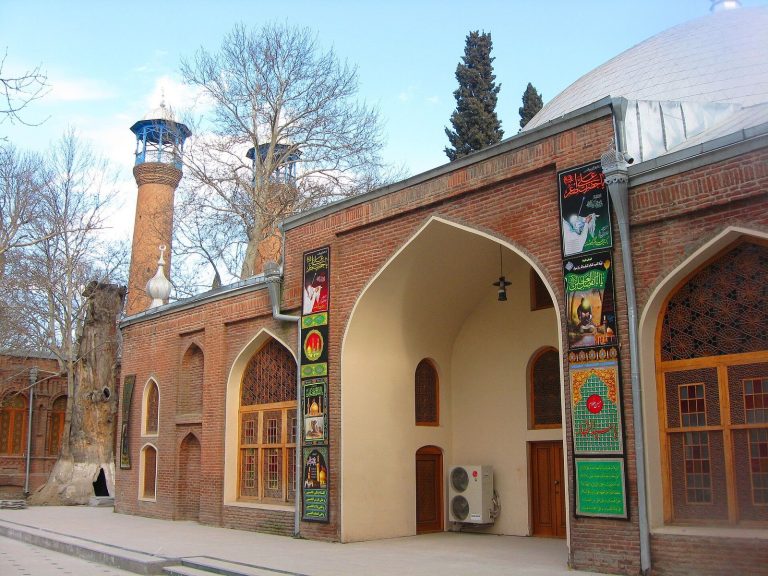
The Göy Imam mausoleum, also called Imamzade, stands north of the excavated ruins. An imamzade is a shrine associated with a descendant of an imam. The building was restored in 1878–1879 on the initiative of Major General Israfil bey Yadigarzade. A restoration inscription dated 1878 assigns the monument to 737–738. A popular tradition instead identifies it as the tomb of Khosrov, said to have been killed by Mongol attackers in 1393, and places its construction in the fourteenth century.
Jomard Kassab mausoleum
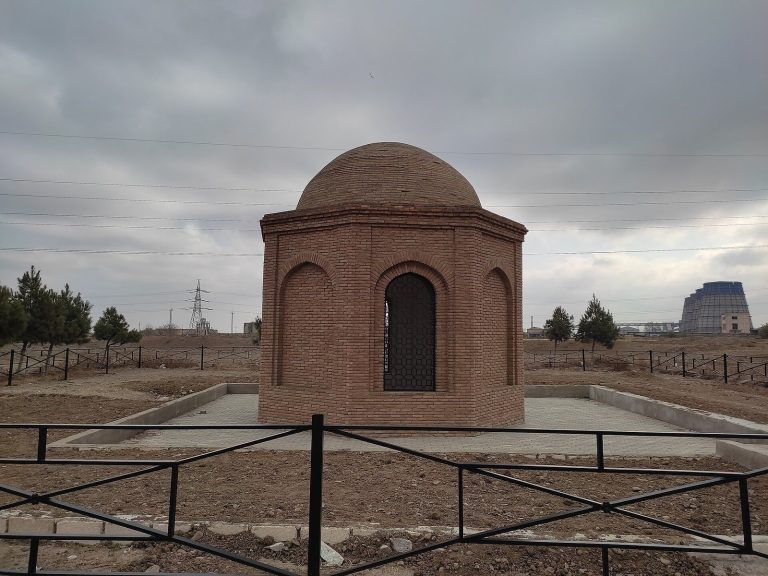
This brick mausoleum stands about 1 km upstream from the southern walls of the city’s right-bank section. Openings in its east, south and west walls give it a partly circular arrangement, with open sides separated by solid wall sections. A tradition connects the building to a butcher-hero who died defending the city and dates it to the ninth century, but its present architectural form does not confirm so early a date.