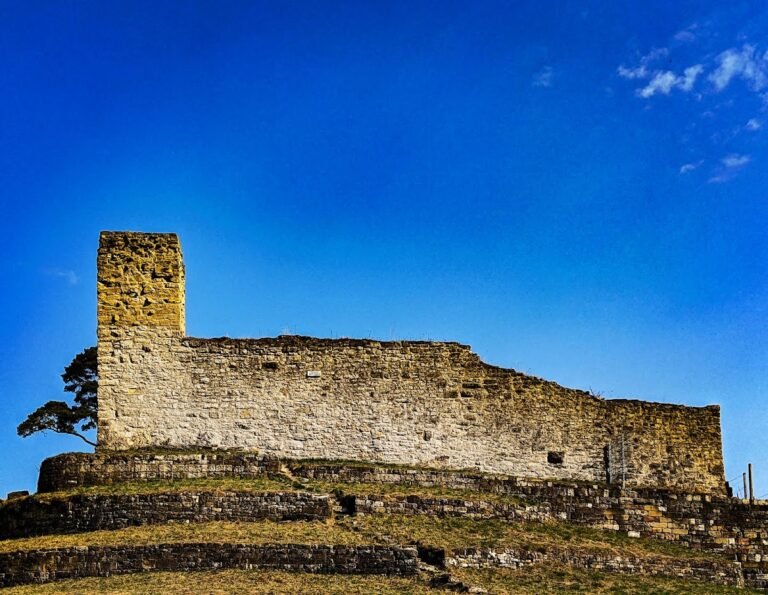
Saint Januarius Church: Medieval Evangelical Church in Erdmannhausen


Site at a Glance
- Rating
- 4.5
- Popularity
- Very Low
- Country
- Germany
- Primary era
- Medieval
- External website
- Open
- Eras represented
- Medieval, Early Modern, Modern
- Civilizations
- German, Holy Roman Empire
- Site type
- Religious
- Remains
- Church
On this page14 sections
History
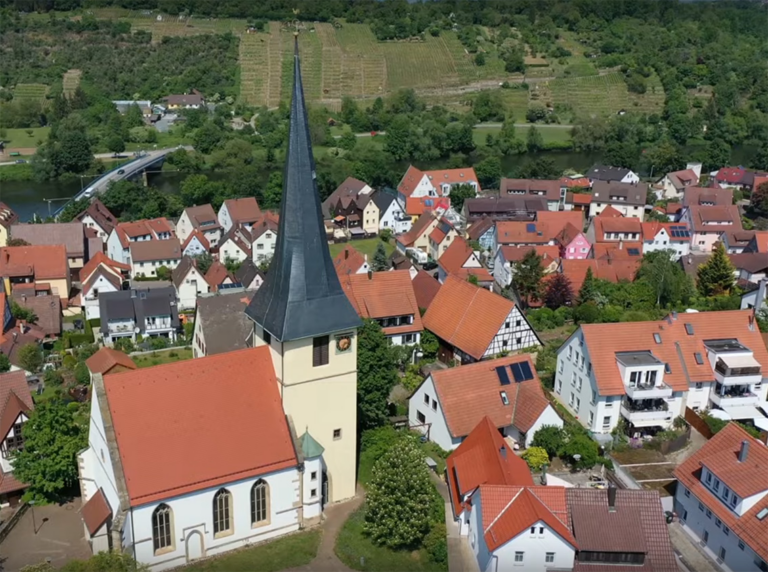
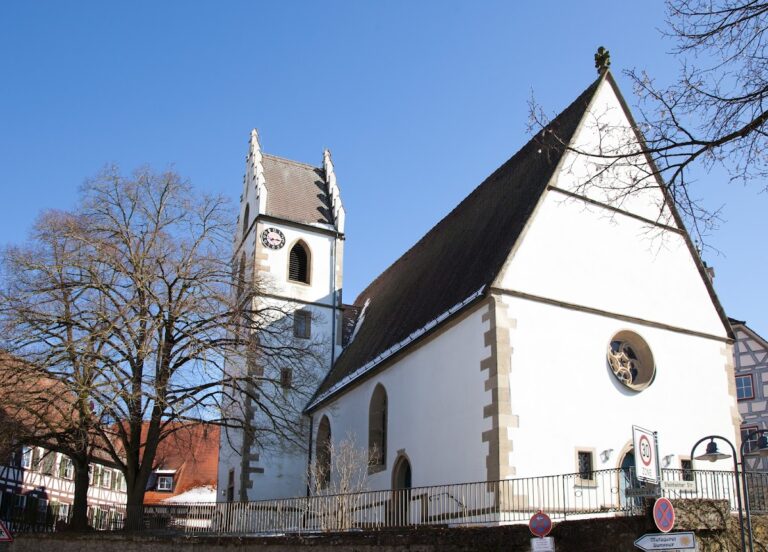
Saint Januarius Church is a medieval Evangelical church in Erdmannhausen, Germany, and a landmark of the locality. Its earliest history is uncertain, but the surviving tower stump belongs to the high Middle Ages, while the narrower Gothic choir probably dates from the thirteenth century. The present nave was begun in 1493, making the building a record of medieval construction and later religious and architectural change.
Medieval origins and Murrhardt Monastery
The large footprint and small windows of the medieval tower allowed it to serve as a refuge for the village population during wartime. Preparations for the later Gothic choir had already been incorporated into the tower’s construction. Little is known about the medieval nave that preceded the present one. A foundation stone dated 1493 was found beneath the southwest corner of the church during the redesign of the forecourt in 1994, confirming the date associated with the existing nave.
The church originally belonged to Murrhardt Monastery, an ecclesiastical institution that held authority over it. Its dedication to Saint Januarius, an early Christian martyr and bishop of Benevento associated with Naples and the preservation of his relics, probably came through this connection. Murrhardt possessed relics of the saint, and its monastic church formerly had a west choir devoted to his veneration. Another Murrhardt possession, the church at Oßweil, also received a dedication to Januarius.
Reformation and early modern history
During the Reformation, the sixteenth-century religious transformation that replaced Catholic institutions and worship with Protestant church structures in Württemberg, the church passed under Württemberg authority and became part of the territory’s reformed churches. Peter Gscheidlin was its first Protestant pastor. During the German Peasants’ War of 1524 to 1525, an uprising against social and political conditions, he sided with the peasants. Knowledge of the church’s earlier pastors is incomplete because Murrhardt Monastery’s archive burned during the conflict.
The church appears to have survived the Thirty Years’ War, the major European conflict of 1618 to 1648, without major damage. A local entry from 1661 described the church as being in good condition. The parsonage had burned completely, however, and the pastorate remained vacant from 1644 to 1665. The church was again considered satisfactory in 1677, but its roof structure was described as dilapidated in 1684. It was renewed in 1690, covered with new roofing in 1702, and renovated in 1706. Damage to the tower was also noted in 1702.
Eighteenth- and nineteenth-century repairs
By 1751 the church was considered too small for the congregation, and enlargement of the gallery was approved. Work was carried out on the sacristy in 1754. Between 1758 and 1773, the roof was repeatedly described as being in danger of collapse, while the church clock and tower were also defective. The leaded windows were altered in 1788 to admit more light. Plans to increase the number of pews, made in 1790, had not been implemented by 1797.
Repairs to the tower were delayed when taxes imposed during the Napoleonic Wars prevented the necessary financing. In 1801 the tower was repaired as an urgent safety measure and received its present Welsch hood, a curved, domed tower roof, in place of its former pyramidal roof. Broken windows were renewed in 1802 and 1810. The church was thoroughly cleaned for the Reformation Festival in 1817, although the cost prevented some planned repairs.
Friedrich Karl Ludwig Reichenbach served as pastor from 1808 to 1839. He was the brother of the painter Ludovike Simanowiz. Their sister Johanna Franziska Reichenbach kept house for him in Erdmannhausen and later became the locality’s first honorary citizen. A cracked bell was recast in 1831. Damage to the tower roof was noted again in 1882, and a new church clock was acquired in 1909.
Twentieth-century transformation
During the First World War, three bells were requisitioned. The Bachert foundry in Kochendorf supplied replacements in 1920. A comprehensive renovation followed in 1924. The organ was moved from the choir to the gallery, a new pulpit was made by Dietl of Sinsheim and Wolff of Marbach am Neckar, and figurative decoration was added. Stuttgart glass painters Jahn and Gaiser produced new colored choir windows, while new seating provided 450 places.
Further bell requisitions during the Second World War again deprived the church of its peal. Three replacement bells, weighing between 278 and 658 kilograms, were acquired in 1950, and a fourth bell weighing 1,166 kilograms was added in 1965. The church was renovated again in 1963. Its last comprehensive renovation took place in 1993 and 1994, with conservation work and a redesign of the exterior grounds. The 1493 foundation stone was recovered in 1994. The Walcker organ was later replaced by a Mühleisen organ, built and installed in 2009 after the earlier instrument had become unsatisfactory.
Remains
Saint Januarius Church is a single-nave building with a narrower choir facing east. The choir is Gothic and covered by a rib vault, a masonry vault supported by intersecting ribs. A massive tower stands on the south side of the choir. Its lower storey serves as the sacristy, while its upper section carries the curved Welsch hood added in 1801. Inside, the nave has a wooden coffered ceiling, and a gallery extends along two sides, beside the choir arch and along the west gable.
Choir and medieval interior features
Gothic choir
The narrower east-facing choir forms the medieval architectural core of the interior. Its rib vault gives the space its Gothic character, while the adjoining tower incorporates the sacristy in its lower storey. The choir’s windows were renewed and colored during the 1924 renovation by the Stuttgart glass painters Jahn and Gaiser.
Gothic baldachins
To the right of the choir arch stands a Gothic baldachin, a canopied architectural feature, covered by a net vault. Its polychromed keystone depicts the Evangelist John holding a chalice. The baldachin sheltered a side altar before the Reformation and now serves as the baptistery. A second baldachin formerly stood to the left of the choir arch. It was removed when the gallery was enlarged, but its keystone, showing the crowned Mary with the infant Jesus, was preserved in the wall beside the north gallery.
Baptismal font and carved stone chronicle
The baptismal font in the baptistery dates from 1494, shortly after construction of the present nave. An abbot’s staff and the letter M refer to the church’s former connection with Murrhardt Monastery. The Württemberg arms and the Urach horn represent the secular rule of the Counts of Württemberg-Mömpelgard.
A corner stone in the exterior wall functions as a carved stone chronicle. Its inscriptions refer to a hail year in 1517, the Peasants’ War in 1525, a cold winter in 1608, plague years in 1570 and 1626, and the Battle of Nördlingen in 1634, a major engagement of the Thirty Years’ War. The year 1564 also appears without an associated event. The south-facing side was later supplemented with dates connected to the two World Wars.
Later furnishings and instruments
Pulpit and communion vessels
The pulpit was made in 1924 by Dietl of Sinsheim and Wolff of Marbach. Its panels depict the four Evangelists, Matthew, Mark, Luke, and John. The church also possesses a silver Communion chalice donated in 1827 by Johanna Reichenbach and Ludovike Simanowiz, née Reichenbach, together with a tin host box dated 1719.
Organs
The first organ was installed in 1741 on a gallery in the choir. A new instrument replaced it in 1865, and the 1924 renovation moved that organ to the main gallery. The 1963 renovation brought a Walcker organ from Ludwigsburg, but its size meant that it was placed in the choir. The present Mühleisen organ was installed in 2009. It has 17 stops across two manuals and a pedal, with mechanical action that transmits the player’s movements through physical linkages. Because of its size, it stands to the left in front of the choir arch.
Bell peal
The tower contains a four-bell peal. Three smaller bells were cast in 1950 by the Kurtz foundry in Stuttgart and bear the additional inscription “ERDMANNHAUSEN 1950.” The largest bell was cast in 1965 by the Rincker foundry. Together, the bells reflect the church’s replacement of instruments requisitioned during the two World Wars.