Saint Anne Church: A Gothic Parish Church in Ząbkowice Śląskie, Poland


Site at a Glance
- Rating
- 4.6
- Popularity
- Low
- Country
- Poland
- Primary era
- Medieval
- External website
- Open
- Eras represented
- Medieval, Early Modern, Modern
- Civilizations
- German, Habsburg, Holy Roman Empire, Kingdom of Bohemia, Kingdom of Prussia
- Site type
- Religious
- Remains
- Church
On this page13 sections
History
Saint Anne Church is a Roman Catholic parish church in Ząbkowice Śląskie, Poland, built as a Gothic brick church during the later Middle Ages and subsequently partly remodeled in the Neo-Gothic style. Its history reaches back to a wooden church mentioned in 1292, while the present stone church was constructed between 1354 and 1415, with its completion also placed around the middle of the fourteenth century. The project received financial support from Charles IV of Luxembourg, the fourteenth-century Holy Roman Emperor and King of Bohemia.
Medieval foundation and reconstruction
In 1330, Duke Bolko II of Schweidnitz endowed the church’s Cross Altar with several hides of farmland at Kunzendorf. The land later became part of the endowment supporting the town parish priest. This early provision connected the church with the religious and administrative life of the medieval town.
The Gothic building suffered severe damage when Hussite forces attacked Ząbkowice Śląskie in 1428 during the Hussite Wars, a series of fifteenth-century religious and political conflicts centered in Bohemia and neighboring regions. Reconstruction began in 1444 and was completed in 1453, restoring the church after the destruction caused by the assault.
Confessional changes and later additions
During the sixteenth century, the church was partly enlarged and received new interior vaults. Protestant worship took place there from 1538 to 1550 and again from 1602 to 1629. Clemens Mälzer served as its first Protestant pastor, while all Catholic priests were expelled from the town in 1541. Protestant worship returned under Swedish protection in 1632. In 1646, the building became a simultaneous church, meaning that different Christian confessions shared it for worship. It later returned to exclusive use as a Roman Catholic parish church.
A visitation record of the Breslau archdeaconry identifies the church under the patronage of Saint Anne, the Christian saint traditionally regarded as the mother of the Virgin Mary and grandmother of Jesus. A late-Baroque Chapel of Saint Anne was added in 1772. The church’s liturgical commemoration is held on 26 July.
Restoration and present ecclesiastical role
Between 1893 and 1896, the church was restored and partly remodeled in the Neo-Gothic style. Its facades were refaced with machine-made brick, and extensions were added to the south and west sides. Interior work in 1976 and 1977 removed plaster damaged by damp and mold, dried the brickwork, and repainted the interior with a lime-casein technique. The roof was renovated in 2008.
Saint Anne Church is the parish church of Saint Anne Parish in the northern Ząbkowice Śląskie deanery of the Diocese of Świdnica. It has been legally protected as a historic monument since 1960.
Remains
Gothic plan and vaulted interior
The church is an oriented, three-aisled, four-bay brick hall church. In this type of building, the nave and aisles are approximately equal in height, creating a unified interior space. The eastern bays of both side aisles contain rectangular chapels that project outward in a transept-like arrangement. At the eastern end, a three-bay chancel, the part containing the main liturgical area, closes on five sides and is strengthened by buttresses.
Several types of ribbed vaults survive within the building. Cross-ribbed vaults cover the side aisles, sacristy, and baptistery. The chancel and main nave have net vaults, whose intersecting ribs form a mesh-like pattern. An eight-armed star vault covers the western bay of the main nave, while four-armed star vaults appear over the north porch and the Marian Brotherhood room. The church contains three altars.
Leaning bell tower
A bell tower stands on the north side of the church. It leans by 2.55 degrees and is known as the Leaning Tower of Ząbkowice Śląskie. Its inclined position is one of the building’s defining physical features.
Altars and devotional sculpture
The late-Baroque main altar was made between 1754 and 1759. It contains a painting of Saint Anne Selbdritt, an image showing Saint Anne with the Virgin Mary and the child Jesus. The painting dates from 1701 and is attributed to J. Classen of Antwerp.
Another representation of Saint Anne Selbdritt is a sculpture dated to 1493. In this work, the numeral 4 is represented as half of an 8, an unusual detail within the carved image.
Dynastic memorials and epitaphs
Ducal tomb monument
A full-length carved tomb monument commemorates Duke Charles I of Ziębice and his wife, Anna of Żagań. The monument forms part of the church’s group of aristocratic memorials and preserves the memory of the ruling family connected with the medieval and early modern history of the region.
Kauffung Chapel
The Kauffung Chapel contains the stone sarcophagus of Charles I Podiebrad, a Silesian duke of Ziębice, and his wife, Anna of Żagań. The sarcophagus originally stood in the chancel. Its surface bears heraldic arms associated with the couple and their dynastic connections, including the Duchy of Ziębice, the Duchy of Żagań, the Kingdom of Sicily, the Koldicz family, Ursula of Brandenburg, the Margraviate of Meissen, Bavaria, the Duchy of Milan, Lorraine, Württemberg, Baden, the Czastolowicz family, the Duchy of Opava, Thuringia, Saxony, and the Duchy of Opole. The heraldic information is attributed to Hans Lutsch.
The chapel also contains epitaphs to the knight Sigismund Kaufung von Chlum, who died in 1573, and his son, who died in 1634.
Renaissance tomb monuments
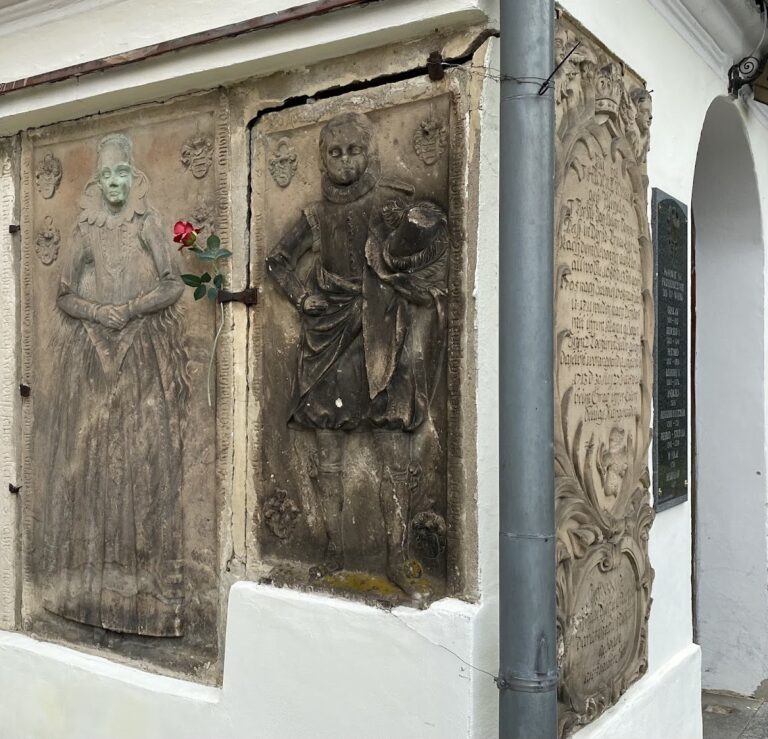
Renaissance tomb monuments to Charles I Podiebrad, who died in 1536, and his wife Anna, who died around 1541, stand in the south porch. They were made by Jan Ulryk, who served as court architect to Sigismund the Old, King of Poland and Grand Duke of Lithuania in the early sixteenth century.
Exterior epitaphs
The exterior walls carry numerous epitaphs. One commemorates Wit Stwosz the Younger, identified as the son of the Görlitz goldsmith Florian and the grandson of Wit Stwosz.