Saif ed-Din Bokharzi: A Medieval Sufi Mausoleum Complex in Bukhara
Site at a Glance
- Rating
- 4.8
- Popularity
- Very Low
- Country
- Uzbekistan
- Primary era
- Medieval
- Eras represented
- Medieval
- Civilizations
- Chagatai Khanate, Mongolian
- Site type
- Religious
- Remains
- Tomb
On this page10 sections
History
Saif ed-Din Bokharzi is a medieval mausoleum complex in Bukhara, Uzbekistan, developed around the grave of a Khorasani Sufi sheikh and leader of the Kubrawiya, a Sufi order associated with spiritual teachings traced to the Iranian mystic Najm al-Din Kubra. The complex stands in Fathabad, east of medieval Bukhara, and is regarded as an important religious, historical, and cultural monument in the development of the city’s medieval architecture.
Saif ed-Din Bokharzi and the Kubrawiya
Saif ed-Din Bokharzi was born in 1190, probably in Khorasan, and died in Bukhara in 1261 or possibly 1262. He lived in Bukhara for about four decades and was highly respected by the ruling elite. Alongside his religious leadership, he was known as a poet and theologian.
His followers established several khanakas, residences and meeting places for Sufis and dervishes, with support from donations made by members of the order. After Bokharzi’s death, the khanaka beside his grave became a center of the Kubrawiya in Bukhara. It offered dervishes and pilgrims shelter, food, clothing, footwear, and other necessities. On some occasions, more than 100 dervishes ate there. The complex was also supported by a landholding of about 10,000 hectares south of Bukhara’s Qarshi Gates.
The mausoleums at Fathabad
The first mausoleum over Bokharzi’s grave was completed in the early fourteenth century, but that building no longer survives. The present mausoleum dates from the second half or the end of the fourteenth century, while its monumental entrance portal was added later. It may have replaced an earlier memorial or mausoleum.
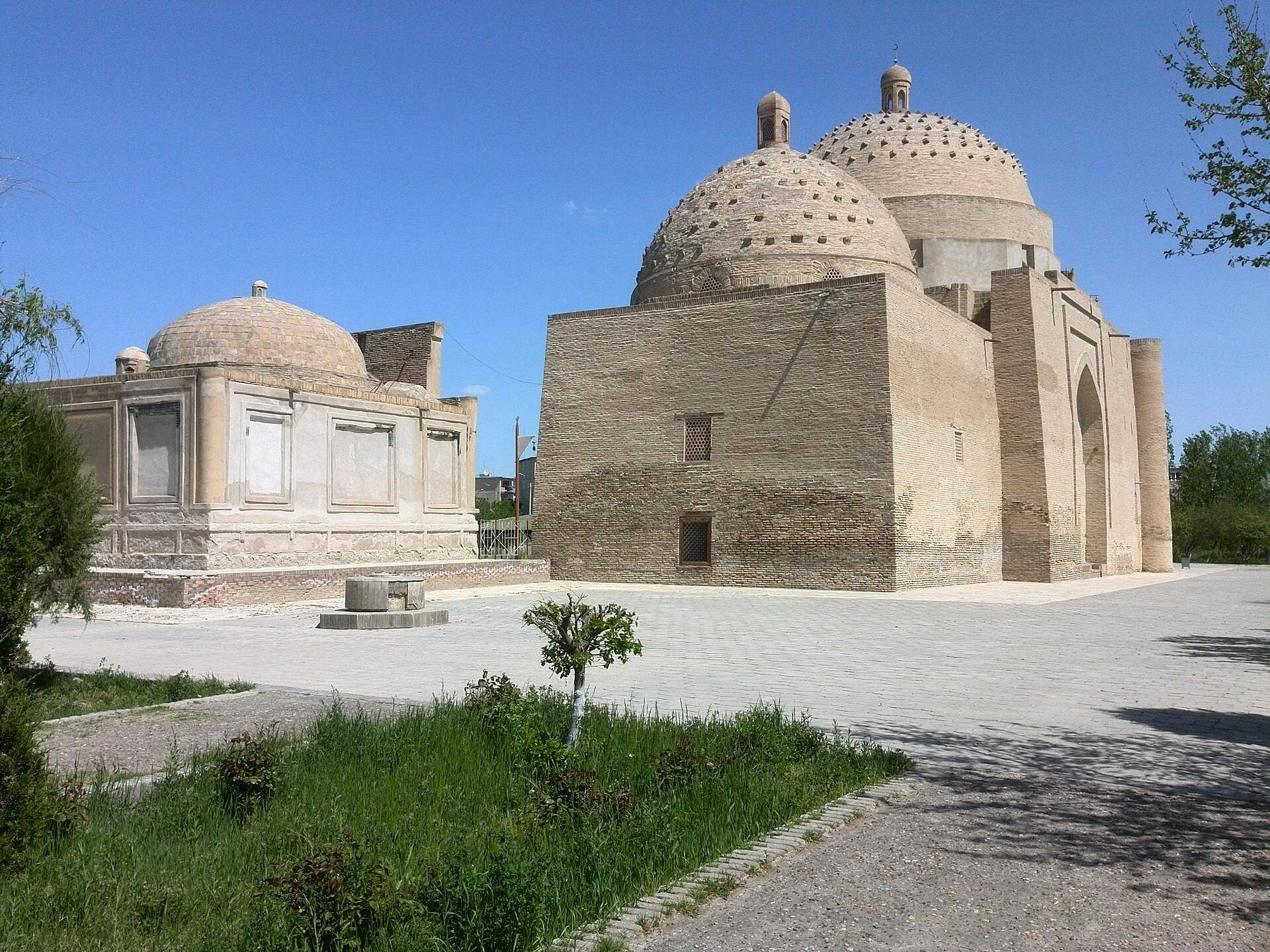
The complex also contains the mausoleum of Bayan-Quli Khan, a Chagatai ruler from 1348 to 1358. The Chagatai Khanate was a Mongol-ruled polity in Central Asia established by the descendants of Chagatai, a son of Genghis Khan. Bayan-Quli Khan wished to be buried near Bokharzi’s grave and was interred there. His mausoleum was built in 1358, before the present, larger mausoleum of Bokharzi.
Repairs and modern history
Fathabad was formerly a suburb, or rabad, of Bukhara and was later incorporated into the city. During the Soviet period, the area became an industrial zone. Repairs in the 1960s strengthened the roof and walls, but a 1976 earthquake severely damaged the building. A restoration group of the Special Scientific Institute for the Restoration and Conservation of Monuments of the Uzbek SSR subsequently carried out structural reinforcement and complete restoration under architect A. Bogodukhov and engineer Y. Golshtein.
Remains
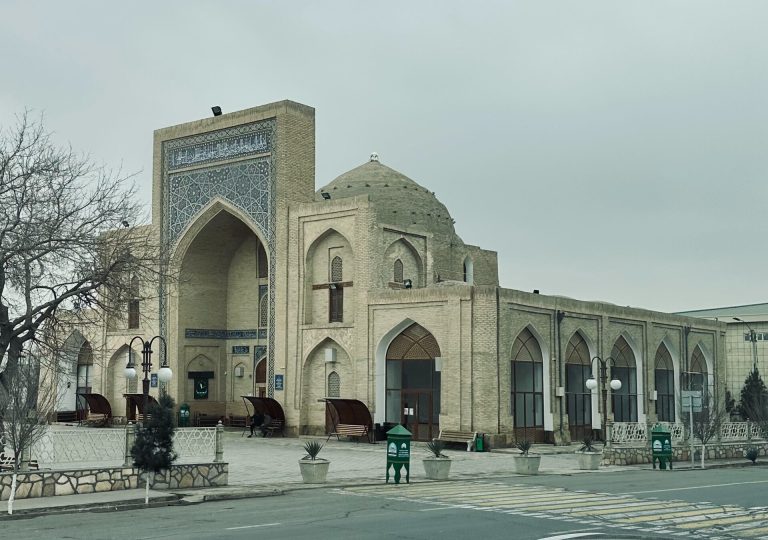
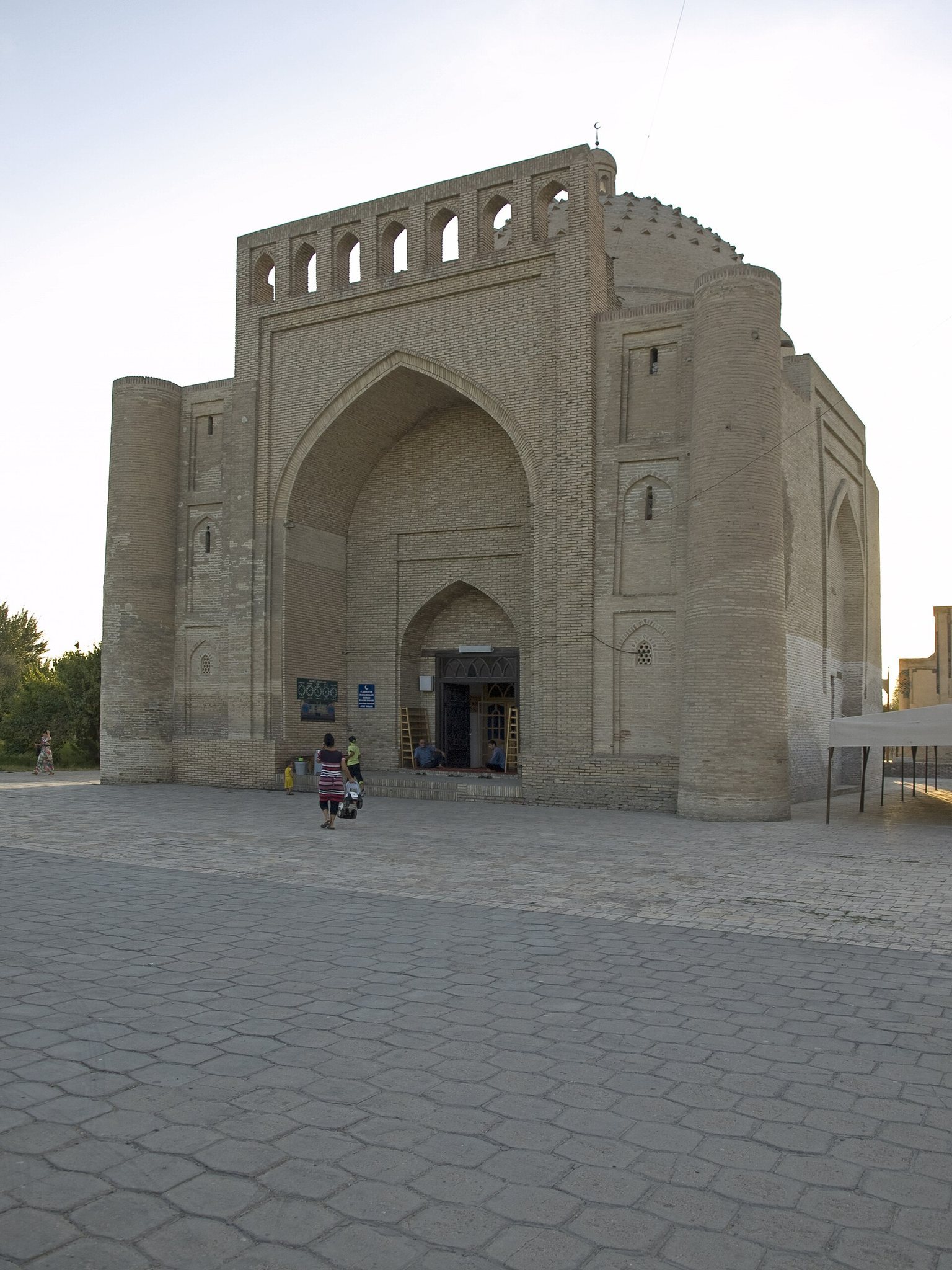
The paired mausoleums form a funerary complex centered on the memorial and burial traditions associated with Bokharzi and Bayan-Quli Khan. The principal Bokharzi mausoleum is a powerful, largely cubic structure measuring approximately 30 by 15 metres. Two slender round towers flank its eastern narrow side. Its strong forms and austere simplicity give the building a restrained architectural character, with little substantial decoration on either the interior or exterior.
The Bokharzi mausoleum
Portal and domed chambers
Entry is through an iwan, a vaulted or recessed entrance space, framed by a monumental pishtaq, a projecting portal that emphasizes the facade. The portal is later than the main structure. Behind it lies the ziyarat-khana, a visitation and prayer chamber used for the assembly of pilgrims and worshippers. At the rear is the gurkhana, the sheikh’s burial chamber, which is not open to the public. Each of the two principal chambers is covered by a dome, separating visitation and prayer from burial.
Geometric transitions and interior light
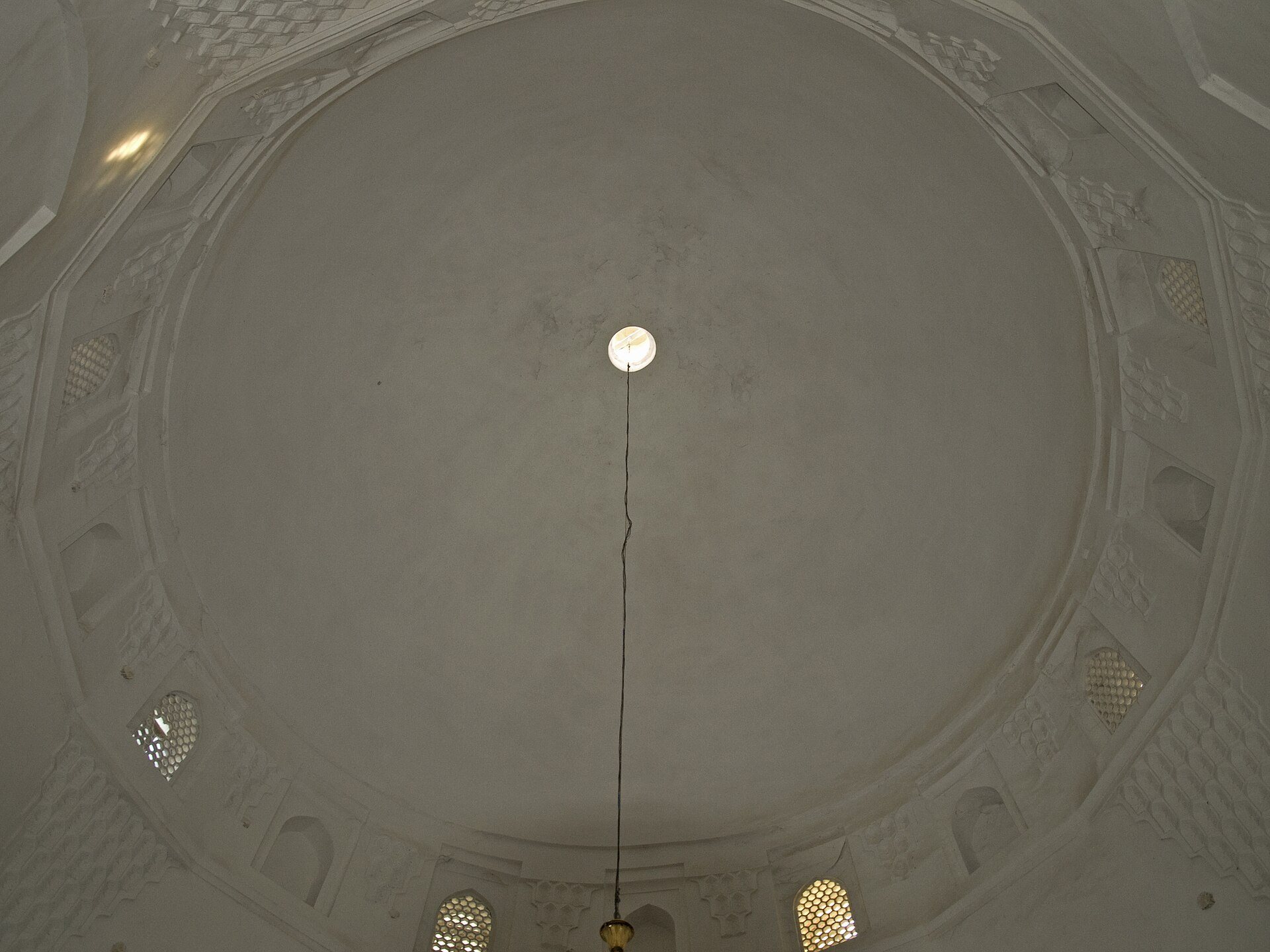
The square foundation of the ziyarat-khana rises into an octagonal form and then into a hexagonal clerestory, an elevated windowed section that brings light into the interior. Muqarnas, three-dimensional cellular vaulting, mediate between these changing geometric levels and support the upper structure. Small windows in the hexagonal section admit soft sunlight, while the dome completes the chamber above. The inner dome and whitewashed walls strengthen the illumination of the visitation space, and the two domed chambers organize the building’s side elevation.
Carved tomb
The tomb in the gurkhana is a medieval wooden carving that combines polychrome imagery, intricate interlaced motifs, and complex Arabic calligraphy. Its decoration provides a marked contrast to the mausoleum’s otherwise austere architectural treatment. The building’s geometric transitions and handling of interior light exemplify craftsmen’s experimentation and innovation in construction.
Bayan-Quli Khan’s mausoleum
Bayan-Quli Khan’s mausoleum forms the companion monument in the complex. Built in 1358 after the ruler was buried near Bokharzi’s grave, it belongs to the same funerary setting while predating the present larger Bokharzi mausoleum. Together, the two structures preserve the physical relationship between the revered Sufi sheikh and the ruler who chose burial beside him.