Saheb-ol-Amr Mosque: A Historic Shiite Mosque in Tabriz


Site at a Glance
- Rating
- 4.4
- Popularity
- Low
- Country
- Iran
- Primary era
- Early Modern
- Eras represented
- Early Modern
- Civilizations
- Safavid
- Site type
- Religious
- Remains
- Mosque
On this page9 sections
History
Saheb-ol-Amr Mosque is a historic mosque in Tabriz, Iran, whose origins are attributed to the Aq Qoyunlu, a Turkmen ruling confederation that controlled parts of Iran and Anatolia in the fifteenth century. It was established as a royal mosque during the rule of Abu al-Nasr Hasan Beg, better known as Uzun Hasan, and follows the Persian mosque tradition, while the surviving building is also associated with Safavid architecture.
Aq Qoyunlu and Safavid Foundations
The mosque is also known as the Shah Tahmasp Mosque and Hasan Pasha Mosque. A second tradition connects it with Shah Tahmasp I, the second Safavid ruler of Iran, and identifies it as the first mosque of his reign. It was rebuilt in 1636, but the structure associated with the Safavid period was destroyed during the Ottoman ruler Murad IV’s invasion of Tabriz in 1638. After Iranian forces recovered the city, the mosque was rebuilt.
Further reconstruction followed the Ottoman withdrawal. Mirza Muhammad Ibrahim, vizier of Azerbaijan during the reign of Shah Sultan Husayn, directed another rebuilding campaign. The mosque was later badly damaged by an earthquake, and Goli Khan Danbali oversaw the reconstruction of the square and the mosque.
Later History and Religious Associations
The mosque suffered extensive damage in a subsequent earthquake and was repaired during the nineteenth century through the efforts of Mirza Ali Akbar Khan, an interpreter at the Russian consulate in Tabriz. The Akbariyya School, a madrasa or Islamic religious and educational institution, was established in one of the courtyards. Part of its courtyard was destroyed when Daraiee Street was expanded, leaving only a portion of the school.
Saheb-ol-Amr refers to an honorific meaning “Master of Command,” associated with Muhammad al-Mahdi, the twelfth and final Imam in Twelver Shiite belief. A 1673 map of Tabriz by Jean Chardin, a French traveler and writer who described Safavid Iran, recorded the mosque as “Saheb Saman” and called it the “Mosque of the last true Caliph.” The mosque has a Shiite affiliation and hosted a meeting between scholars of Tabriz and Siyyid Ali Muhammad, known as the Bab, the nineteenth-century founder of the Babi religious movement.
A popular story from March 1849 concerns a cow that escaped slaughter and entered the shrine vestibule. According to the story, the butcher who tried to remove it suddenly died, after which the animal was treated as sacred. Crowds gathered, miracle stories circulated, and visitors left offerings and devotional images. Following the cow’s death, it received an elaborate funeral and was buried at a place remembered as the cow’s tomb. Mir Fattah, a Tabriz religious scholar associated with unrest during the second Russo-Iranian war and the Treaty of Turkmenchay, encouraged claims about the cow’s miracles and assertions that Tabriz should be exempt from taxation and government authority.
Restoration and Present Use
The mosque underwent extensive restoration during the 1990s. It was added to Iran’s National Heritage List in 2001 under registration number 4196 and is administered within Iran’s cultural-heritage system. The building continues to function as a mosque and houses the Quran and Calligraphy Museum.
Remains
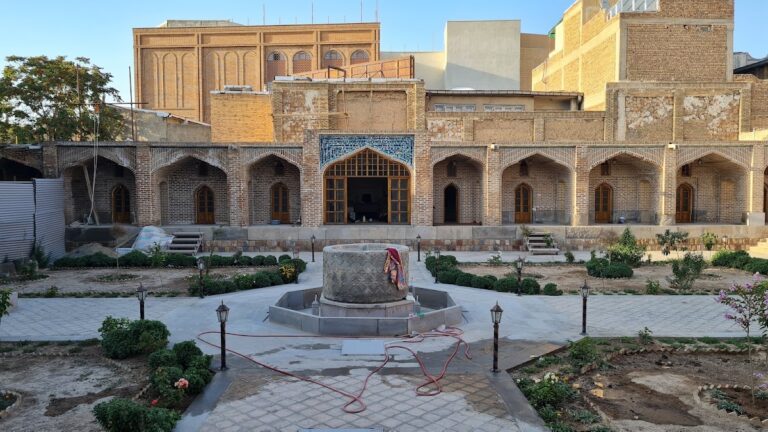
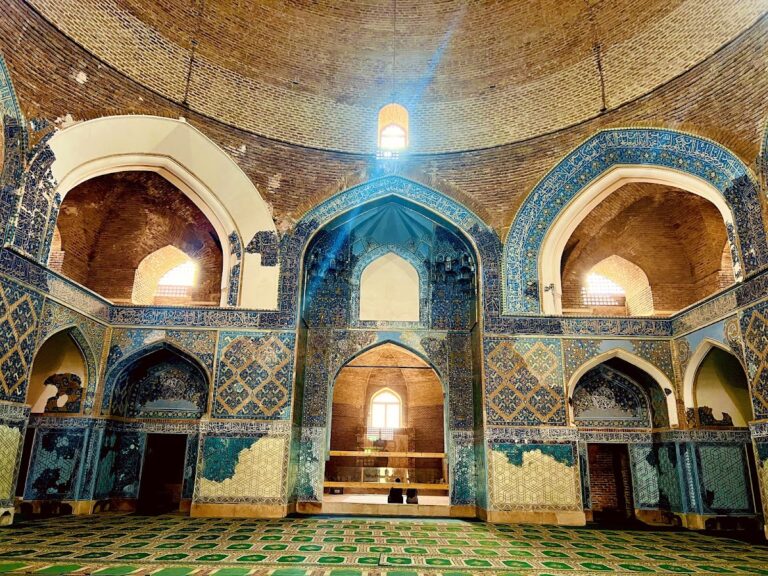
Saheb-ol-Amr Mosque stands in central Tabriz on the eastern side of historic Sahebabad Square, north of the Mehranrud River and near the end of Daraiee Street. The brick complex follows Persian mosque architecture and has one dome and two minarets whose forms are described as substantially different from those of other mosques. Its surviving elements include the mosque entrance, a prayer niche, a courtyard, two marble arches associated with the period of Shah Tahmasp, and part of the Akbariyya School complex.
Surviving Architectural Features
Marble Arches and Inscriptions
Only two marble arches from Shah Tahmasp’s period survive. A marble inscription stands beside one arch, while the text of Surah al-Jinn, the seventy-second chapter of the Quran, is carved above the other. Together, these features preserve material evidence of the mosque’s Safavid associations within the later rebuilt complex.
Akbariyya School and Courtyard
The complex includes the partially surviving Akbariyya School and a courtyard connected with the mosque. The former school courtyard was partly destroyed during the expansion of Daraiee Street, and only part of the school remains. The mosque’s main entrance and prayer niche are also preserved within the complex, which now contains the Quran and Calligraphy Museum.
Earlier Religious Association
The site is said to have been occupied in antiquity by a temple connected with Mithraism, an ancient mystery religion associated with Mithras, a god of light and covenant.